
研究烤阿萨伊()种子粉作为咖啡替代品:水温、添加牛奶以及体外消化对酚类物质含量和抗氧化能力的影响。
Investigating Roasted Açaí () Seed Powder as a Coffee Substitute: Effects of Water Temperature, Milk Addition, and In Vitro Digestion on Phenolic Content and Antioxidant Capacity.
作者信息
Cruz Lima Rayssa, Aparecida Lelis Carini, Craveiro de Andrade Jelmir, Conte-Junior Carlos Adam
机构信息
Technological Development Support Laboratory (LADETEC), Center for Food Analysis (NAL), Federal University of Rio de Janeiro (UFRJ), Cidade Universitária, Rio de Janeiro 21941-598, RJ, Brazil.
Graduate Program in Veterinary Hygiene (PPGHV), Faculty of Veterinary Medicine, Fluminense Federal University (UFF), Vital Brazil Filho, Niterói 24230-340, RJ, Brazil.
出版信息
Foods. 2025 Jul 31;14(15):2696. doi: 10.3390/foods14152696.
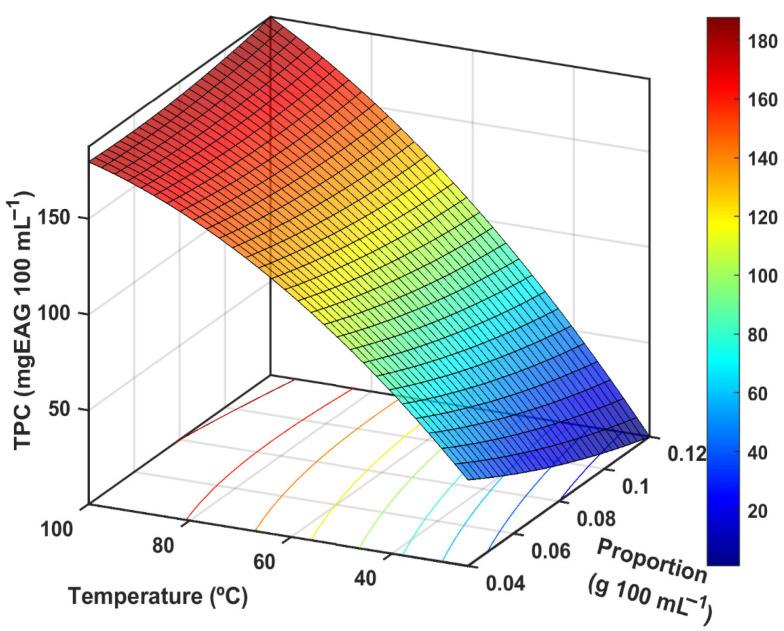
Açaí () seeds account for up to 95% of the fruit's weight and are commonly discarded during pulp processing. Roasted açaí seed extract (RASE) has recently emerged as a caffeine-free coffee substitute, although its composition and functionality remain underexplored. This study characterized commercial açaí seed powder and evaluated the effect of temperature on the recovery of total phenolic content (TPC) in the aqueous extract using a Central Composite Rotatable Design (CCRD). An intermediate extraction condition (6.0 ± 0.5 g 100 mL at 100 °C) was selected, resulting in 21.78 mg GAE/g TPC, 36.23 mg QE/g total flavonoids, and notable antioxidant capacity (FRAP: 183.33 µmol TE/g; DPPH: 23.06 mg TE/g; ABTS: 51.63 mg TE/g; ORAC: 31.46 µmol TE/g). Proton Nuclear Magnetic Resonance (H NMR) analysis suggested the presence of amino acids, carbohydrates, and organic acids. During in vitro digestion, TPC decreased from 54.31 to 17.48 mg GAE 100 mL when RASE was combined with goat milk. However, higher bioaccessibility was observed with skimmed (33%) and semi-skimmed (35%) cow milk. These findings highlight RASE as a phenolic-rich, antioxidant beverage with functional stability when prepared with boiling water. This is the first study to report the phytochemical profile of RASE and its interactions with different milk types, supporting its potential as a coffee alternative.
阿萨伊()种子占果实重量的95%,在果肉加工过程中通常被丢弃。烤阿萨伊种子提取物(RASE)最近成为一种不含咖啡因的咖啡替代品,但其成分和功能仍未得到充分研究。本研究对市售阿萨伊种子粉进行了表征,并使用中心复合旋转设计(CCRD)评估了温度对水提取物中总酚含量(TPC)回收率的影响。选择了中间提取条件(100℃下6.0±0.5g/100mL),得到21.78mg GAE/g TPC、36.23mg QE/g总黄酮,以及显著的抗氧化能力(FRAP:183.33μmol TE/g;DPPH:23.06mg TE/g;ABTS:51.63mg TE/g;ORAC:31.46μmol TE/g)。质子核磁共振(H NMR)分析表明存在氨基酸、碳水化合物和有机酸。在体外消化过程中,当RASE与羊奶混合时,TPC从54.31mg GAE/100mL降至17.48mg GAE/100mL。然而,脱脂牛奶(33%)和半脱脂牛奶(35%)的生物可及性更高。这些发现突出了RASE作为一种富含酚类、具有抗氧化功能的饮料,用沸水冲泡时具有功能稳定性。这是第一项报道RASE的植物化学特征及其与不同类型牛奶相互作用的研究,支持了其作为咖啡替代品的潜力。

 Zotero 插件