
使用基于模拟的推理构建虚拟患者。
Building virtual patients using simulation-based inference.
作者信息
Paul Nathalie, Karamitsou Venetia, Giegerich Clemens, Sadeghi Afshin, Lücke Moritz, Wagenhuber Britta, Kister Alexander, Rehberg Markus
机构信息
Fraunhofer Institute for Intelligent Analysis and Information Systems IAIS, Sankt Augustin, Germany.
Sanofi R&D, Translational Disease Modeling, Frankfurt, Germany.
出版信息
Front Syst Biol. 2024 Sep 12;4:1444912. doi: 10.3389/fsysb.2024.1444912. eCollection 2024.
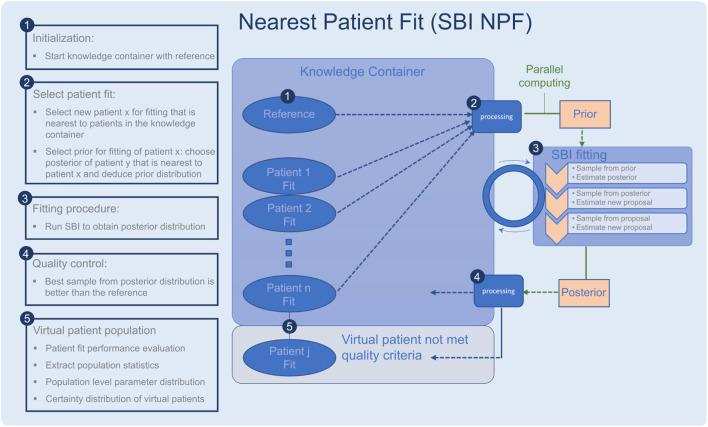
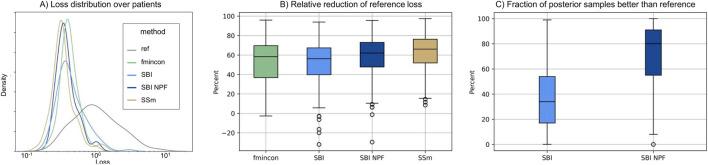
In the context of clinical trials, mechanistic computer models for pathophysiology and pharmacology (here Quantitative Systems Pharmacology models, QSP) can greatly support the decision making for drug candidates and elucidate the (potential) response of patients to existing and novel treatments. These models are built on disease mechanisms and then parametrized using (clinical study) data. Clinical variability among patients is represented by alternative model parameterizations, called virtual patients. Despite the complexity of disease modeling itself, using individual patient data to build these virtual patients is particularly challenging given the high-dimensional, potentially sparse and noisy clinical trial data. In this work, we investigate the applicability of simulation-based inference (SBI), an advanced probabilistic machine learning approach, for virtual patient generation from individual patient data and we develop and evaluate the concept of nearest patient fits (SBI NPF), which further enhances the fitting performance. At the example of rheumatoid arthritis where prediction of treatment response is notoriously difficult, our experiments demonstrate that the SBI approaches can capture large inter-patient variability in clinical data and can compete with standard fitting methods in the field. Moreover, since SBI learns a probability distribution over the virtual patient parametrization, it naturally provides the probability for alternative parametrizations. The learned distributions allow us to generate highly probable alternative virtual patient populations for rheumatoid arthritis, which could potentially enhance the assessment of drug candidates if used for trials.
在临床试验的背景下,用于病理生理学和药理学的机制计算机模型(这里指定量系统药理学模型,QSP)可以极大地支持药物候选物的决策,并阐明患者对现有和新型治疗的(潜在)反应。这些模型基于疾病机制构建,然后使用(临床研究)数据进行参数化。患者之间的临床变异性由替代模型参数化表示,称为虚拟患者。尽管疾病建模本身很复杂,但鉴于高维、潜在稀疏且有噪声的临床试验数据,使用个体患者数据来构建这些虚拟患者极具挑战性。在这项工作中,我们研究了基于模拟的推理(SBI)(一种先进的概率机器学习方法)在从个体患者数据生成虚拟患者方面的适用性,并开发和评估了最近患者拟合(SBI NPF)的概念,该概念进一步提高了拟合性能。以类风湿性关节炎为例,在该疾病中治疗反应的预测非常困难,我们的实验表明,SBI方法可以捕捉临床数据中患者之间的巨大变异性,并且可以与该领域的标准拟合方法相竞争。此外,由于SBI学习虚拟患者参数化的概率分布,它自然会提供替代参数化的概率。所学习的分布使我们能够为类风湿性关节炎生成高度可能且不同的虚拟患者群体,如果用于试验,这可能会增强对药物候选物的评估。


 Zotero 插件