
生长分化因子-15、高迁移率族蛋白B1和巨噬细胞炎性蛋白-1γ/趋化因子CXCL9在儿童急性肝衰竭中的相互作用
Intertwined roles for GDF-15, HMGB1, and MIG/CXCL9 in Pediatric Acute Liver Failure.
作者信息
Zamora Ruben, Yin Jinling, Barclay Derek, Squires James E, Vodovotz Yoram
机构信息
Department of Surgery, University of Pittsburgh, Pittsburgh, PA, United States.
Center for Inflammation and Regenerative Modeling, McGowan Institute for Regenerative Medicine, Pittsburgh, PA, United States.
出版信息
Front Syst Biol. 2024 Oct 15;4:1470000. doi: 10.3389/fsysb.2024.1470000. eCollection 2024.
INTRODUCTION
Pediatric Acute Liver Failure (PALF) presents as a rapidly evolving, multifaceted, and devastating clinical syndrome whose precise etiology remains incompletely understood. Consequently, predicting outcomes-whether survival or mortality-and informing liver transplantation decisions in PALF remain challenging. We have previously implicated High-Mobility Group Box 1 (HMGB1) as a central mediator in PALF-associated dynamic inflammation networks that could be recapitulated in acetaminophen (APAP)-treated mouse hepatocytes (HC) . Here, we hypothesized that Growth/Differentiation Factor-15 (GDF-15) is involved along with HMGB1 in PALF.
METHODS
28 and 23 inflammatory mediators including HMGB1 and GDF15 were measured in serum samples from PALF patients and cell supernatants from wild-type (C57BL/6) mouse hepatocytes (HC) and from cells from HC-specific HMGB1-null mice (HC-HMGB1) exposed to APAP, respectively. Results were analyzed computationally to define statistically significant and potential causal relationships.
RESULTS
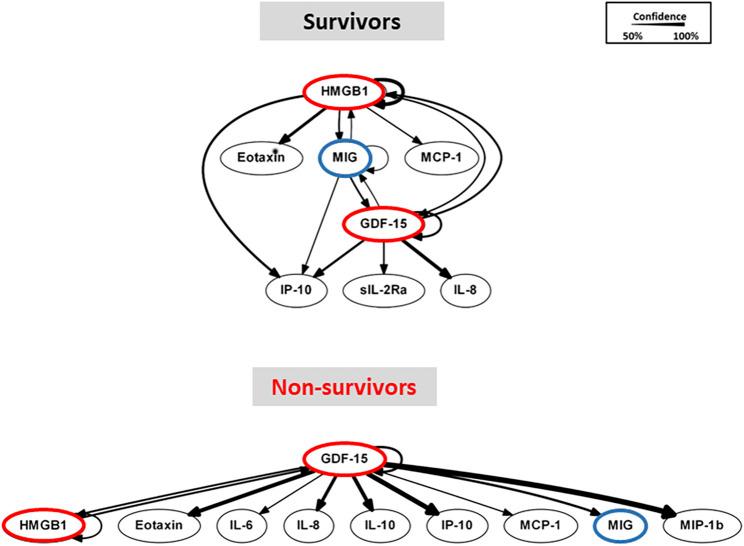
Circulating GDF-15 was elevated significantly ( < 0.05) in PALF non-survivors as compared to survivors, and together with HMGB1 was identified as a central node in dynamic inflammatory networks in both PALF patients and mouse HC. This analysis also pointed to MIG/CXCL9 as a differential node linking HMGB1 and GDF-15 in survivors but not in non-survivors, and, when combined with studies, suggested that MIG suppresses GDF-15-induced inflammation.
DISCUSSION
This study suggests GDF-15 as a novel PALF outcome biomarker, posits GDF-15 alongside HMGB1 as a central node within the intricate web of systemic inflammation dynamics in PALF, and infers a novel, negative regulatory role for MIG.
引言
小儿急性肝衰竭(PALF)是一种迅速发展、多方面且具有毁灭性的临床综合征,其确切病因仍未完全明确。因此,预测PALF的预后(无论是生存还是死亡)并为肝移植决策提供依据仍然具有挑战性。我们之前曾指出,高迁移率族蛋白B1(HMGB1)是PALF相关动态炎症网络中的核心介质,这一网络可在对乙酰氨基酚(APAP)处理的小鼠肝细胞(HC)中重现。在此,我们假设生长/分化因子-15(GDF-15)与HMGB1共同参与了PALF的发病过程。
方法
分别检测了PALF患者血清样本以及野生型(C57BL/6)小鼠肝细胞(HC)和HC特异性HMGB1基因敲除小鼠(HC-HMGB1)的细胞上清液中包括HMGB1和GDF15在内的28种和23种炎症介质。对结果进行计算分析,以确定具有统计学意义的潜在因果关系。
结果
与存活者相比,PALF非存活者循环中的GDF-15显著升高(<0.05),并且与HMGB1一起被确定为PALF患者和小鼠HC动态炎症网络中的核心节点。该分析还指出,MIG/CXCL9是存活者而非非存活者中连接HMGB1和GDF-15的差异节点,并且结合相关研究表明,MIG可抑制GDF-15诱导的炎症。
讨论
本研究表明GDF-15是一种新型的PALF预后生物标志物,将GDF-15与HMGB1一同定位为PALF复杂系统炎症动态网络中的核心节点,并推断出MIG具有新的负调控作用。




 Zotero 插件