
实时磁共振成像引导加速器在非小细胞肺癌立体定向体部放射治疗中的应用
Real-time magnetic resonance imaging guided accelerator in stereotactic body radiation therapy for non-small cell lung cancer.
作者信息
Qiao Qiang, Zhu Wanqi, Tian Changna, Shi Xihua, Xie Peng, Li Zhenjiang, Zhao Hanxi, Li Xiaolin, Xing Ligang
机构信息
School of Clinical Medicine, Shandong Second Medical University, Weifang, China.
Department of Radiation Oncology, Shandong Cancer Hospital and Institute, Shandong First Medical University and Shandong Academy of Medical Sciences, Jinan, China.
出版信息
J Thorac Dis. 2025 Jul 31;17(7):5055-5064. doi: 10.21037/jtd-24-686. Epub 2025 Jul 17.
BACKGROUND
Stereotactic body radiotherapy (SBRT) is crucial for lung tumor treatment, but facing challenges like intra-fractional anatomical changes and organ risks. Magnetic resonance-guided online adaptive SBRT (MRg-SBRT) is an innovative technique promising safer delivery of ablative doses and protect organ at risk (OAR). This study aimed to investigate the feasibility of the whole process of MRg-SBRT for non-small cell lung cancer (NSCLC) patients.
METHODS
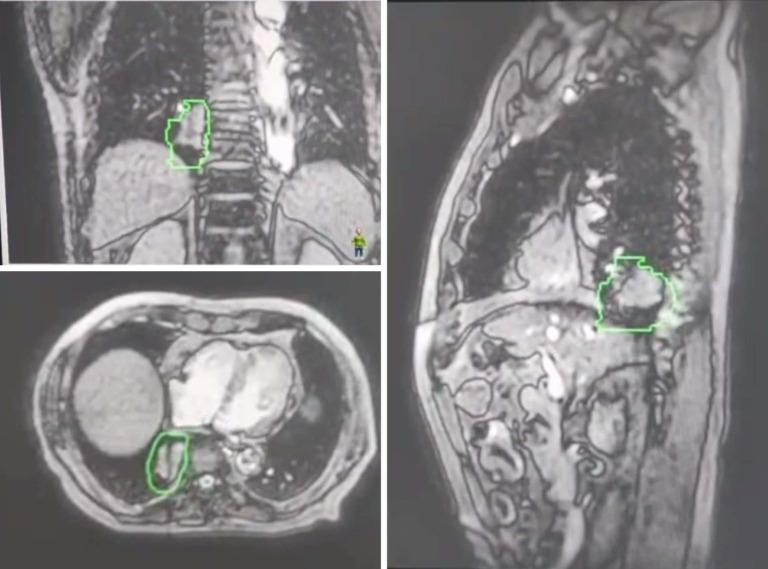
Physical parameters of radiotherapy for 23 cases of NSCLC who underwent MRg-SBRT were retrospectively analyzed. This included patients' treatment course, planned target volume (PTV), target area coverage, and OAR recipient volume. The focus was on inter- and intra-fraction MR real-time monitoring to correct off-target. Local control and adverse event outcomes of patients' SBRT treatment were also retrospectively analyzed.
RESULTS
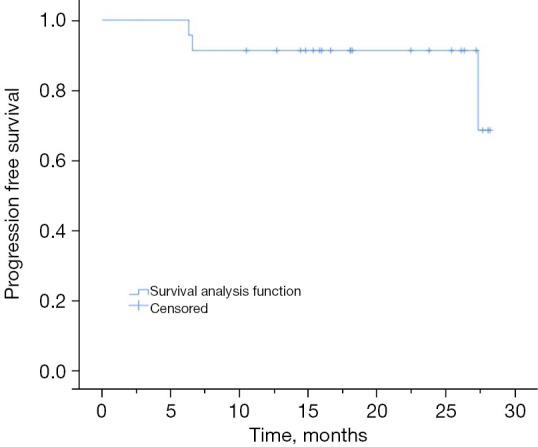
All 23 patients completed treatment on time without any treatment interruptions or pauses due to the MR. Tumor movement was predominantly in the superior-inferior (SI) directions through Elekta Unity real-time online monitoring. The baseline plan was altered in four patients, and an adaptive plan was used to correct inter- and intra-fraction off-targeting in a timely manner. The prescribed dose coverage for PTV was 95.3%, with a median bilateral lung volume 20 (V20) GY of 6.3%, and a maximal dose to the spinal cord of 117.3 cGy. The response results showed that the disease control rate (DCR) was 100% with an objective response rate (ORR) of 82.6%. Follow-up results showed an acute grade one to two pneumonia incidence of 82.6% and grade three pneumonias in one patient.
CONCLUSIONS
MRg-SBRT can guide treatment plans for the clinical needs of SBRT for lung cancer patients, especially for old patients, proving the feasibility of SBRT for lung lesions with MRg-SBRT, and online real-time monitoring reduces intra- and inter-fraction off-targeting, and guarantees the treatment efficiency of patients without significantly increasing the incidence of serious adverse events.
背景
立体定向体部放疗(SBRT)对肺癌治疗至关重要,但面临诸如分次内解剖结构变化和器官风险等挑战。磁共振引导的在线自适应SBRT(MRg-SBRT)是一种创新技术,有望更安全地给予消融剂量并保护危及器官(OAR)。本研究旨在探讨MRg-SBRT对非小细胞肺癌(NSCLC)患者全过程的可行性。
方法
回顾性分析23例行MRg-SBRT的NSCLC患者的放疗物理参数。这包括患者的治疗疗程、计划靶体积(PTV)、靶区覆盖情况以及OAR受照体积。重点在于分次间和分次内的磁共振实时监测以纠正靶区偏差。还回顾性分析了患者SBRT治疗的局部控制和不良事件结果。
结果
所有23例患者均按时完成治疗,未因磁共振检查导致任何治疗中断或暂停。通过医科达Unity实时在线监测,肿瘤运动主要在上下(SI)方向。4例患者的基线计划发生改变,并采用自适应计划及时纠正分次间和分次内的靶区偏差。PTV的处方剂量覆盖率为95.3%,双侧肺体积20(V20)Gy的中位数为6.3%,脊髓最大剂量为117.3 cGy。反应结果显示疾病控制率(DCR)为100%,客观缓解率(ORR)为82.6%。随访结果显示急性一至二级肺炎发生率为82.6%,1例患者发生三级肺炎。
结论
MRg-SBRT可根据肺癌患者SBRT临床需求指导治疗计划,尤其适用于老年患者,证明了MRg-SBRT用于肺部病变SBRT的可行性,在线实时监测减少了分次内和分次间的靶区偏差,并在不显著增加严重不良事件发生率的情况下保证了患者的治疗效率。
 Zotero 插件