
入住神经重症监护病房的血液学/肿瘤学患者的静脉血栓栓塞预防措施
Venous thromboembolism prophylaxis practices in hematology/oncology patients admitted to neurological intensive care units.
作者信息
Alsuhebany Nada, Alfehaid Lama, Alodhaibi Danah, Mahdali Madhawi, Almohareb Sumaya, Alshaya Abdulrahman
机构信息
Department of Pharmacy Practice, College of Pharmacy, King Saud bin Abdulaziz University for Health Sciences, Riyadh, Saudi Arabia.
Department of Pharmaceutical Care Services, King Abdulaziz Medical City, Ministry of National Guard-Health Affairs, Riyadh, Saudi Arabia.
出版信息
Front Cardiovasc Med. 2025 Jul 30;12:1573080. doi: 10.3389/fcvm.2025.1573080. eCollection 2025.
OBJECTIVE
Venous thromboembolism (VTE) presents a significant challenge for neurocritically ill patients with cancer due to the combined risks of thrombosis and bleeding. This study aimed to describe VTE prophylaxis practices among this high-risk population.
METHODS
This is a retrospective cohort study at a tertiary teaching hospital. Data were obtained for all patients admitted with neurocritical illness with a history of either solid tumors or hematological malignancies. The main outcome was the incidence of bleeding events in the neurocritical care unit (NCCU) using the International Society on Thrombosis and Haemostasis (ISTH) criteria. Other secondary outcomes were the incidence of thrombotic events, NCCU length of stay, and in-hospital mortality.
RESULTS
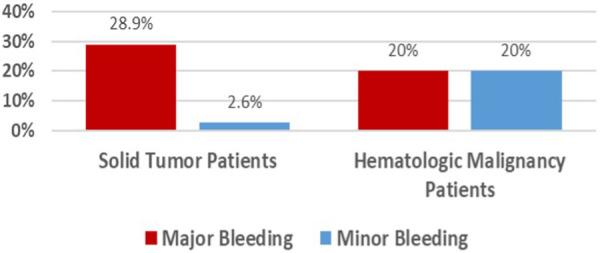
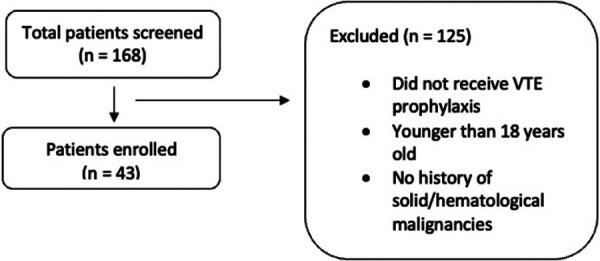
Out of the 168 patients screened, 43 patients were included, of which 38 patients (88.3%) had solid tumors, and 5 patients (11.6%) had hematologic malignancies. The majority of patients (81.3%) received chemical VTE prophylaxis during hospitalization. The incidence of major bleeding events was reported in 8 patients (21%) with solid tumors and one patient (20%) with hematologic malignancies, with no cases of thrombosis during hospitalization. Compared to the literature, the incidence of major bleeding events in our study is lower than indicated by a previous report on high bleeding risks in similar patient populations. The median duration of hospital stay was five days in the NCCU and 17 days in the hospital, with a 30-day mortality rate of 14%.
CONCLUSION
Our study highlights the complexity of managing VTE prophylaxis in neurocritically ill cancer patients, emphasizing the need for a careful risk-benefit assessment. The absence of thrombotic events suggests effectiveness; however, bleeding risks warrant caution. These findings underscore the importance of individualized care and highlight the need for further research to refine prophylaxis protocols, thereby ensuring both safety and efficacy in this high-risk group.
目的
静脉血栓栓塞症(VTE)对患有癌症的神经重症患者构成了重大挑战,因为存在血栓形成和出血的综合风险。本研究旨在描述这一高危人群的VTE预防措施。
方法
这是一项在三级教学医院进行的回顾性队列研究。收集了所有因神经重症疾病入院且有实体瘤或血液系统恶性肿瘤病史的患者的数据。主要结局是使用国际血栓与止血学会(ISTH)标准评估神经重症监护病房(NCCU)内出血事件的发生率。其他次要结局包括血栓形成事件的发生率、NCCU住院时间和院内死亡率。
结果
在筛查的168例患者中,纳入了43例患者,其中38例(88.3%)患有实体瘤,5例(11.6%)患有血液系统恶性肿瘤。大多数患者(81.3%)在住院期间接受了化学VTE预防。报告有8例(21%)实体瘤患者和1例(20%)血液系统恶性肿瘤患者发生了大出血事件,住院期间无血栓形成病例。与文献相比,我们研究中的大出血事件发生率低于先前关于类似患者群体高出血风险的报告。NCCU的中位住院时间为5天,全院为17天,30天死亡率为14%。
结论
我们的研究凸显了神经重症癌症患者VTE预防管理的复杂性,强调了仔细进行风险效益评估的必要性。无血栓形成事件表明预防措施有效;然而,出血风险仍需谨慎对待。这些发现强调了个体化护理的重要性,并凸显了进一步研究以完善预防方案的必要性,从而确保这一高危群体的安全性和有效性。
 Zotero 插件