
基于用仙人掌果果皮生物合成的金纳米结构的高灵敏度和选择性的铁比色和等离子体传感器。
Highly sensitive and selective colorimetric and plasmonic sensor of Fe based on gold nanostructures biosynthesized with Opuntia joconostle fruit peel.
作者信息
Reza-Sámano Eric, Gómez-Sánchez Rosa, Peñaloza-Garduño Alan, Morales-Luckie Raúl A, Olea-Mejía Oscar F, González-Pedroza María Guadalupe, Sánchez-Mendieta Victor
机构信息
Facultad de Química, Universidad Autónoma del Estado de México, Paseo Colón y Paseo Tollocan, 50120, Toluca, Estado de México, Mexico.
Centro Conjunto de Investigación en Química Sustentable UAEM-UNAM, Carretera Toluca‑Atlacomulco Km. 14.5, 50200, San Cayetano, Toluca, Estado de México, Mexico.
出版信息
Discov Nano. 2025 Aug 14;20(1):137. doi: 10.1186/s11671-025-04333-4.
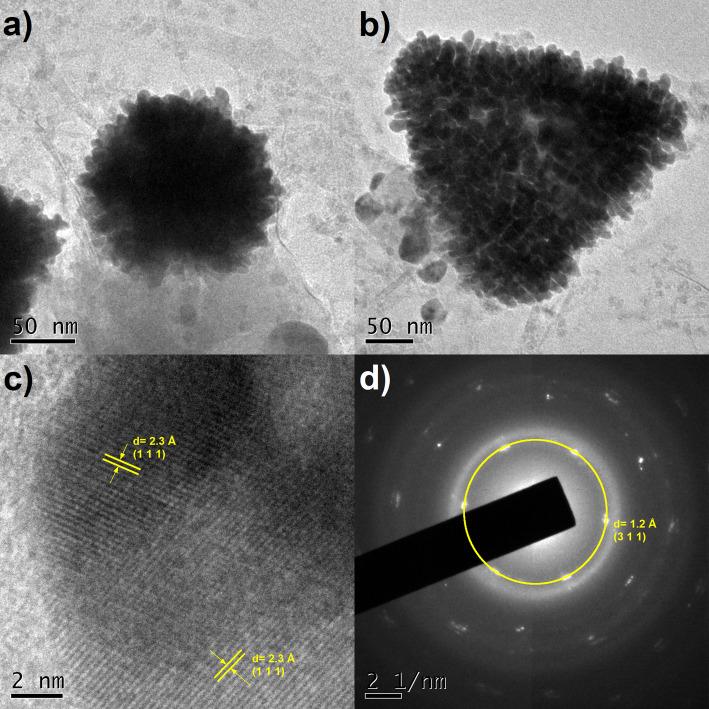
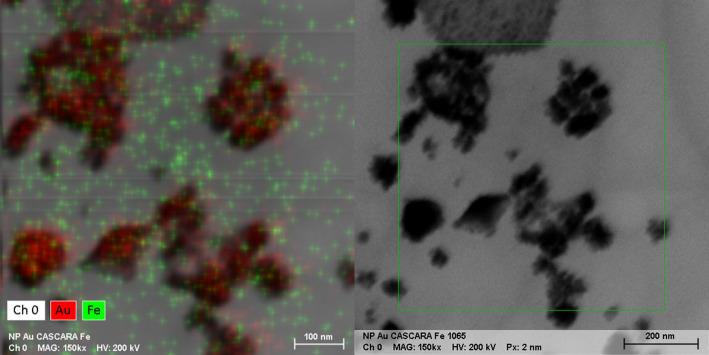
Biogenic gold nanostructures have been obtained, for the first time, by bio-reduction of Au ions with an aqueous extract of Opuntia joconostle fruit peel (Oj-AuNPs). This particular methodology is completely green, since room temperature was used, and no infusion preparation was required. The Oj-AuNPs exhibit a broad surface plasmon resonance (SPR) signal, with a maximum at 556 nm. SEM and TEM observations show Oj-AuNPs with mean size around 80 nm and raspberry-like morphologies, mainly, made of smaller nanoparticles glued by the biomass. When freshly prepared Oj-AuNPs solution is placed in contact with Fe, the solution changes from brown to a green-grayish color, being the only metal ion changing the Oj-AuNPs solution color among the other twelve metal ions probed, including Fe. Once the Fe ions are detected, the SPR of the Oj-AuNPs becomes broader with a considerable red shift. Furthermore, smaller Au nanostructures, with better defined morphologies than those in the original Oj-AuNPs, are observed by TEM. Therefore, the conceivable mechanism of the naked eye and plasmonic detection of Fe by Oj-AuNPs involves the disaggregation of the original larger gold nanostructures. Sensitivity studies of the Oj-AuNPs detection of Fe were performed from 200 ppm to 0.1 ppb. The limit of detection (LOD) and limit of quantification (LOQ) for Fe are 0.023 and 0.079 ppb, respectively. Moreover, the Oj-AuNPs colorimetric sensor was effectively tested for highly sensitive detection of Fe in tap water.
首次通过用乔科诺斯特仙人掌果实果皮水提取物(Oj-AuNPs)对金离子进行生物还原获得了生物源金纳米结构。这种特殊方法完全是绿色的,因为采用了室温,且无需进行浸液制备。Oj-AuNPs呈现出宽泛的表面等离子体共振(SPR)信号,在556nm处有最大值。扫描电子显微镜(SEM)和透射电子显微镜(TEM)观察显示,Oj-AuNPs的平均尺寸约为80nm,形态类似覆盆子,主要由被生物质粘结的较小纳米颗粒组成。当新制备的Oj-AuNPs溶液与铁接触时,溶液从棕色变为绿灰色,在包括铁在内的其他十二种被探测金属离子中,铁是唯一能改变Oj-AuNPs溶液颜色的金属离子。一旦检测到铁离子,Oj-AuNPs的SPR会变得更宽,并伴有相当大的红移。此外,通过TEM观察到比原始Oj-AuNPs形态更清晰的较小金纳米结构。因此,Oj-AuNPs对铁进行肉眼和等离子体检测的可能机制涉及原始较大金纳米结构的解聚。对Oj-AuNPs检测铁的灵敏度研究在200ppm至0.1ppb范围内进行。铁的检测限(LOD)和定量限(LOQ)分别为0.023和0.079ppb。此外,Oj-AuNPs比色传感器有效地用于自来水中铁的高灵敏度检测。





 Zotero 插件