
免疫细胞在细胞因子和内毒素介导的内皮通透性中起关键作用。
Immune cells play a critical role in cytokine- and endotoxin-mediated endothelial permeability.
作者信息
Gogesch Patricia, Ortega Iannazzo Samira, Rupp Nicole, Rom Joachim, Kreuz Markus, Reiche Kristin, Anzaghe Martina, Waibler Zoe
机构信息
Division of Immunology, Paul-Ehrlich-Institut, Langen, Germany.
Department of Gynecology, Varisano Klinikum sFrankfurt Höchst, Frankfurt, Germany.
出版信息
PLoS One. 2025 Aug 14;20(8):e0329700. doi: 10.1371/journal.pone.0329700. eCollection 2025.
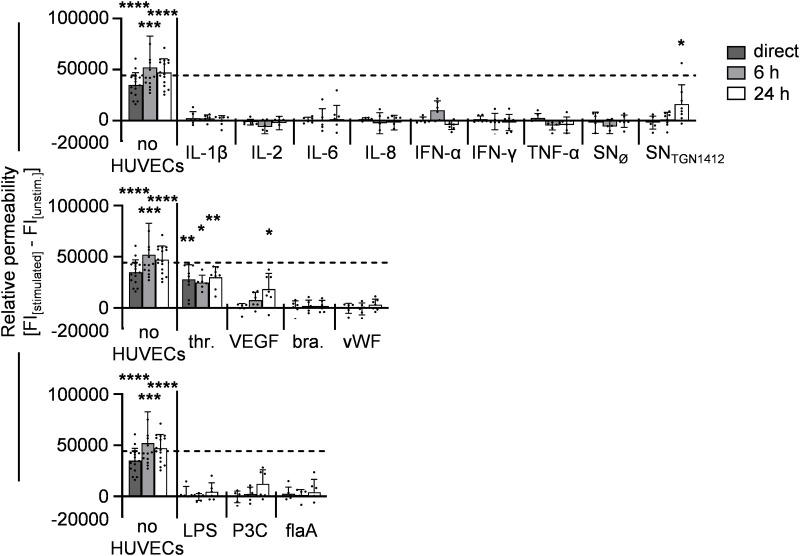
Vascular leakage (VL) is a severe pathology occurring in a broad range of scenarios, e.g., during sepsis, cytokine storms, or as side effect of immunotherapies. Its severity is underlined by the high lethality rate of 20-30% for the systemic capillary leakage syndrome. While many compounds are reported to affect endothelial cell (EC)-activation, exact mechanisms behind VL remain unclear. We analyzed activation, viability, cytokine secretion, and relative permeability of human umbilical vein endothelial cells (HUVECs) upon treatment with 16 different stimuli. Relative HUVEC-permeability was assessed in a trans-well-based leakage assay in presence or absence of human peripheral blood mononuclear cells (PBMCs). HUVEC-activation is characterized by correlating upregulation of intercellular adhesion molecule (ICAM)-1, vascular cell adhesion molecule (VCAM)-1, and E-selectin, as well as production of interleukin (IL)-8, monocyte chemoattractant protein (MCP)-1, and IL-6. Strong HUVEC-activation and reduced viability was observed upon treatment with IL-1β, tumor necrosis factor (TNF)-α, a TGN1412-induced cytokine cocktail (SNTGN1412), thrombin, and lipopolysaccharide (LPS). Only thrombin, SNTGN1412, and vascular endothelial growth factor (VEGF) led to increased relative permeability, while other compounds associated with vascular leakage, including TNF-α, IL-1β, or LPS, had no direct effect on relative HUVEC-permeability. Interestingly, co-cultures with PBMCs mediated IL-1β- and LPS- but not TNF-α-induced relative HUVEC-permeability. In our study, we show that HUVEC activation upon direct stimulation does not necessarily result in increased relative permeability or massive cytokine production. Interestingly, we could demonstrate that activated HUVECs respond with a conserved pattern of markers, independent from the stimulus used. Moreover, we observed that the interplay with immune cells is critical to enhance relative HUVEC-permeability, which however depended on the stimulus applied suggesting different mechanisms of immune-mediated VL. A better understanding of VL will uncover potential treatment-targets for patients suffering from VL and help to improve safety-assessment of leakage-associated immunotherapies.
血管渗漏(VL)是一种在多种情况下发生的严重病理状况,例如在脓毒症、细胞因子风暴期间,或作为免疫疗法的副作用。系统性毛细血管渗漏综合征20%-30%的高致死率凸显了其严重性。虽然据报道许多化合物会影响内皮细胞(EC)的激活,但VL背后的确切机制仍不清楚。我们分析了用16种不同刺激物处理后人脐静脉内皮细胞(HUVECs)的激活、活力、细胞因子分泌和相对通透性。在有或无人外周血单核细胞(PBMCs)存在的情况下,通过基于跨膜的渗漏试验评估HUVEC的相对通透性。HUVEC的激活表现为细胞间黏附分子(ICAM)-1、血管细胞黏附分子(VCAM)-1和E-选择素的相关上调,以及白细胞介素(IL)-8、单核细胞趋化蛋白(MCP)-1和IL-6的产生。在用IL-1β、肿瘤坏死因子(TNF)-α、TGN1412诱导的细胞因子混合物(SNTGN1412)、凝血酶和脂多糖(LPS)处理后,观察到强烈的HUVEC激活和活力降低。只有凝血酶、SNTGN1412和血管内皮生长因子(VEGF)导致相对通透性增加,而其他与血管渗漏相关的化合物,包括TNF-α、IL-1β或LPS,对HUVEC的相对通透性没有直接影响。有趣的是,与PBMCs的共培养介导了IL-1β和LPS诱导的HUVEC相对通透性,但不是TNF-α诱导的。在我们的研究中,我们表明直接刺激后HUVEC的激活不一定会导致相对通透性增加或大量细胞因子产生。有趣的是,我们可以证明激活的HUVECs会以一种保守的标志物模式做出反应,与所使用的刺激物无关。此外,我们观察到与免疫细胞的相互作用对于提高HUVEC的相对通透性至关重要,然而这取决于所应用的刺激物,提示免疫介导的VL有不同机制。对VL有更好的理解将为患有VL的患者揭示潜在的治疗靶点,并有助于改善与渗漏相关的免疫疗法的安全性评估。


 Zotero 插件