
深圳地区(2019 - 2024年)住院急性呼吸道感染儿童及青少年人群中人类鼻病毒的流行病学特征与临床特点:一项纵向研究
Epidemiology and clinical characteristics of human rhinovirus in hospitalized children and adolescents with acute respiratory infections: a longitudinal study in Shenzhen, China (2019-2024).
作者信息
Liu Jiao, Wang Wei, Cao Ke, Ren Zhenmin, Fu Xiaoying, Chen Yunsheng, Wang WenJian, Zheng Yuejie, Bao Yanmin, Luo Xiaojuan, Chen Jiehua
机构信息
Department of Respiratory Medicine, Shenzhen Children's Hospital, Shenzhen, 518038, China.
Department of Clinical Laboratory, Shenzhen Children's Hospital, Shenzhen, 518038, China.
出版信息
Virol J. 2025 Aug 14;22(1):280. doi: 10.1186/s12985-025-02901-9.
BACKGROUND
Human rhinovirus (HRV) is a significant pathogen responsible for acute respiratory infections (ARIs) in children and is closely associated with pediatric wheezing. However, its clinical importance remains a subject of debate. This study aims to investigate the epidemiology, clinical characteristics of HRV, and to explore the impact of the Coronavirus Disease 2019 (COVID-19) pandemic and non-pharmaceutical interventions (NPIs) on HRV dynamics.
METHODS
A retrospective analysis was conducted on HRV-positive cases among children and adolescents hospitalized for ARIs at a tertiary medical center in Shenzhen, China, from September 2019 to December 2024. Multiplex PCR was employed to detect 12 common respiratory pathogens, and molecular typing of HRV was performed on selected bronchoalveolar lavage fluid (BALF) samples. Demographic data, epidemiological patterns, co-infection profiles, clinical characteristics were analyzed. Data were stratified into three periods based on COVID-19 pandemic and NPIs implementation: pre-pandemic (September-December 2019), pandemic (2020-2022, with NPIs in effect), and post-pandemic (2023-2024, after NPIs cessation).
RESULTS
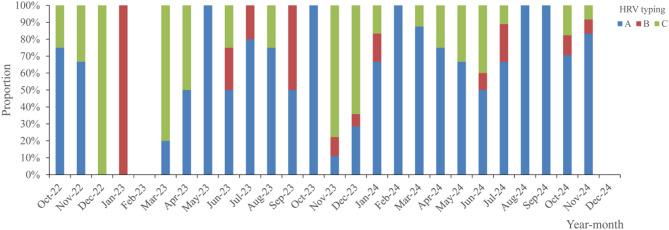
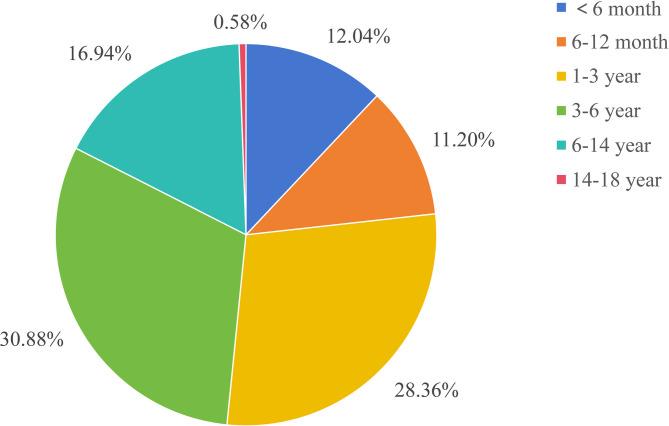
Among 74,330 children and adolescents hospitalized for ARIs, HRV was detected in 18,681 cases (25.13%), exhibiting year-round prevalence with seasonal peaks in spring and autumn. HRV-A (62.84%) was the predominant genotype, followed by HRV-C (28.38%). Co-infections occurred in 32.00% of HRV cases and were associated with higher rates of pneumonia and severe pneumonia (P < 0.001). Conversely, HRV mono-infections were significantly correlated with hospitalizations for acute wheezing illnesses and more severe clinical outcomes (all P < 0.001). During the stringent NPIs period (early 2020), HRV detection rates declined markedly but rebounded rapidly following the relaxation of measures. The overall HRV positivity rate post-pandemic (25.53%) was significantly higher than that during the pandemic (23.50%, P < 0.001). The median age of HRV-infected children and adolescents increased significantly from 1.83 years pre-pandemic to 2.25 years during the pandemic to 3.33 years post-pandemic (P < 0.0001). However, clinical severity indicators for HRV mono-infections remained largely unchanged between the pandemic and post-pandemic periods.
CONCLUSION
HRV is a major pathogen in pediatric ARIs, with HRV mono-infections strongly associated with hospitalizations for acute wheezing illnesses and severe clinical outcomes. Unlike other respiratory viruses, HRV demonstrated relative resilience to NPIs and a notable post-pandemic shift in the age distribution of infections toward older children. These findings underscore HRV's ongoing public health significance and the necessity for continued surveillance.
背景
人鼻病毒(HRV)是导致儿童急性呼吸道感染(ARI)的重要病原体,与小儿喘息密切相关。然而,其临床重要性仍存在争议。本研究旨在调查HRV的流行病学、临床特征,并探讨2019冠状病毒病(COVID-19)大流行和非药物干预(NPI)对HRV动态的影响。
方法
对2019年9月至2024年12月在中国深圳一家三级医疗中心因ARI住院的儿童和青少年中的HRV阳性病例进行回顾性分析。采用多重PCR检测12种常见呼吸道病原体,并对选定的支气管肺泡灌洗液(BALF)样本进行HRV分子分型。分析人口统计学数据、流行病学模式、合并感染情况、临床特征。根据COVID-19大流行和NPI实施情况将数据分为三个时期:大流行前(2019年9月至12月)、大流行期间(2020-2022年,NPI有效)和大流行后(2023-2024年,NPI停止后)。
结果
在74330例因ARI住院的儿童和青少年中,18681例(25.13%)检测到HRV,全年均有流行,春秋季出现季节性高峰。HRV-A(62.84%)是主要基因型,其次是HRV-C(28.38%)。32.00%的HRV病例发生合并感染,与肺炎和重症肺炎的发生率较高相关(P<0.001)。相反,HRV单一感染与急性喘息性疾病住院和更严重的临床结局显著相关(所有P<0.001)。在严格的NPI时期(2020年初),HRV检测率显著下降,但措施放宽后迅速反弹。大流行后HRV总体阳性率(25.53%)显著高于大流行期间(23.50%,P<0.001)。HRV感染儿童和青少年的中位年龄从大流行前的1.83岁显著增加到大流行期间的2.25岁,再到大流行后的3.33岁(P<0.0001)。然而,大流行期间和大流行后时期HRV单一感染的临床严重程度指标基本保持不变。
结论
HRV是小儿ARI的主要病原体,HRV单一感染与急性喘息性疾病住院和严重临床结局密切相关。与其他呼吸道病毒不同,HRV对NPI表现出相对的抵抗力,并且在大流行后感染的年龄分布向大龄儿童显著转移。这些发现强调了HRV持续的公共卫生重要性以及持续监测的必要性。



 Zotero 插件