
皮肤自体荧光可能有助于预测1型糖尿病患者的低骨质量——一项临床横断面研究
Skin Autofluorescence May Contribute to Prediction of Low Bone Quality in Type 1 Diabetes-A Clinical Cross-Sectional Study.
作者信息
Brandt Inge Agnete Gerlach, Vestergaard Peter, Frost Morten, Juhl Claus Bogh, Harsløf Torben
机构信息
Steno Diabetes Center North Denmark, Aalborg, Denmark.
Aalborg University Hospital, Aalborg, Denmark.
出版信息
Diabetes Metab Res Rev. 2025 Sep;41(6):e70080. doi: 10.1002/dmrr.70080.
INTRODUCTION
People with type 1 diabetes are at risk of complications, including impaired bone health. Hyperglycaemia and accumulation of advanced glycation end products (AGEs) are involved in the development of those. Bone measurements such as trabecular bone score (TBS), high-resolution periphery quantitative computed tomography (HR-pQCT), and impact microindentation may detect impaired bone health better than bone mineral density (BMD). Clinical measures reflecting risk factors such as AGE accumulation or prevalence of cardiovascular autonomic neuropathy may also predict low bone quality.
METHODS
This cross-sectional study included 111 adults with type 1 diabetes and 37 healthy sex- and age-matched. Bone health was assessed through DXA with TBS, HR-pQCT and impact microindentation. Accumulation of AGEs was evaluated by skin autofluorescence, and screening for cardiovascular autonomic neuropathy was performed.
RESULTS
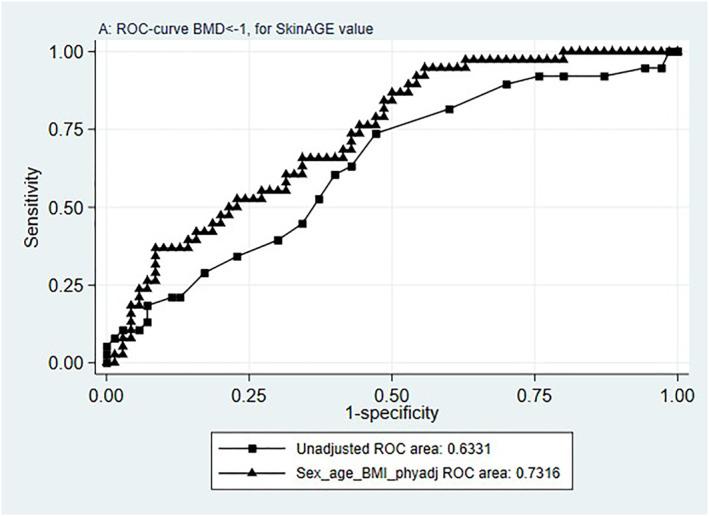
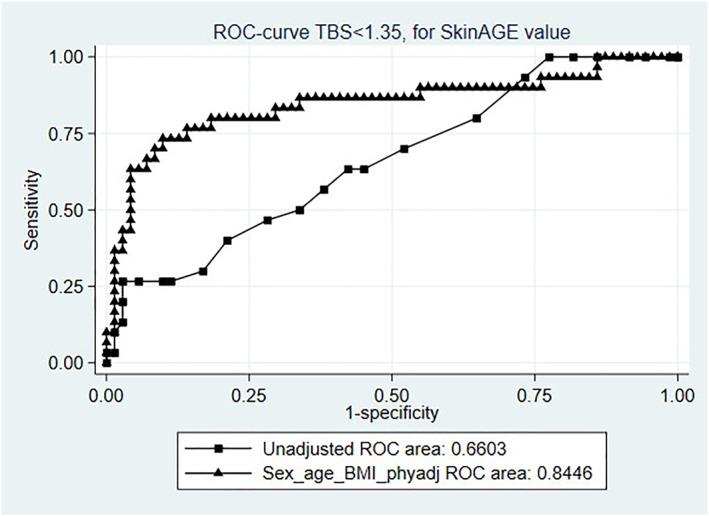
The mean (SD) age of the participants was 42.3 (13.8) years and the median (IQR) BMI was 26.9 [24.5; 30.1] kg/m. Median SkinAGE value was higher in the type 1 diabetes group (2.1 [1.9; 2.7]) than in the control group (1.8 [1.6; 2.3]), p = 0.004. In the diabetes group, SkinAGE correlated with femoral neck, total hip BMD, and TBS. SkinAGE showed predictive value for low TBS upon adjustment for age, sex, and BMI.
CONCLUSION
In persons with type 1 diabetes, higher levels of AGE accumulation measured by skin autofluorescence are related to a lower BMD as well as a lower TBS. Along with consideration of age, sex, BMI and other risk factors of osteoporosis, a high skin autofluorescence should increase the suspicion of impaired bone health.
引言
1型糖尿病患者有发生并发症的风险,包括骨骼健康受损。高血糖和晚期糖基化终产物(AGEs)的积累与这些并发症的发生有关。诸如小梁骨评分(TBS)、高分辨率外周定量计算机断层扫描(HR-pQCT)和冲击微压痕等骨测量方法可能比骨密度(BMD)能更好地检测出骨骼健康受损情况。反映AGE积累或心血管自主神经病变患病率等风险因素的临床指标也可能预测低骨质量。
方法
这项横断面研究纳入了111名1型糖尿病成年患者以及37名年龄和性别匹配的健康对照者。通过双能X线吸收法(DXA)结合TBS、HR-pQCT和冲击微压痕来评估骨骼健康。通过皮肤自发荧光评估AGEs的积累,并进行心血管自主神经病变筛查。
结果
参与者的平均(标准差)年龄为42.3(13.8)岁,体重指数(BMI)的中位数(四分位间距)为26.9 [24.5;30.1] kg/m²。1型糖尿病组的皮肤AGE值中位数(2.1 [1.9;2.7])高于对照组(1.8 [1.6;2.3]),p = 0.004。在糖尿病组中,皮肤AGE与股骨颈、全髋BMD和TBS相关。在调整年龄、性别和BMI后,皮肤AGE对低TBS具有预测价值。
结论
在1型糖尿病患者中,通过皮肤自发荧光测量的较高水平的AGE积累与较低的BMD以及较低的TBS相关。除了考虑年龄、性别、BMI和其他骨质疏松风险因素外,高皮肤自发荧光应增加对骨骼健康受损的怀疑。
 Zotero 插件