
整合性单细胞核RNA测序、分子对接和动力学模拟确定拉米地坦为阿尔茨海默病的候选药物。
Integrative snRNA-seq, molecular docking and dynamics simulations identifies Lasmiditan as drug candidate for Alzheimer's disease.
作者信息
Nwadiugwu Martin, Reza Md Selim, Afolabi Boluwatife, Maraganore Demetrius M, Shen Hui, Deng Hongwen
机构信息
Tulane Center for Biomedical Informatics and Genomics, Deming Department of Medicine, Tulane University School of Medicine, Tulane University, New Orleans, Louisiana, USA.
Department of Neurology, Center for Clinical Neurosciences, Tulane University School of Medicine, Tulane University, New Orleans, Louisiana, USA.
出版信息
Clin Transl Med. 2025 Aug;15(8):e70443. doi: 10.1002/ctm2.70443.
BACKGROUND
Alzheimer's disease (AD) is a growing healthcare crisis with limited effective therapies. This study aims to identify new candidate drugs that can be repurposed using key transcriptional regulators (DERs) in AD as therapeutic targets.
METHODS
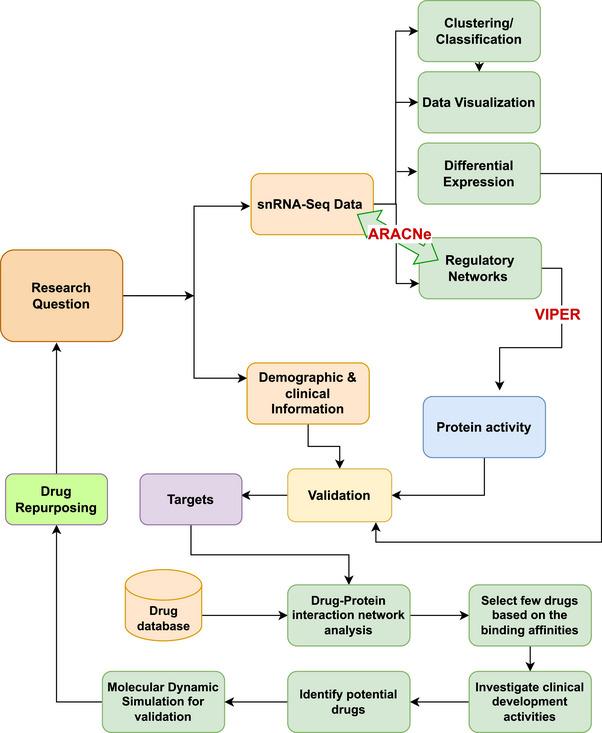
Multi-cohort single-nucleus RNA sequencing (snRNA-seq) data from the prefrontal cortex were analysed to identify DERs. Molecular docking and dynamic simulations analysis evaluated interactions between DERs and 2200 Food and Drug Administration-approved drugs to assess binding stability, whilst pharmacokinetic parameters relevant to blood-brain barrier permeability were evaluated.
RESULTS
We identified 20 key DERs associated with AD. Lasmiditan stood out as the most promising drug amongst other drug candidates (Vorapaxar, Bictegravir, Tonaftate, Fluspirilene, Lisuride, Olaparib) interacting with five DERs: ZEB2, APP, PAX6, ETV6, and ST18. Lasmiditan-ETV6 complex showed the best binding stability (RMSD: 2.98 Å, H-bonds: 68.38) and optimal passive diffusion (LogP3-4, TPSA 60-75 Å).
DISCUSSION
Lasmiditan is a potential AD therapeutic candidate that warrants further preclinical validation.
KEY POINTS
20 key transcriptional regulators (DERs) were identified linked to AD in myeloid, and neuronal cell populations. The DERs correlated with Braak stage, APOE genotype, and aging. ETV6 is a potentially viable therapeutic target due to its ability to form stable and strongly interacting complexes across multiple drugs. Lasmiditan showed the strongest binding to ETV6 (RMSD: 2.98 Å, H-bonds: 68.38) and optimal blood-brain-barrier (BBB) penetration (LogP 3-4, TPSA 60-75). Lasmiditan is a potentially promising AD therapeutic candidate that warrants further preclinical validation.
背景
阿尔茨海默病(AD)是一场日益严重的医疗保健危机,有效治疗方法有限。本研究旨在确定可将AD中的关键转录调节因子(DERs)重新用作治疗靶点的新候选药物。
方法
分析来自前额叶皮质的多队列单核RNA测序(snRNA-seq)数据以鉴定DERs。分子对接和动态模拟分析评估了DERs与2200种美国食品药品监督管理局批准的药物之间的相互作用,以评估结合稳定性,同时评估了与血脑屏障通透性相关的药代动力学参数。
结果
我们鉴定出20个与AD相关的关键DERs。在与五个DERs(ZEB2、APP、PAX6、ETV6和ST18)相互作用的其他候选药物(沃拉帕沙、比克替拉韦、托萘酯、氟司必林、利苏立得、奥拉帕利)中,拉米地坦脱颖而出,成为最有前景的药物。拉米地坦-ETV6复合物表现出最佳的结合稳定性(均方根偏差:2.98 Å,氢键:68.38)和最佳的被动扩散(脂水分配系数3 - 4,拓扑极性表面积60 - 75 Å)。
讨论
拉米地坦是一种潜在的AD治疗候选药物,值得进一步进行临床前验证。
关键点
在髓样细胞和神经元细胞群体中鉴定出20个与AD相关的关键转录调节因子(DERs)。这些DERs与Braak分期、APOE基因型和衰老相关。ETV6是一个潜在可行的治疗靶点,因为它能够与多种药物形成稳定且相互作用强烈的复合物。拉米地坦与ETV6的结合最强(均方根偏差:2.98 Å,氢键:68.38),并且具有最佳的血脑屏障(BBB)通透性(脂水分配系数3 - 4,拓扑极性表面积60 - 75)。拉米地坦是一种潜在有前景的AD治疗候选药物,值得进一步进行临床前验证。



 Zotero 插件