
澳大利亚新南威尔士州阿片类药物依赖治疗诊所中临床医生对药用大麻的态度和知识。
Clinicians' attitudes and knowledge of medicinal cannabis in opioid dependence treatment clinics in New South Wales, Australia.
作者信息
Parvaresh Laila, Mills Llewellyn, Gholami Jaleh, Jansen Louisa, Jamshidi Nazila, Baker Kate, Tremonti Christopher, Tracy Marguerite, Dunlop Adrian, Lintzeris Nicholas
机构信息
South Eastern Sydney Local Health District Drug and Alcohol Services, 591 South Dowling Street, Surry Hills, New South Wales, 2010, Australia.
Discipline of Addiction Medicine, Central Clinical School, Faculty of Medicine and Health, The University of Sydney, New South Wales, Australia.
出版信息
J Cannabis Res. 2025 Aug 16;7(1):59. doi: 10.1186/s42238-025-00315-6.
BACKGROUND
There are no prior studies investigating the attitudes and knowledge of opioid treatment program (OTP) clinicians on prescribed medicinal cannabis in OTP clients. This study examined the OTP clinicians' medicinal cannabis experience, knowledge, concerns, and educational needs.
METHODS
Staff from six public OTP services in New South Wales completed a medicinal cannabis survey. Staff included nurses, doctors, pharmacists, allied health, and consumer workers. Single-level regression models were used to estimate participants' sex, role, and year of experience effect.
RESULTS
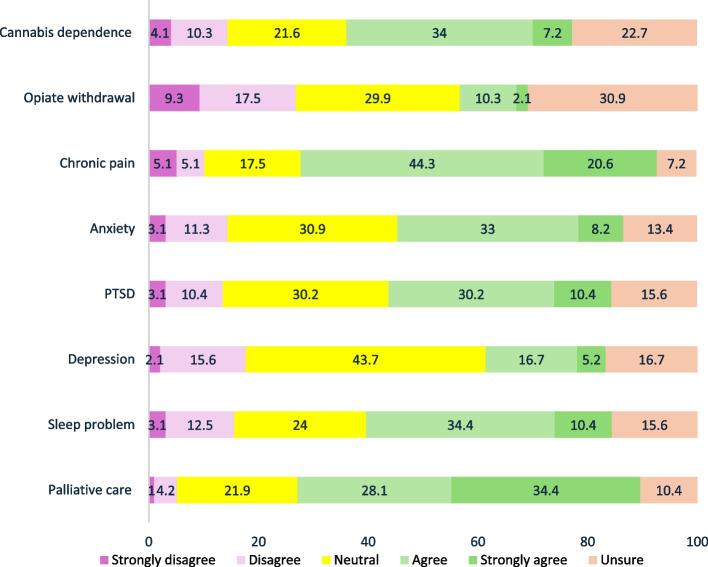
102 (63%) clinicians responded to the medicinal cannabis part of the survey, mostly female (n = 58, 56.9%), and more than half worked full-time (n = 54, 52.9%). Most of the participants (88.5%, 85/96) lacked experience providing medicinal cannabis, two in three (66.7%, 68/102) agreed to consider medicinal cannabis as a treatment for addressing cannabis use in OTP clients. Over 70% (71.5%, 73/102) expressed similar agreement to consider medicinal cannabis for other health conditions in OTP clients. More than half of the clinicians (54.2%, 52/96) expressed a lack of confidence in assisting clients with accessing medicinal cannabis, and were unfamiliar with current regulations (56.2%, 54/96). Clinicians expressed safety concerns regarding side effects such as driving-related problems (74%, 71/96), cognitive impairment (54.2%, 52/96), and cannabis dependence (54.2%, 52/96). The three conditions most endorsed as having sufficient evidence to support the use of tetrahydrocannabinol (THC)-based medicinal cannabis were palliative care symptom management (72.4%, 71/98), chronic pain (67.4%, 66/98), and multiple sclerosis (43.8%, 43/98). The three conditions most identified as having sufficient evidence to support the routine clinical use of cannabidiol (CBD)-based medicinal cannabis were chronic pain (64.9%, 63/97), palliative care (62.5%, 60/96), and sleep problems (44.8%, 43/96). The most common educational needs identified by participants were the evidence for the effectiveness of medicinal cannabis in cannabis dependence treatment (88.5%, 85/96), other health conditions (87.5%, 84/96), and indications and contraindications for using medicinal cannabis (87.5%, 84/96).
CONCLUSION
Despite the interest in using medicinal cannabis for treating cannabis dependence and /or other health conditions, clinicians identified several barriers including limited experience, lack of confidence, and poor understanding of the regulatory framework.
背景
此前尚无研究调查阿片类药物治疗项目(OTP)的临床医生对OTP患者使用药用大麻的态度和知识。本研究调查了OTP临床医生对药用大麻的经验、知识、担忧及教育需求。
方法
新南威尔士州六个公共OTP服务机构的工作人员完成了一项药用大麻调查。工作人员包括护士、医生、药剂师、专职医疗人员及消费者服务人员。采用单水平回归模型评估参与者的性别、角色及工作年限的影响。
结果
102名(63%)临床医生回复了调查中的药用大麻部分,其中大多数为女性(n = 58,56.9%),超过半数为全职工作(n = 54,52.9%)。大多数参与者(88.5%,85/96)缺乏提供药用大麻的经验,三分之二(66.7%,68/102)的人同意考虑将药用大麻作为治疗OTP患者大麻使用问题的一种疗法。超过70%(71.5%,73/102)的人同样同意考虑将药用大麻用于治疗OTP患者的其他健康状况。超过半数的临床医生(54.2%,52/96)表示在协助患者获取药用大麻方面缺乏信心,且不熟悉现行法规(56.2%,54/96)。临床医生对副作用表示安全担忧,如与驾驶相关的问题(74%,71/96)、认知障碍(54.2%,52/96)和大麻依赖(54.2%,52/96)。被认为有足够证据支持使用基于四氢大麻酚(THC)的药用大麻的三种最常见病症是姑息治疗症状管理(72.4%,71/98)、慢性疼痛(67.4%,66/98)和多发性硬化症(43.8%,43/98)。被认为有足够证据支持常规临床使用基于大麻二酚(CBD)的药用大麻的三种最常见病症是慢性疼痛(64.9%,63/97)、姑息治疗(62.5%,60/96)和睡眠问题(44.8%,43/96)。参与者确定的最常见教育需求是药用大麻在大麻依赖治疗(88.5%,85/96)、其他健康状况(87.5%,84/96)以及使用药用大麻的适应症和禁忌症(87.5%,84/96)方面有效性的证据。
结论
尽管对使用药用大麻治疗大麻依赖和/或其他健康状况感兴趣,但临床医生指出了几个障碍,包括经验有限、缺乏信心以及对监管框架理解不足。


 Zotero 插件