
舒更葡糖钠与新斯的明对老年肺切除患者术后不良呼吸事件的影响:一项随机对照试验的研究方案
Sugammadex versus neostigmine on postoperative adverse respiratory events in elderly patients undergoing lung resection: study protocol for a randomized controlled trial.
作者信息
Wang Yuxin, Li Xiang, Deng Huimin, Feng Di, Zhao Liuyuan, Lin Feihong, Jin Tian, Wang Sheng, Lv Xin, Wei Juan
机构信息
Department of Anesthesiology, School of Medicine, Shanghai Pulmonary Hospital, Tongji University, Shanghai, China.
Shanghai Institute of Acupuncture and Anesthesia, Shanghai, China.
出版信息
Ann Med. 2025 Dec;57(1):2545562. doi: 10.1080/07853890.2025.2545562. Epub 2025 Aug 17.
BACKGROUND
Elderly patients undergoing lung resection are particularly susceptible to postoperative adverse respiratory events (AREs), due to age-related physiological decline and a higher incidence of residual neuromuscular blockade (RNMB). Sugammadex is a selective relaxant binding agent that enables rapid and complete reversal of aminosteroid neuromuscular blocking agents such as rocuronium, offering potential advantages over traditional acetylcholinesterase inhibitors like neostigmine. However, evidence directly comparing the impact of sugammadex versus neostigmine on clinically relevant respiratory outcomes, particularly AREs in elderly patients undergoing lung resection remains limited.
METHODS AND ANALYSIS
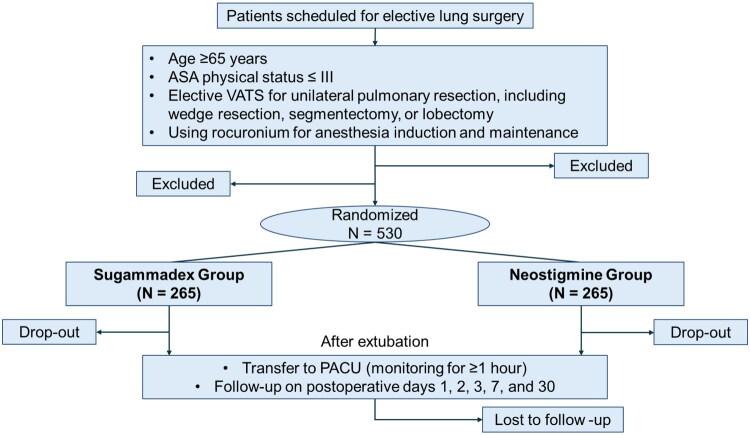
This is a prospective, double-blinded, randomized controlled clinical trial involving 530 elderly patients (≥65 years old) scheduled for video-assisted thoracoscopic lung surgery requiring one-lung ventilation. Patients will be 1:1 randomized to receive sugammadex or neostigmine for neuromuscular blockade reversal. The primary outcome is a composite of AREs occurring in the post-anaesthesia care unit (PACU). Secondary outcomes include time from neuromuscular to extubation, the composite of ARE and rescue measures, PACU length of stay, postoperative pulmonary and extra-pulmonary complications, unplanned intensive care unit (ICU) admission, chest drainage tube duration, hospital length of stay, and mortality. All patients will be followed up until 30 days after surgery. The primary analysis will be conducted on a modified intention-to-treat basis.
DISCUSSION
This trial is designed to address a critical gap in perioperative care for elderly patients undergoing lung resection by directly comparing sugammadex and neostigmine in terms of clinically meaningful respiratory outcomes. While previous studies have primarily focused on pharmacokinetic profiles or surrogate markers such as train-of-four recovery time, evidence regarding the impact of these agents on postoperative AREs remains limited. Given the growing elderly surgical population and the high incidence of RNMB and pulmonary complications in this group, the findings of this study will offer valuable insight into optimizing neuromuscular blockade reversal strategies.
TRIAL REGISTRATION
This study is registered at Chinese clinical trial registry (ChiCTR2400094005).
背景
由于与年龄相关的生理机能衰退以及残余神经肌肉阻滞(RNMB)发生率较高,接受肺切除术的老年患者特别容易发生术后不良呼吸事件(AREs)。舒更葡糖钠是一种选择性肌松药结合剂,能够快速、完全地逆转罗库溴铵等氨基甾体类神经肌肉阻滞剂的作用,与新斯的明等传统乙酰胆碱酯酶抑制剂相比具有潜在优势。然而,直接比较舒更葡糖钠与新斯的明对临床相关呼吸结局,特别是对接受肺切除术的老年患者AREs影响的证据仍然有限。
方法与分析
这是一项前瞻性、双盲、随机对照临床试验,纳入530例计划接受电视辅助胸腔镜肺手术且需要单肺通气的老年患者(≥65岁)。患者将按1:1随机分组,接受舒更葡糖钠或新斯的明用于逆转神经肌肉阻滞。主要结局是麻醉后监护病房(PACU)发生的AREs的复合指标。次要结局包括从神经肌肉阻滞恢复到拔管的时间、AREs与抢救措施的复合指标、PACU住院时间、术后肺部和肺外并发症、非计划性重症监护病房(ICU)入院、胸腔引流管留置时间、住院时间和死亡率。所有患者将随访至术后30天。主要分析将在改良意向性分析基础上进行。
讨论
本试验旨在通过直接比较舒更葡糖钠和新斯的明在具有临床意义的呼吸结局方面的差异,填补接受肺切除术老年患者围手术期护理的关键空白。虽然既往研究主要关注药代动力学特征或四个成串刺激恢复时间等替代指标,但关于这些药物对术后AREs影响的证据仍然有限。鉴于老年手术患者群体不断增加,且该群体中RNMB和肺部并发症的发生率较高,本研究结果将为优化神经肌肉阻滞逆转策略提供有价值的见解。
试验注册
本研究已在中国临床试验注册中心注册(ChiCTR2400094005)。
 Zotero 插件