
新西兰毛利族胃肠道癌手术后“未能挽救”情况中的不平等现象。
Inequities in 'failure to rescue' for Indigenous Māori after gastrointestinal cancer surgery in New Zealand.
作者信息
Wells Cameron I, Wehipeihana Emma, Varghese Chris, Paterson Luke, O'Grady Greg, Harmston Chris, Gurney Jason, Bissett Ian, Koea Jonathan
机构信息
Department of Surgery, University of Auckland, Auckland, New Zealand.
Department of General Surgery, Auckland City Hospital, Auckland, New Zealand.
出版信息
Br J Surg. 2025 Aug 1;112(8). doi: 10.1093/bjs/znaf161.
BACKGROUND
Indigenous populations worldwide experience unjust inequities in surgical outcomes. In Aotearoa New Zealand, Indigenous Māori experience poorer health outcomes, including higher rates of postoperative mortality. The aim of this study was to quantify ethnic disparities in 'failure to rescue' (FTR), complications, and mortality following gastrointestinal cancer surgery and to analyse trends over time.
METHODS
A retrospective national population-based cohort study of patients undergoing resection for gastrointestinal and hepatopancreatobiliary cancers from 2005 to 2020 was conducted. Self-reported ethnicity data were collected at the time of surgery. The primary outcome was FTR, defined as mortality following a complication within 90 days of surgery.
RESULTS
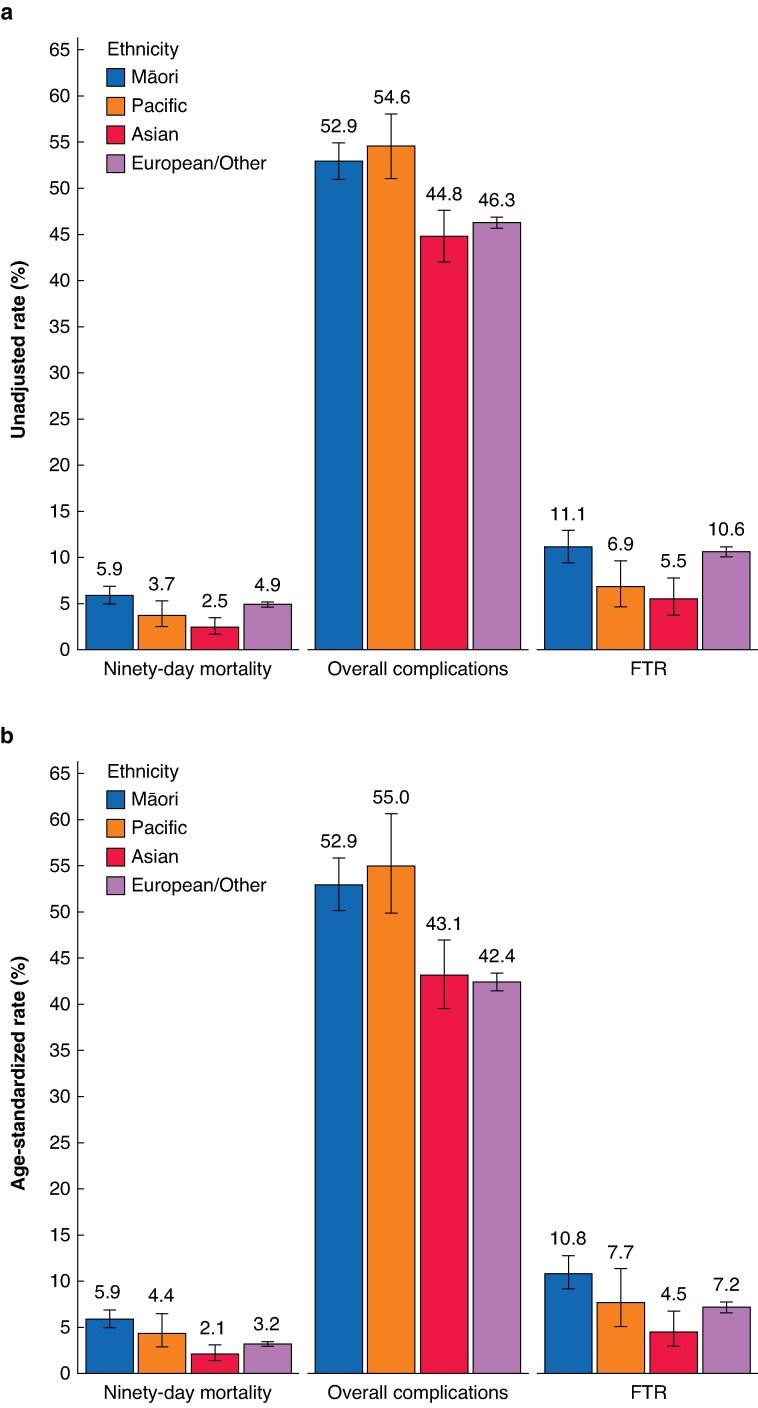
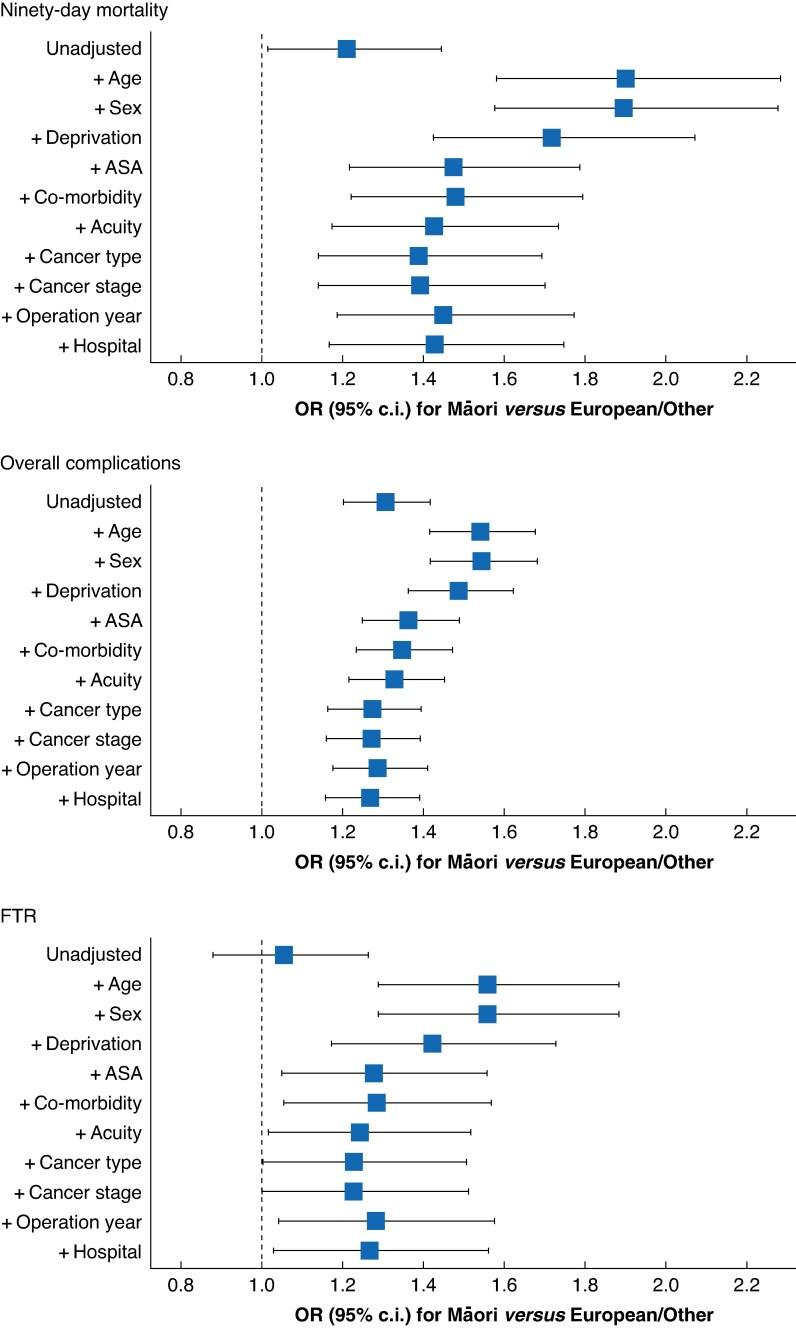
In total, 31 185 patients were included; 2479 (7.9%) were Māori, 46.5% were female, and the median age was 71 (interquartile range 62-78) years. Māori patients were younger and had higher levels of socio-economic deprivation and co-morbidity. Māori had higher age-standardized rates of mortality (5.9% versus 3.2%), complications (52.9% versus 42.4%), and FTR (10.8% versus 7.2%), compared with European/Other. Multivariable regression demonstrated higher odds of mortality (adjusted OR (aOR) 1.45 (95% c.i. 1.15-1.82)), complications (aOR 1.30 (95% c.i. 1.17-1.45)), and FTR (aOR 1.29 (95% c.i. 1.01-1.62)) for Māori. Analysis over time showed a significant improvement in risk-adjusted rates of mortality (6.2% in 2005-2008 versus 3.4% in 2017-2020) and FTR (7.3% in 2005-2008 versus 4.0% in 2017-2020) for European/Other, but no change for Māori (rates of mortality were 6.6% in 2005-2008 versus 5.4% in 2017-2020 and rates of FTR were 7.8% in 2005-2008 versus 6.3% in 2017-2020).
CONCLUSION
Widening inequities in FTR have worsened disparities in postoperative mortality for Māori patients. 'Complication rescue' is a target to reduce inequities and improve perioperative care for Māori patients.
背景
全球原住民在手术结果方面面临不公正的不平等。在新西兰的奥特亚罗瓦,原住民毛利人的健康结果较差,包括术后死亡率较高。本研究的目的是量化胃肠癌手术后“未能挽救”(FTR)、并发症和死亡率方面的种族差异,并分析随时间的趋势。
方法
对2005年至2020年接受胃肠和肝胆胰癌切除术的患者进行了一项基于全国人群的回顾性队列研究。在手术时收集自我报告的种族数据。主要结局是FTR,定义为手术后90天内并发症后的死亡。
结果
总共纳入了31185名患者;2479名(7.9%)为毛利人,46.5%为女性,中位年龄为71岁(四分位间距62 - 78岁)。毛利患者更年轻,社会经济剥夺和合并症水平更高。与欧洲/其他种族相比,毛利人的年龄标准化死亡率(5.9%对3.2%)、并发症发生率(52.9%对42.4%)和FTR发生率(10.8%对7.2%)更高。多变量回归显示毛利人死亡(调整后比值比(aOR)1.45(95%置信区间1.15 - 1.82))、并发症(aOR 1.30(95%置信区间1.17 - 1.45))和FTR(aOR 1.29(95%置信区间1.01 - 1.62))的几率更高。随时间分析显示,欧洲/其他种族的风险调整死亡率(2005 - 2008年为6.2%,2017 - 2020年为3.4%)和FTR(2005 - 2008年为7.3%,2017 - 2020年为4.0%)有显著改善,但毛利人无变化(2005 - 2008年死亡率为6.6%,2017 - 2020年为5.4%;2005 - 2008年FTR发生率为7.8%,2017 - 2020年为6.3%)。
结论
FTR方面日益扩大的不平等加剧了毛利患者术后死亡率的差异。“并发症挽救”是减少不平等并改善毛利患者围手术期护理的一个目标。

 Zotero 插件