
免疫球蛋白A主要在尾段位点携带硫酸化和乙酰化聚糖——位点特异性聚糖鉴定策略。
Immunoglobulin A carries sulfated and -acetylated -glycans primarily at the tailpiece site - strategies for site-specific -glycan identification.
作者信息
Zuniga-Banuelos Frania J, Lemke Greta, Hoffmann Marcus, Reichl Udo, Rapp Erdmann
机构信息
Bioprocess Engineering, Max Planck Institute for Dynamics of Complex Technical Systems, Magdeburg, Germany.
glyXera GmbH, Magdeburg, Germany.
出版信息
Front Mol Biosci. 2025 Aug 1;12:1595173. doi: 10.3389/fmolb.2025.1595173. eCollection 2025.
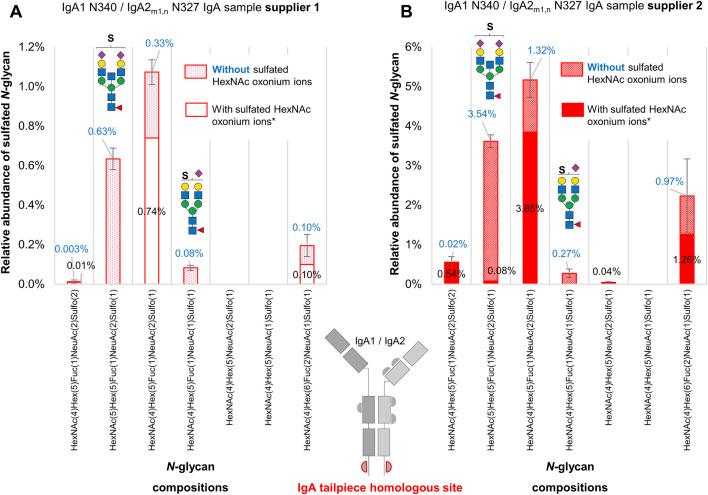
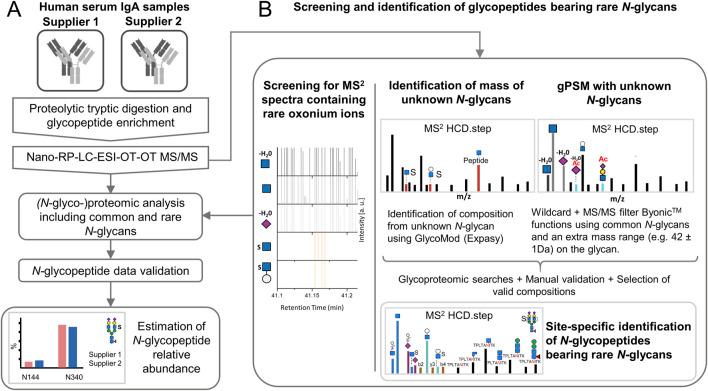
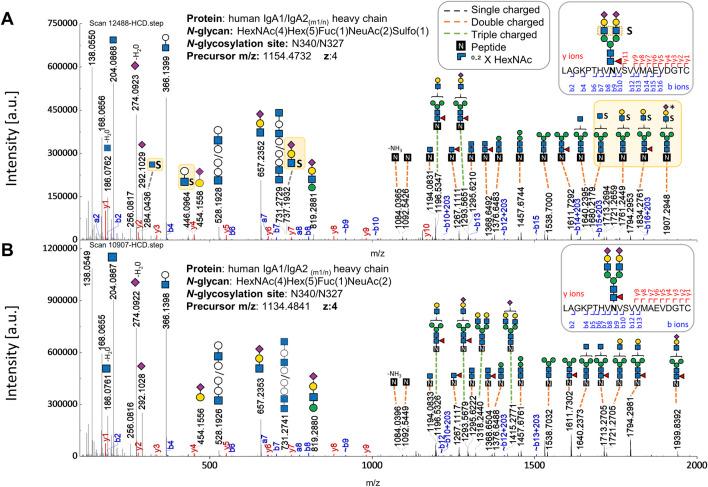
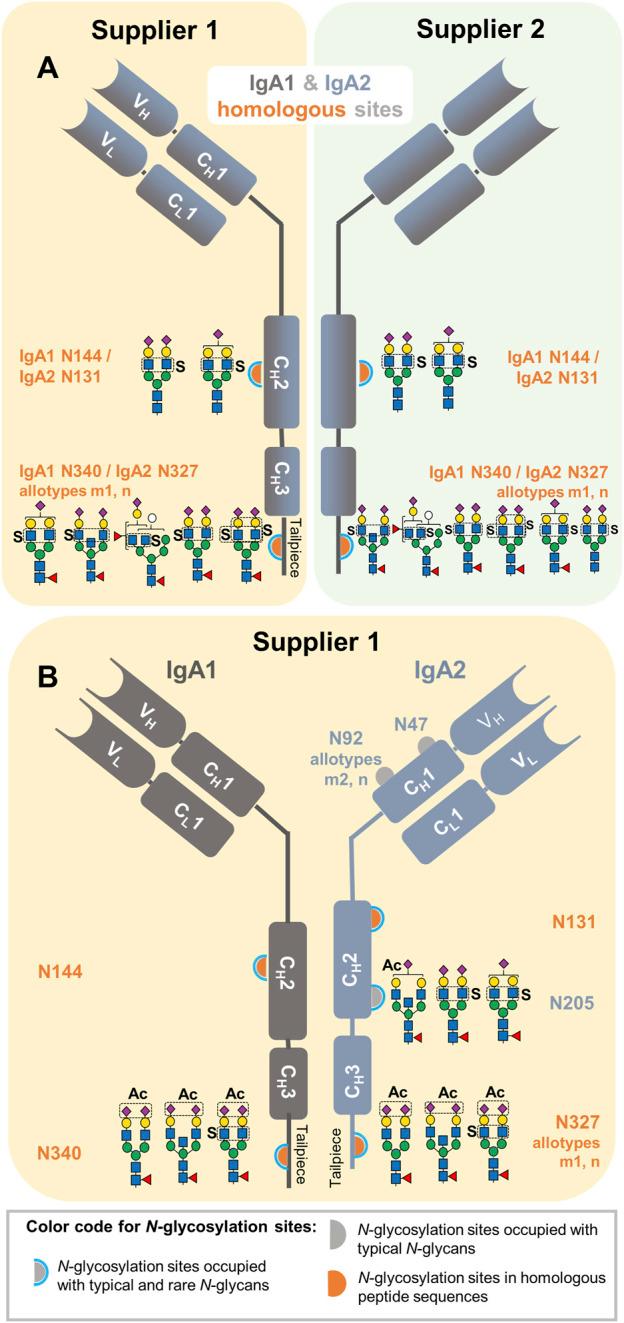
Sulfated glycans from human immunoglobulin A (IgA) were recently discovered via glycomic approaches. However, their site-specific description is still pending. Certain glycan structures at specific glycosylation sites in IgA are crucial for microbial neutralization and effector functions. For instance, sialylated glycans on the C-terminal tailpiece mediate anti-viral activity by interfering with sialic-acid-binding viruses. Sulfated glycan epitopes can be ligands for viral proteins and thus play a role in the immune response. In this study, we performed a site-specific screening for sulfated and other rare glycans in two commercially available human serum IgA samples employing an in-depth glycoproteomic approach, previously developed by us. We found evidence of complex-type and hybrid-type glycans containing sulfated acetylhexosamine (sulfated HexNAc) attached to the glycosylation sites in the tailpiece and the C2 domain of both IgA subclasses. Also, complex-type glycan compositions bearing acetylated sialic acid were identified primarily at the tailpiece site. Surprisingly, glycans bearing glucuronic acid were identified in the commercial IgA samples, but from peptides of "contaminant" glycoproteins. A detailed comparison of the glycosylation profiles of human serum IgA samples from two suppliers showed such glycans with sulfated HexNAc consistently in higher abundance in the tailpiece region. These findings have not been described before for a site-specific glycopeptide analysis. Overall, our work provides strategies for performing a dedicated site-specific search for sulfated and acetylated glycans that can be easily transferred, e.g., to human IgA derived from mucosal tissues, milk, or saliva. We expect that a wider and deeper micro-heterogeneity description of clinically relevant glycoproteins, such as immunoglobulins, can expand the screening for biomarkers or treatment options.
人免疫球蛋白A(IgA)的硫酸化聚糖最近通过糖组学方法被发现。然而,它们的位点特异性描述仍未完成。IgA中特定糖基化位点的某些聚糖结构对于微生物中和及效应功能至关重要。例如,C末端尾段上的唾液酸化聚糖通过干扰唾液酸结合病毒来介导抗病毒活性。硫酸化聚糖表位可以是病毒蛋白的配体,因此在免疫反应中发挥作用。在本研究中,我们采用我们之前开发的深入糖蛋白质组学方法,对两种市售人血清IgA样品中的硫酸化和其他稀有聚糖进行了位点特异性筛选。我们发现了复杂型和杂合型聚糖的证据,这些聚糖含有连接到两个IgA亚类尾段和C2结构域糖基化位点上的硫酸化乙酰己糖胺(硫酸化己糖胺)。此外,主要在尾段位点鉴定出了带有乙酰化唾液酸的复杂型聚糖组成。令人惊讶的是,在市售IgA样品中鉴定出了带有葡萄糖醛酸的聚糖,但来自“污染物”糖蛋白的肽段。对来自两个供应商的人血清IgA样品糖基化谱的详细比较表明,尾段区域中带有硫酸化己糖胺的此类聚糖始终具有更高的丰度。这些发现之前尚未在位点特异性糖肽分析中被描述过。总体而言,我们的工作提供了对硫酸化和乙酰化聚糖进行专门位点特异性搜索的策略,这些策略可以很容易地转移,例如用于源自黏膜组织、牛奶或唾液的人IgA。我们期望对临床相关糖蛋白(如免疫球蛋白)进行更广泛和深入的微异质性描述能够扩大对生物标志物或治疗选择的筛选。

 Zotero 插件