
在用热灭活疫苗免疫期间消耗髓源性抑制细胞(MDSC)可增强对卡介苗(BCG)感染的抵抗力。
MDSC depletion during immunization with heat-killed increases protection against BCG infection.
作者信息
Aintablian Arpa, Arold Anna M, Alattar Haisam, Cyran Laura, Schoen Christoph, Du Plessis Nelita, Walzl Gerhard, Schaible Ulrich, Beilhack Andreas, Nieuwenhuizen Natalie E, Lutz Manfred B
机构信息
Institute for Virology and Immunobiology, University of Würzburg, Würzburg, Germany.
Department of Medicine II, Würzburg University Hospital, Würzburg, Germany.
出版信息
Front Immunol. 2025 Jul 31;16:1646526. doi: 10.3389/fimmu.2025.1646526. eCollection 2025.
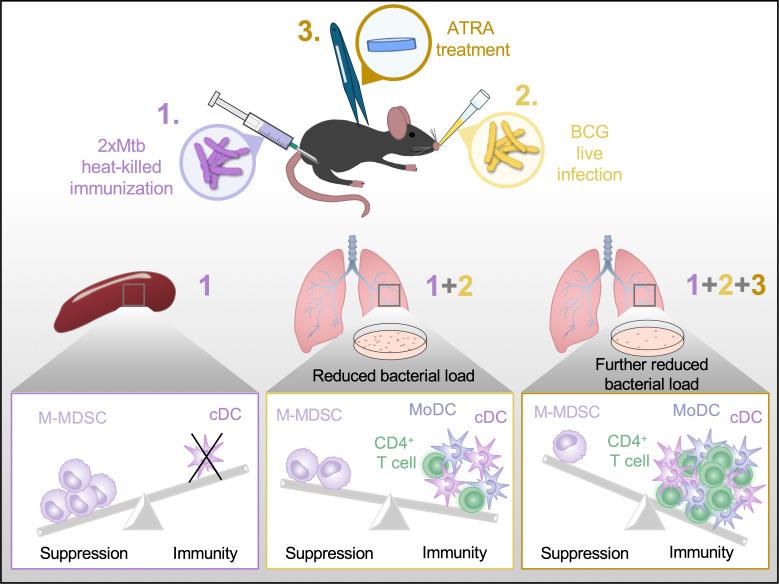
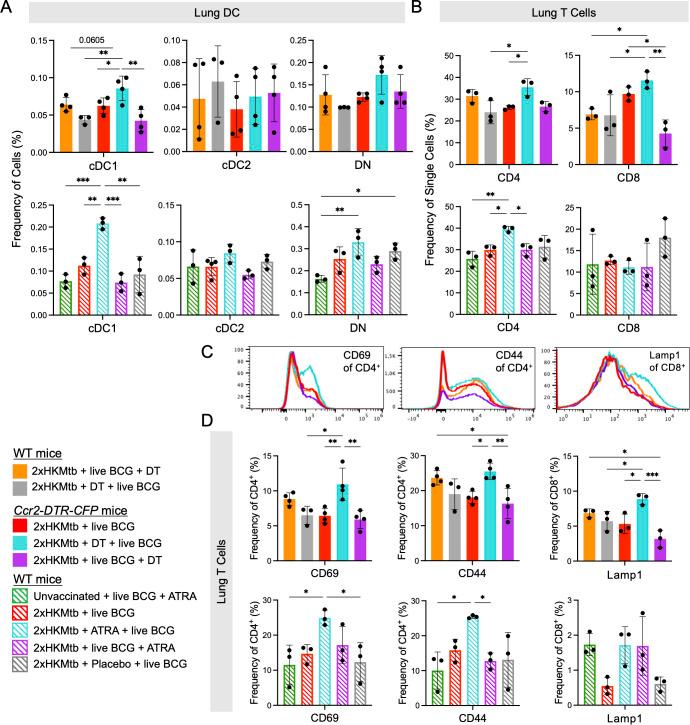
Tuberculosis (TB) remains one of the deadliest infectious diseases globally. Although the approved human Bacille-Calmette-Guérin (BCG) vaccines provide limited protection, a vaccine based on (Mtb) has yet to be approved. Our previous findings demonstrated that s.c. immunization with heat-killed Mtb significantly increased the number of monocytic myeloid-derived suppressor cells (M-MDSC) in mice. Thus, we hypothesized that the defense against a subsequent BCG infection would be compromised in Mtb-immunized mice. Surprisingly, mice vaccinated with Mtb were protected against BCG infection and exhibited elevated frequencies and activation of dendritic cells (DC) and mycobacteria-specific T cells, despite high frequencies and suppressor activity of M-MDSC. Genetic ablation of CCR2 monocytic cells or pharmacological intervention with all-trans retinoic acid (ATRA) reduced the frequency of Mtb-induced M-MDSC, enhanced the frequencies and activation of DC and CD4 T cells, and resulted in decreased bacterial loads in the lungs and spleen. These findings provide new insights into TB vaccination using heat-killed Mtb despite the concurrent unwanted effects of vaccine-induced M-MDSC. M-MDSC depletion via ATRA further shifts the balance toward immunity and should be considered an adjunct host-directed therapy alongside TB vaccines in humans.
结核病(TB)仍然是全球最致命的传染病之一。尽管已获批的卡介苗(BCG)对人类的保护作用有限,但基于结核分枝杆菌(Mtb)的疫苗尚未获批。我们之前的研究结果表明,用热灭活的Mtb进行皮下免疫可显著增加小鼠单核细胞来源的髓系抑制细胞(M-MDSC)的数量。因此,我们推测,接种Mtb的小鼠对随后的卡介苗感染的防御能力会受到损害。令人惊讶的是,接种Mtb的小鼠对卡介苗感染具有抵抗力,并且尽管M-MDSC频率较高且具有抑制活性,但树突状细胞(DC)和分枝杆菌特异性T细胞的频率和活化水平有所升高。CCR2单核细胞的基因敲除或全反式维甲酸(ATRA)的药物干预降低了Mtb诱导的M-MDSC频率,增强了DC和CD4 T细胞的频率和活化水平,并导致肺和脾中的细菌载量降低。这些发现为使用热灭活的Mtb进行结核病疫苗接种提供了新的见解,尽管疫苗诱导的M-MDSC存在不良影响。通过ATRA消耗M-MDSC可进一步使平衡向免疫方向转变,在人类中应将其视为与结核病疫苗一起的辅助宿主导向疗法。



 Zotero 插件