
作为解码塑料相关信息标志物的小分子:聚焦于聚合物组成
Small Molecules as Markers for Decoding Plastic-Related Information: A Focus on Polymer Composition.
作者信息
Li Yu, Poisson Katherine, McMinn Madison H, Zhang Changyong, Yang Shuai, Tian Zhenyu
机构信息
Department of Chemistry and Chemical Biology, College of Science, Northeastern University, Boston, Massachusetts 02115, United States.
Department of Environmental Science and Engineering, University of Science and Technology of China, Hefei, Anhui 230026, China.
出版信息
Environ Sci Technol Lett. 2025 Jul 29;12(8):1019-1025. doi: 10.1021/acs.estlett.5c00448. eCollection 2025 Aug 12.
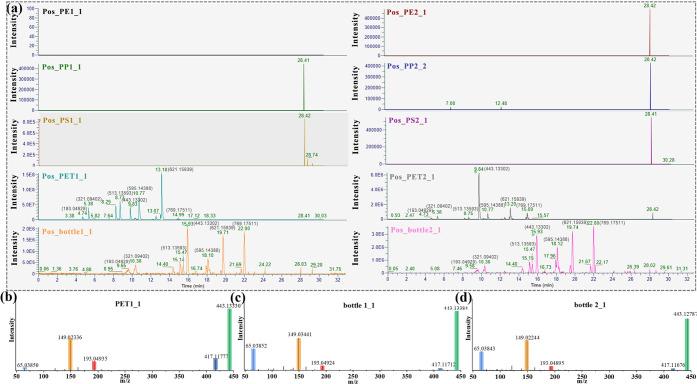
Although the relationship between plastics and their embedded small molecules has been previously hypothesized, direct and systematic evidence remains limited. Herein, we introduced an innovative approach to validate this relationship by screening specific small molecules as markers to decode plastic information. Given the mature techniques available for polymer identification, enabling subsequent validation, this study focused on screening polymer-specific small molecule markers. Specifically, plastic samples of various polymer typesincluding raw plastic pellets and postprocessed plastic productswere collected, extracted, and analyzed with a nontargeted method. Distinct polymer-based features were observed in raw plastic pellets: 21 in polyethylene (PE), 69 in polypropylene (PP), 119 in poly-(ethylene terephthalate) (PET), and 14 in polystyrene (PS). Of these, 2, 28, 101, and 10 features were also detected in postprocessed plastic products of the same polymer, indicating these co-occurring features could serve as polymer-specific markers. Representative markers were identified, including Irganox 1010 transformation products in PP-based plastics, PET oligomers in PET-based plastics, and dibenzoylmethane in PS-based plastics. These markers were then used to identify the polymer type of two additional plastic bottles as PET, consistent with results obtained from pyrolysis-gas chromatography/mass spectrometry. This work provides a proof-of-concept for employing small molecule markers to decode plastic-related information.
尽管此前已有人推测塑料与其所含小分子之间的关系,但直接且系统的证据仍然有限。在此,我们引入了一种创新方法,通过筛选特定小分子作为标记物来解码塑料信息,从而验证这种关系。鉴于现有用于聚合物鉴定的成熟技术可用于后续验证,本研究聚焦于筛选聚合物特异性小分子标记物。具体而言,收集了各种聚合物类型的塑料样品——包括原始塑料颗粒和后处理塑料制品——采用非靶向方法进行提取和分析。在原始塑料颗粒中观察到了基于不同聚合物的特征:聚乙烯(PE)中有21种,聚丙烯(PP)中有69种,聚对苯二甲酸乙二酯(PET)中有119种,聚苯乙烯(PS)中有14种。其中,在相同聚合物的后处理塑料制品中也检测到了2种、28种、101种和10种特征,这表明这些同时出现的特征可作为聚合物特异性标记物。确定了代表性标记物,包括基于PP的塑料中的抗氧剂1010转化产物、基于PET的塑料中的PET低聚物以及基于PS的塑料中的二苯甲酰甲烷。然后使用这些标记物将另外两个塑料瓶的聚合物类型鉴定为PET,这与热解气相色谱/质谱法获得的结果一致。这项工作为利用小分子标记物解码与塑料相关的信息提供了概念验证。

 Zotero 插件