
消化系统疾病暴露及生活方式因素与帕金森病的关联
Associations of digestive diseases exposure and lifestyle factors with Parkinson's disease.
作者信息
Yang Kaitai, Zeng Ruitian, Zheng Yiling, Zhong Siqi, Wang Jiani, Yu Xinxi, Zhong Huilin, Chen Xuanjie, Shi Yisen, Lin Fabin, Ye Qinyong, Sun Ning, Cai Guoen
机构信息
Department of Neurology, Fujian Medical University Union Hospital, Fuzhou, 350001, China.
Fujian Medical University, Fuzhou, 350001, China.
出版信息
NPJ Parkinsons Dis. 2025 Aug 18;11(1):245. doi: 10.1038/s41531-025-01098-6.
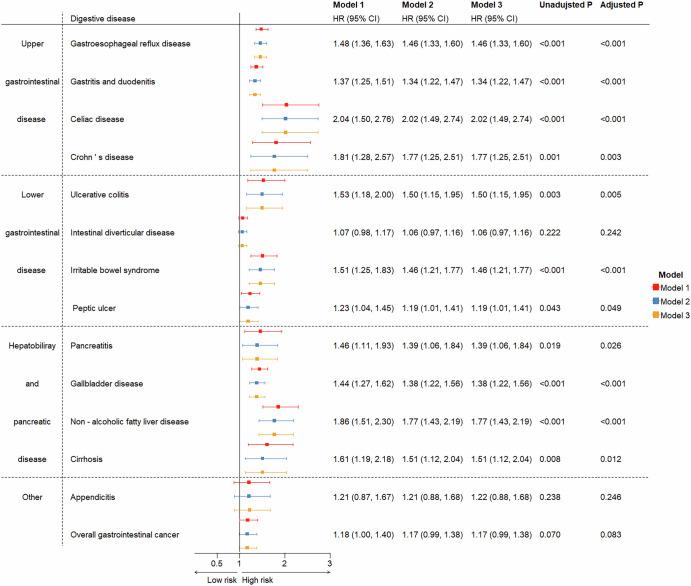
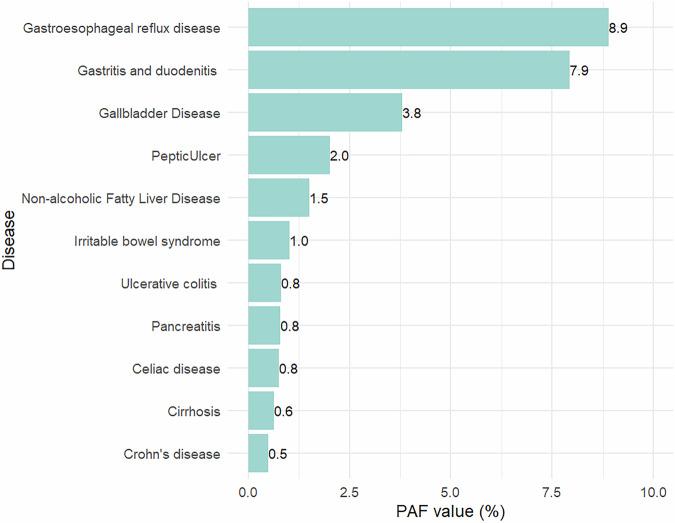
Emerging evidence highlights the importance of gastrointestinal (GI) dysfunction in Parkinson's disease (PD). While inflammatory bowel disease (IBD) has been linked to PD, the association with other GI conditions remains unclear. This study analyzed data from 501,483 participants, including 907 PD cases. Cox models revealed that digestive diseases were significantly associated with an increased PD risk (HR = 1.43). Eleven digestive diseases were linked to PD, with lifestyle factors such as sleep patterns and diet reducing PD risk. Notably, interactions between Non-alcoholic Fatty Liver Disease (NAFLD) and sleep (P-int = 0.0119), and Crohn's disease and dietary diversity (P-int = 0.0081) were observed. Population attributable fraction (PAF) analysis indicated that eliminating exposure to gastroesophageal reflux disease (GERD), gastritis and duodenitis, and gallbladder and biliary diseases could reduce PD cases by approximately 8.9%, 7.9%, and 3.8%, respectively. These findings emphasize the role of digestive diseases and lifestyle in PD risk.
新出现的证据凸显了胃肠道(GI)功能障碍在帕金森病(PD)中的重要性。虽然炎症性肠病(IBD)与PD有关,但与其他胃肠道疾病的关联仍不明确。本研究分析了501483名参与者的数据,其中包括907例PD病例。Cox模型显示,消化系统疾病与PD风险增加显著相关(风险比=1.43)。11种消化系统疾病与PD有关,睡眠模式和饮食等生活方式因素可降低PD风险。值得注意的是,观察到非酒精性脂肪性肝病(NAFLD)与睡眠之间的相互作用(交互作用P值=0.0119),以及克罗恩病与饮食多样性之间的相互作用(交互作用P值=0.0081)。人群归因分数(PAF)分析表明,消除胃食管反流病(GERD)、胃炎和十二指肠炎以及胆囊和胆道疾病的暴露,可分别减少约8.9%、7.9%和3.8%的PD病例。这些发现强调了消化系统疾病和生活方式在PD风险中的作用。


 Zotero 插件