
在体外以及胆道闭锁小鼠模型中,二肽基肽酶4(DPP4)抑制可减少α-β和γ-δ T细胞促炎细胞因子的产生。
DPP4-inhibition reduces pro-inflammatory cytokine production by alpha-beta and gamma-delta T cells in vitro and in the biliary atresia mouse model.
作者信息
Wilde Anne-Christin, Uecker Marie, Gueler Faikah, Prinz Immo, Madadi-Sanjani Omid, Petersen Claus, Kuebler Joachim F, Klemann Christian
机构信息
Department of Hepatology and Gastroenterology, Charité - Universitätsmedizin Berlin, Campus Virchow-Klinikum (CVK) and Campus Charité Mitte (CCM), Berlin, Germany.
Department of Pediatric Surgery, Center of Surgery, Hannover Medical School, Hannover, Germany.
出版信息
Sci Rep. 2025 Aug 18;15(1):30226. doi: 10.1038/s41598-025-16097-z.
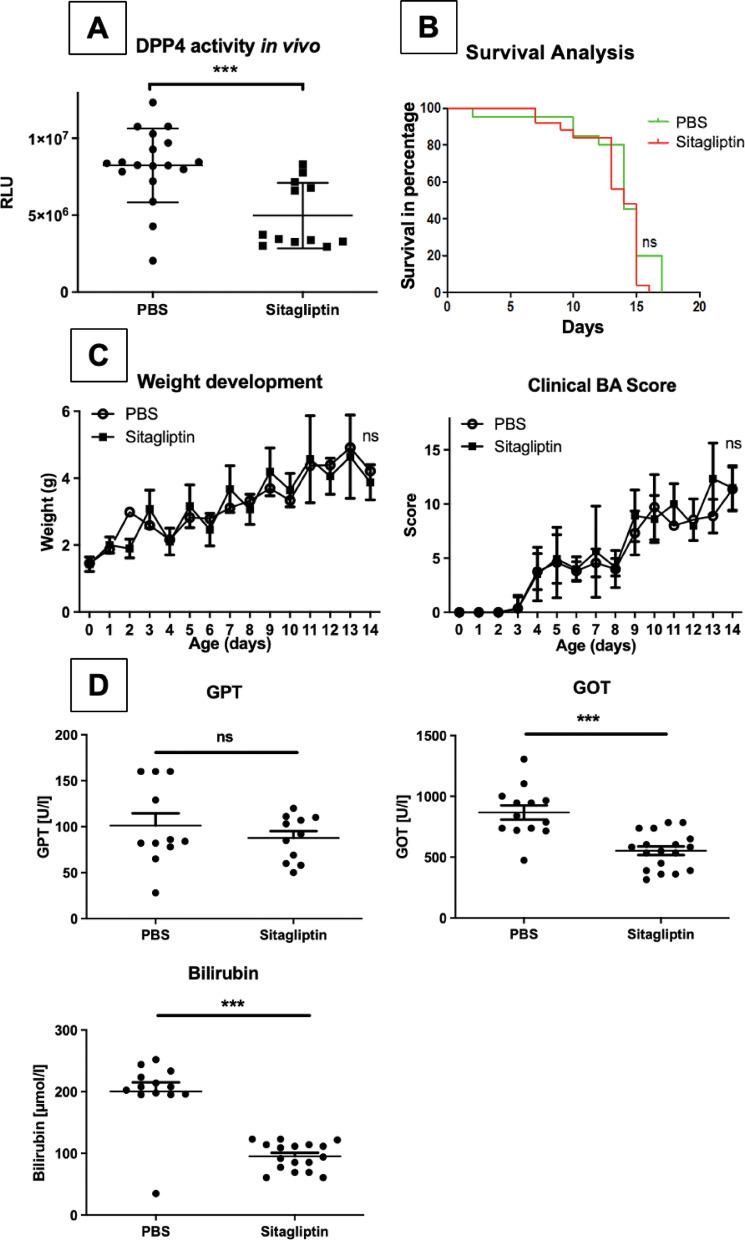
Etiology and pathogenesis of biliary atresia (BA) remain elusive. Evidence points to a T cell mediated autoimmune response contributing to the disease by driving the ongoing hepatic inflammation. CD26, also known as dipeptidylpeptidase 4 (DPP4), is an immunoregulatory protein also expressed on T-lymphocytes. We aimed to investigate the potential of pharmacological DPP4 inhibition on cytokine production of T cells and potential therapeutic benefits in experimental BA. We analyzed the expression and regulation of CD26/DPP4 on αβ and γδ T cells in mice suffering from rotavirus-induced BA. Enzymatic DPP4 activity in murine and human serum was examined. In cell cultures, lymphocytes were incubated with the DPP4-inhibitor Sitagliptin to study the effects of DPP4 inhibition on cytokine production. Clinical effects were assessed by intraperitoneal Sitagliptin injection of mice suffering from BA. Analyses included flow cytometry, qPCR, serum analysis and histological examinations. In mice suffering from BA, CD26/DPP4 was strongly expressed and upregulated on αβ and to an even greater extent on γδ T cells compared to healthy controls. DPP4-inhibition led to a dose-dependent suppression of the pro-inflammatory cytokines IL-17 and IFN-γ produced by Th1, Th17 and γδ T cells. Therapeutic administration of Sitagliptin in experimental BA led to reduced serum levels of GOT and Bilirubin as well as decreased hepatic infiltration with F4/80 macrophages but had no effect on overall survival. In humans, serum DPP4-activity was upregulated in infants suffering from BA compared to healthy children. To our knowledge, this is the first time an upregulation of CD26 expression has been demonstrated for γδ T cells in the setting of an autoimmune inflammatory response. Mechanistically, we could demonstrate that DPP4/CD26 is upregulated on T cells in experimental BA and that pharmacological inhibition decreased their pro-inflammatory potential. However, this translated to only mild clinical benefits in the mouse model. Thus, although the protein appears to play a role in BA, further research is needed to elucidate the potential to serve as a therapeutic target.
胆道闭锁(BA)的病因和发病机制仍不清楚。有证据表明,T细胞介导的自身免疫反应通过引发持续的肝脏炎症而导致该病。CD26,也称为二肽基肽酶4(DPP4),是一种免疫调节蛋白,也在T淋巴细胞上表达。我们旨在研究药物性抑制DPP4对T细胞细胞因子产生的影响以及在实验性BA中的潜在治疗益处。我们分析了轮状病毒诱导的BA小鼠中αβ和γδ T细胞上CD26/DPP4的表达和调节情况。检测了小鼠和人血清中的DPP4酶活性。在细胞培养中,将淋巴细胞与DPP4抑制剂西他列汀孵育,以研究DPP4抑制对细胞因子产生的影响。通过对BA小鼠腹腔注射西他列汀来评估临床效果。分析包括流式细胞术、qPCR、血清分析和组织学检查。与健康对照相比,在BA小鼠中,αβ T细胞上CD26/DPP4强烈表达且上调,在γδ T细胞上上调程度更大。DPP4抑制导致Th1、Th17和γδ T细胞产生的促炎细胞因子IL-17和IFN-γ呈剂量依赖性抑制。在实验性BA中给予西他列汀治疗可降低血清谷草转氨酶(GOT)和胆红素水平,并减少F4/80巨噬细胞的肝脏浸润,但对总体生存率没有影响。在人类中,与健康儿童相比,BA婴儿的血清DPP4活性上调。据我们所知,这是首次在自身免疫性炎症反应背景下证明γδ T细胞上CD26表达上调。从机制上讲,我们可以证明在实验性BA中T细胞上DPP4/CD26上调,并且药物抑制降低了它们的促炎潜力。然而,这在小鼠模型中仅转化为轻微的临床益处。因此,尽管该蛋白似乎在BA中起作用,但仍需要进一步研究以阐明其作为治疗靶点的潜力。


 Zotero 插件