
吸入一氧化氮治疗青紫型先天性心脏病肺动脉高压的效用:一项倾向评分匹配队列研究
Utility of inhaled nitric oxide for pulmonary hypertension in cyanotic congenital heart disease: a cohort study with propensity score matching.
作者信息
Wang Xiaofeng, Li Chenyu, Wang Shilin, Zhu Zhiyuan, Chen Qinnan, Shen Ruihuan, Wang Xu
机构信息
Department of Pediatric Intensive Care Unit, National Center for Cardiovascular Disease and Fuwai Hospital, Chinese Academy of Medical Sciences, Peking Union Medical College, Beijing, China.
Department of Pediatric Intensive Care Unit, Fuwai Yunnan Hospital, Chinese Academy of Medical Sciences, Affiliated Cardiovascular Hospital of Kunming Medical University, Kunming, Yunnan Province, China.
出版信息
Med Gas Res. 2026 Jun 1;16(2):93-97. doi: 10.4103/mgr.MEDGASRES-D-25-00062. Epub 2025 Aug 18.
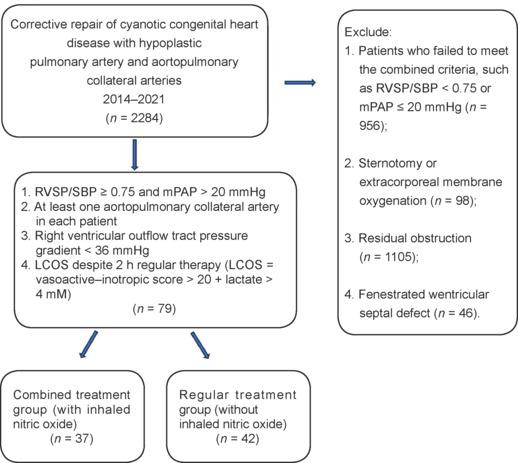
JOURNAL/mgres/04.03/01612956-202606000-00001/figure1/v/2025-08-18T154854Z/r/image-tiff Pulmonary hypertension can lead to hemodynamic instability and worsen the outcome after the repair of cyanotic congenital heart disease with decreased pulmonary blood flow. However, the safety and effectiveness of targeted therapy, such as inhaled nitric oxide, remain controversial. This retrospective cohort study included patients who underwent corrective repair for tetralogy of Fallot, double outlet right ventricle, or pulmonary atresia with ventricular septal defect with hypoplastic pulmonary vasculature at Fuwai Hospital between 2014 and 2021. Patients were divided into a regular treatment group and a combined treatment group depending on whether inhaled nitric oxide was prescribed. The improvement in low cardiac output syndrome within 24 hours after surgery and the main clinical outcomes during hospitalization were compared between the two groups after 1:1 propensity score matching. Compared with those in the regular treatment group, both the incidence of low cardiac output syndrome and the rate of renal replacement therapy were lower in the combined treatment group. Inhaled nitric oxide therapy is effective in the treatment of patients with pulmonary hypertension after corrective repair of cyanotic congenital heart disease.
《JOURNAL/mgres/04.03/01612956 - 202606000 - 00001/figure1/v/2025 - 08 - 18T154854Z/r/image - tiff》肺动脉高压可导致血流动力学不稳定,并使肺血流量减少的青紫型先天性心脏病修复术后的预后恶化。然而,吸入一氧化氮等靶向治疗的安全性和有效性仍存在争议。这项回顾性队列研究纳入了2014年至2021年期间在阜外医院接受法洛四联症、右心室双出口或室间隔缺损合并肺血管发育不良的肺动脉闭锁矫正修复术的患者。根据是否开具吸入一氧化氮处方,将患者分为常规治疗组和联合治疗组。在1:1倾向评分匹配后,比较两组术后24小时内心输出量低综合征的改善情况以及住院期间的主要临床结局。与常规治疗组相比,联合治疗组的心输出量低综合征发生率和肾脏替代治疗率均较低。吸入一氧化氮疗法在青紫型先天性心脏病矫正修复术后肺动脉高压患者的治疗中是有效的。

 Zotero 插件