
用于疾病模型、干细胞成熟和生物混合机器人技术的基于石墨烯光电致动器的非基因神经调节
Non-genetic neuromodulation with graphene optoelectronic actuators for disease models, stem cell maturation, and biohybrid robotics.
作者信息
Molokanova Elena, Zhou Teng, Vasupal Pragna, Cherkas Volodymyr P, Narute Prashant, Ferraz Mariana S A, Reiss Michael, Almenar-Queralt Angels, Chaldaiopoulou Georgia, de Souza Janaina Sena, Hemati Honieh, Downey Francisco, Olajide Omowuyi O, Thörn Perez Carolina, Puppo Francesca, Mesci Pinar, Pfaff Samuel L, Kireev Dmitry, Muotri Alysson R, Savchenko Alex
机构信息
Nanotools Bioscience, La Jolla, CA, 92037, USA.
NeurANO Bioscience, La Jolla, CA, 92037, USA.
出版信息
Nat Commun. 2025 Aug 20;16(1):7499. doi: 10.1038/s41467-025-62637-6.
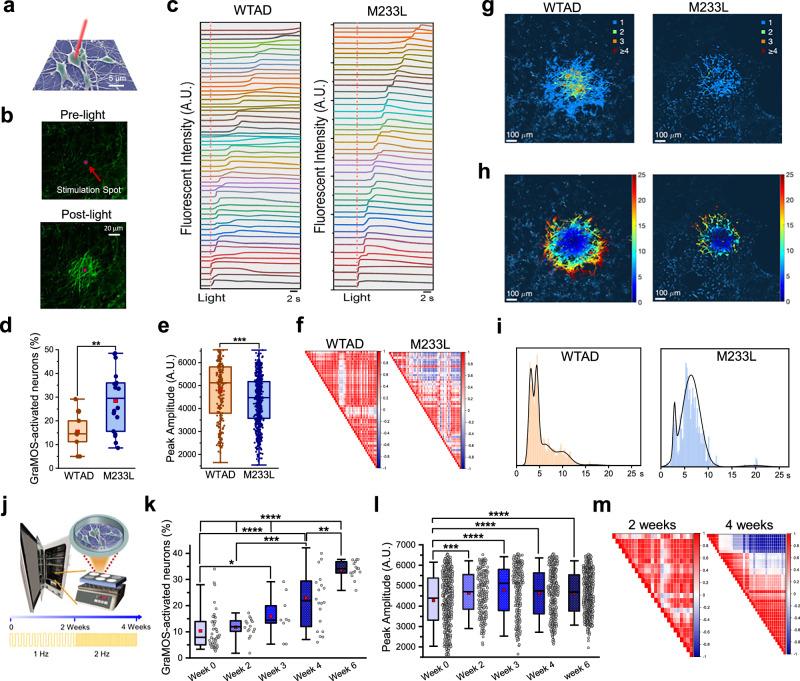
Light can serve as a tunable trigger for neurobioengineering technologies, enabling probing, control, and enhancement of brain function with unmatched spatiotemporal precision. Yet, these technologies often require genetic or structural alterations of neurons, disrupting their natural activity. Here, we introduce the Graphene-Mediated Optical Stimulation (GraMOS) platform, which leverages graphene's optoelectronic properties and its ability to efficiently convert light into electricity. Using GraMOS in longitudinal studies, we found that repeated optical stimulation enhances the maturation of hiPSC-derived neurons and brain organoids, underscoring GraMOS's potential for regenerative medicine and neurodevelopmental studies. To explore its potential for disease modeling, we applied short-term GraMOS to Alzheimer's stem cell models, uncovering disease-associated alterations in neuronal activity. Finally, we demonstrated a proof-of-concept for neuroengineering applications by directing robotic movements with GraMOS-triggered signals from graphene-interfaced brain organoids. By enabling precise, non-invasive neural control across timescales from milliseconds to months, GraMOS opens new avenues in neurodevelopment, disease treatment, and robotics.
光可作为神经生物工程技术的可调谐触发因素,能够以前所未有的时空精度探测、控制和增强脑功能。然而,这些技术通常需要对神经元进行基因或结构改变,从而扰乱其天然活性。在此,我们介绍了石墨烯介导的光刺激(GraMOS)平台,该平台利用了石墨烯的光电特性及其将光有效转化为电的能力。在纵向研究中使用GraMOS,我们发现重复的光刺激可增强人诱导多能干细胞衍生神经元和脑类器官的成熟,这凸显了GraMOS在再生医学和神经发育研究中的潜力。为了探索其在疾病建模方面的潜力,我们将短期GraMOS应用于阿尔茨海默病干细胞模型,发现了神经元活动中与疾病相关的改变。最后,我们通过用来自石墨烯接口脑类器官的GraMOS触发信号指导机器人运动,展示了神经工程应用的概念验证。通过在从毫秒到数月的时间尺度上实现精确、非侵入性的神经控制,GraMOS为神经发育、疾病治疗和机器人技术开辟了新途径。




 Zotero 插件