
阿帕替尼联合替莫唑胺治疗复发性恶性脑胶质瘤的疗效
Efficacy of Apatinib plus Temozolomide in Treating Recurrent Malignant Brain Glioma.
作者信息
Li Guoquan, Hu Tao, Hu Yangwu, Shi Hailiang, Li Ling, Xiong Gang
机构信息
Department of Neurosurgery, Wuhan Jiangxia District First People's Hospital, Wuhan, China.
出版信息
Afr Health Sci. 2025 Jun;25(2):124-130. doi: 10.4314/ahs.v25i2.17.
BACKGROUND
To evaluate the efficacy and safety of apatinib plus tenozolomide in the treatment of recurrent malignant brain glioma.
METHODS
A retrospective analysis of 108 patients with recurrent malignant brain glioma was conducted at our hospital. Out of these, 54 patients received apatinib plus tenozolomide as combination therapy (Combination group) while the remaining 54 were treated with temozolomide alone (Control group). Clinical data was collected and analyzed to compare the treatment efficacy and incidence of adverse reactions between the two groups. Additionally, patient survival and progression-free survival (PFS) were monitored and recorded.
RESULTS
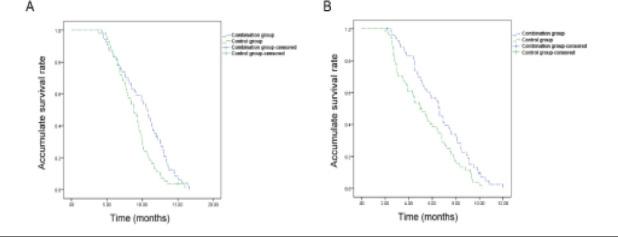
The study evaluated the efficacy of a treatment among patients who completed it. The Combination group had a higher objective response rate (ORR) and disease control rate (DCR) compared to the Control group. Treatment-related adverse reactions were mostly grade I-II and improved with symptomatic treatment. The Combination group had higher incidence rates of hypertension, proteinuria, and hand-foot syndrome. Follow-up results showed that the Combination group had a significantly better overall survival (OS) and progression-free survival (PFS) than the Control group.
CONCLUSION
Compared with temozolomide alone, apatinib plus tenozolomide can significantly improve the clinical efficacy in treating recurrent malignant brain glioma, prolong the survival of patients and produce tolerable adverse reactions.
背景
评估阿帕替尼联合替莫唑胺治疗复发性恶性脑胶质瘤的疗效和安全性。
方法
对我院108例复发性恶性脑胶质瘤患者进行回顾性分析。其中,54例患者接受阿帕替尼联合替莫唑胺作为联合治疗(联合组),其余54例仅接受替莫唑胺治疗(对照组)。收集并分析临床数据,以比较两组的治疗效果和不良反应发生率。此外,监测并记录患者的生存期和无进展生存期(PFS)。
结果
该研究评估了完成治疗的患者的治疗效果。联合组的客观缓解率(ORR)和疾病控制率(DCR)均高于对照组。治疗相关不良反应大多为I-II级,经对症治疗后有所改善。联合组的高血压、蛋白尿和手足综合征发生率较高。随访结果显示,联合组的总生存期(OS)和无进展生存期(PFS)均显著优于对照组。
结论
与单纯使用替莫唑胺相比,阿帕替尼联合替莫唑胺可显著提高复发性恶性脑胶质瘤的临床疗效,延长患者生存期,并产生可耐受的不良反应。
 Zotero 插件