
在基于社区的移动健康干预中通过双点激励提高低参与度个体的身体活动水平:回顾性观察研究
Boosting Physical Activity Among Individuals With Low Engagement Through Double-Point Incentives in a Community-Based mHealth Intervention: Retrospective Observational Study.
作者信息
Joo Jungin, Lee Mangyeong, Yoon Junghee, Cho Hyeonjin, Warrier Govind, Thrul Johannes, Cho Juhee
机构信息
Department of Digital Health, Samsung Advanced Institute for Health Sciences & Technology, Sungkyunkwan University, Seoul, Republic of Korea.
Center for Clinical Epidemiology, Samsung Medical Center, Sungkyunkwan University School of Medicine, Seoul, Republic of Korea.
出版信息
JMIR Mhealth Uhealth. 2025 Aug 21;13:e66227. doi: 10.2196/66227.
BACKGROUND
The administration of incentives to promote physical activity, such as the amount or timing, can vary depending on target health behaviors, research settings, intervention delivery channels, and participants' preferences. Interventions implemented at scale necessitate the consideration of potential fiscal constraints for public health promotion. Since limited funding is a barrier to implementing community-based interventions, examining both immediate and sustained effects of temporary incentive increases on physical activity is important.
OBJECTIVE
This study aimed to evaluate the effect of a 1-week double-point event on increasing physical activity among low-engaged individuals in the context of a community-based mobile intervention.
METHODS
Using retrospective data from a Seoul Metropolitan Government mobile health (mHealth) intervention, we evaluated the effects of a 1-week double-point incentive on participants' physical activity. During 3 registration phases from November to December 2021, a total of 50,145 individuals enrolled. Our analysis focused on the low-engaged group (n=27,833, 55.5%), who averaged fewer than 3 days per week of meeting the daily step challenge (at least 7000 steps) before the intervention. We performed a segmented regression analysis to assess changes in physical activity before and after the event. Multivariable logistic regression and Cox proportional hazards models were used to identify factors associated with improving and maintaining physical activity after starting the intervention.
RESULTS
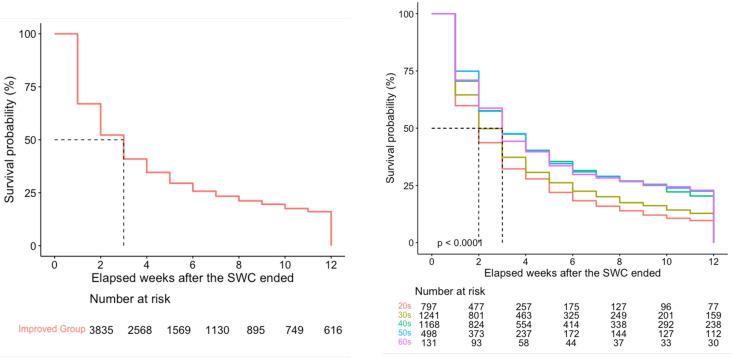
Of 27,833 low-engaged participants, only 13.7% (n=3835) improved their physical activity. Daily challenge engagements per week increased by 2.53 times, and average daily steps increased by 1924.97 (standardized mean difference 0.55, 95% CI 0.51-0.58). In multivariable logistic regression, older age was significantly associated with improved physical activity immediately after starting the intervention. However, 50% (1918/3835) of the improved group was likely to return to low engagement 3 weeks after the intervention ended. Older age and use of certain wearable devices were associated with maintaining physical activity after the intervention.
CONCLUSIONS
Double-point incentives in the short term may serve as a cue-to-action to motivate low-engagement targets; however, they do not seem to guarantee long-term maintenance in the context of community-based mHealth interventions. Further research is needed to identify additional strategies beyond monetary incentives to sustain long-term healthy behavior.
背景
促进身体活动的激励措施的实施,如激励的数量或时机,可能因目标健康行为、研究环境、干预实施渠道以及参与者的偏好而有所不同。大规模实施的干预措施需要考虑公共卫生促进方面潜在的财政限制。由于资金有限是实施基于社区的干预措施的障碍,因此研究临时增加激励对身体活动的即时和持续影响非常重要。
目的
本研究旨在评估在基于社区的移动干预背景下,为期1周的双倍积分活动对低参与度个体增加身体活动的影响。
方法
利用首尔市政府移动健康(mHealth)干预的回顾性数据,我们评估了为期1周的双倍积分激励对参与者身体活动的影响。在2021年11月至12月的3个注册阶段,共有50145人登记。我们的分析集中在低参与度组(n = 27833,55.5%),他们在干预前平均每周满足每日步数挑战(至少7000步)的天数少于3天。我们进行了分段回归分析,以评估活动前后身体活动的变化。多变量逻辑回归和Cox比例风险模型用于确定干预开始后与改善和维持身体活动相关的因素。
结果
在278

 Zotero 插件