
准分子激光原位角膜磨镶术后角膜扩张症和圆锥角膜的共享分子特征以及在[此处可能有缺失内容]、[此处可能有缺失内容]、[此处可能有缺失内容]和[此处可能有缺失内容]方面的关键差异。
Shared molecular profiles of post-laser vision correction ectasia and keratoconus with key differences in , , , and .
作者信息
Jaskiewicz-Rajewicz Katarzyna, Wysocka Alicja, Maleszka-Kurpiel Magdalena, Matuszewska-Mach Eliza, Wozniak Jakub, Ploski Rafal, Matysiak Jan, Rydzanicz Malgorzata, Gajecka Marzena
机构信息
Institute of Human Genetics, Polish Academy of Sciences, Poznan, Poland.
Optegra Eye Healthcare Clinic in Poznan, Poznan, Poland.
出版信息
Front Mol Biosci. 2025 Aug 6;12:1616675. doi: 10.3389/fmolb.2025.1616675. eCollection 2025.
INTRODUCTION
Post-laser vision correction (post-LVC) ectasia is a serious complication that is observed in 0.033%-0.66% of corneal refractive surgeries. Similar to keratoconus (KTCN), post-LVC ectasia is classified under the category of "ectatic diseases." We hypothesize that although the mechanistic aspects of post-LVC ectasia and KTCN are distinct, there are notable similarities in the epithelial responses, including shared molecular features.
METHODS
A total of 11 post-LVC ectasia, 8 mild myopia (controls), and 28 KTCN patients were included in a retrospective multiomics case-control study. The corneal epithelium (CE) samples obtained from the subjects were separated into different ( and ), and a total of 159 experimental samples were subjected to transcriptome (RNA-Seq) and proteome (MALDI-TOF/TOF MS/MS) profiling. The results were then verified/validated using reverse transcription quantitative polymerase chain reaction, immunofluorescence staining, and confocal microscopy in the extended sample set (n = 21).
RESULTS
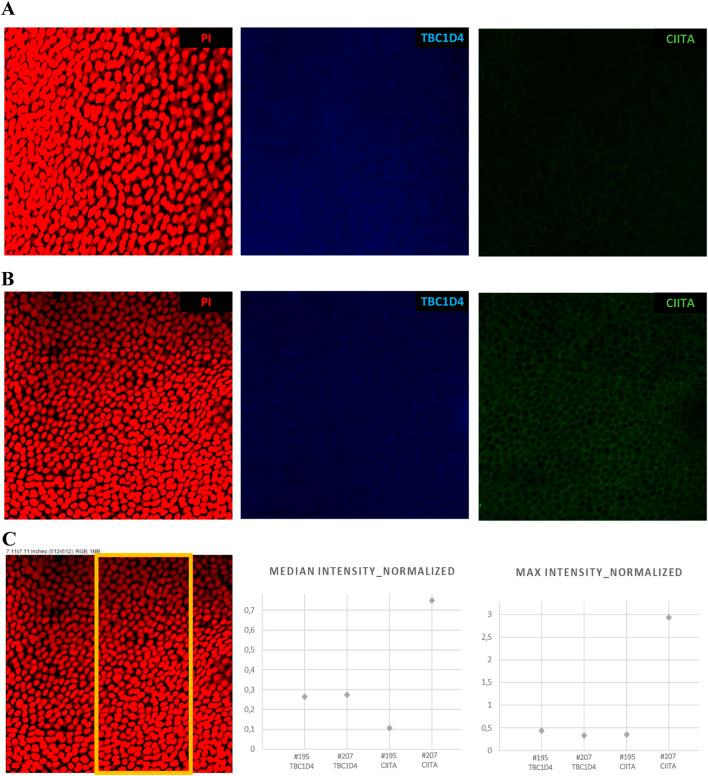
The residual stromal bed, stromal ablation depth, and percent tissue altered indices were found to best predict the risk of post-LVC ectasia. From comparisons of post-LVC ectasia and KTCN, interferon-alpha and interferon-gamma hallmarks were found to be downregulated in the and of the CE of patients with post-LVC ectasia. Downregulation of gene expression was confirmed in all three in the extended CE sample set. Cytoplasmic localizations of the CIITA and TBC1D4 proteins, which are the candidate post-LVC ectasia-specific biomarkers, were demonstrated in the CE samples.
DISCUSSION
The assessment of , and gene expressions could enhance the risk estimation of ectasia in patients. Apart from differences in the transcription and inflammation processes, the CE of patients with post-LVC ectasia exhibits molecular features similar to KTCN.
引言
激光视力矫正术后(post-LVC)角膜扩张是一种严重的并发症,在0.033% - 0.66%的角膜屈光手术中可见。与圆锥角膜(KTCN)类似,post-LVC角膜扩张被归类为“扩张性疾病”。我们推测,尽管post-LVC角膜扩张和KTCN的发病机制不同,但上皮反应存在显著相似性,包括共同的分子特征。
方法
一项回顾性多组学病例对照研究纳入了11例post-LVC角膜扩张患者、8例轻度近视患者(对照组)和28例KTCN患者。从受试者获取的角膜上皮(CE)样本被分为不同组,共159个实验样本进行了转录组(RNA测序)和蛋白质组(基质辅助激光解吸电离飞行时间串联质谱/MS/MS)分析。然后在扩展样本集(n = 21)中使用逆转录定量聚合酶链反应、免疫荧光染色和共聚焦显微镜对结果进行验证。
结果
发现剩余基质床、基质消融深度和组织改变百分比指数最能预测post-LVC角膜扩张的风险。通过对post-LVC角膜扩张和KTCN的比较,发现α干扰素和γ干扰素特征在post-LVC角膜扩张患者的CE的 和 中下调。在扩展的CE样本集中,所有三个 中的 基因表达下调均得到证实。CE样本中证实了CIITA和TBC1D4蛋白的细胞质定位,这两种蛋白是post-LVC角膜扩张特异性候选生物标志物。
讨论
对 、 和 基因表达的评估可以提高患者角膜扩张风险的估计。除了转录和炎症过程的差异外,post-LVC角膜扩张患者的CE表现出与KTCN相似的分子特征。


 Zotero 插件