
头颈部鳞状细胞癌新辅助化疗免疫治疗后的病理退缩模式:一项试点研究。
Pathological regression patterns following neoadjuvant chemo-immunotherapy in head and neck squamous cell carcinoma: a pilot study.
作者信息
Wang Dikan, Zeng Fanning, Zhang Sien, Hu Wanming, Wang Yahui, Ouyang Daiqiao, Zeng Bin, Zeng Guozhong, Li Jingyuan, Liao Guiqing, Liang Yujie
机构信息
Hospital of Stomatology, Guanghua School of Stomatology, Sun Yat-sen University, Guangzhou, Guangdong, China.
Guangdong Provincial Key Laboratory of Stomatology, Sun Yat-sen University, Guangzhou, Guangdong, China.
出版信息
Front Immunol. 2025 Aug 6;16:1627442. doi: 10.3389/fimmu.2025.1627442. eCollection 2025.
INTRODUCTION
Neoadjuvant chemoimmunotherapy (NACI) has drawn considerable attention in Head and neck squamous cell carcinoma (HNSCC) owing to its potential in functional preservation and treatment-failure reduction. Yet whether the surgical extent can be narrowed following NACI is largely debatable due to a potential non-centripetal tumor regression may result in scattered microfoci residing beyond the narrowed margin.
METHODS
In this pilot study, we characterized the tumor regression pattern in a post-NACI HNSCC cohort using a whole-mount histopathological approach. The MRI examinations before and after NACI were used to evaluate the objective response rate (ORR).
RESULTS
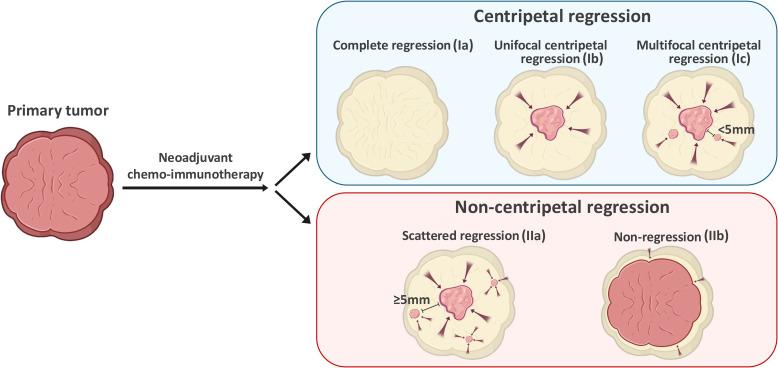
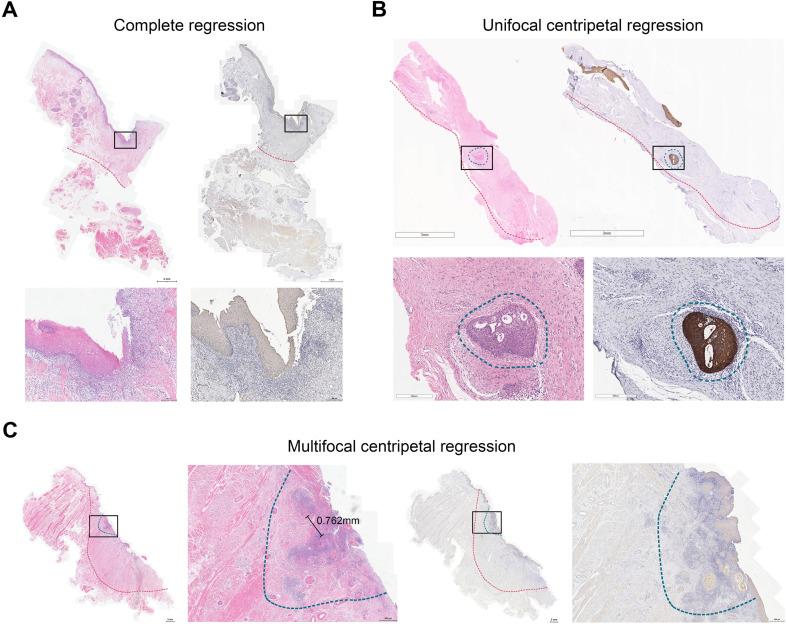
Of the 52 patients enrolled, the ORR was 75%. Pathological complete response (pCR) rate was 15.4%, and the major pathological response (MPR) rate was 40.4%. Two major regression patterns were identified in whole-mount tumor sections, centripetal regression and non-centripetal regression. Centripetal regression was observed in 37 patients (71.2%) and was subcategorized into complete regression (Ia, 15.4%), unifocal centripetal regression (Ib, 36.5%), and multifocal centripetal regression (Ic, 19.2%). Non-centripetal regression was seen in 15 patients (28.8%) and was subcategorized into scattered regression (IIa, 25.0%) and non-regression (IIb, 3.8%). Moreover, we found a pre-NACI CPS higher than 20 or post-NACI (18)F-FDG SUVmax reduction exceeding 50% were potential predictive factors for the centripetal regression pattern.
DISCUSSION
We revealed for that centripetal regression was the predominant pattern of regression after NACI in HNSCC. Hence, our data presumably supports a reduced surgical extent in post-NACI HNSCC patients. Future studies should focus on identifying accurate predictive factors for the regression pattern, which may eventually assist in risk stratification and surgical decision making.
CONCLUSIONS
The pattern of tumor pathological regression after NACI for HNSCC is mainly divided into centripetal and non-centripetal regression, with the former accounting for the major portion of the regression.
引言
新辅助化疗免疫疗法(NACI)在头颈部鳞状细胞癌(HNSCC)中引起了广泛关注,因为它在功能保留和降低治疗失败率方面具有潜力。然而,NACI后手术范围是否可以缩小在很大程度上存在争议,因为潜在的非向心性肿瘤退缩可能导致狭窄切缘以外存在散在的微小病灶。
方法
在这项前瞻性研究中,我们使用全层组织病理学方法对NACI后的HNSCC队列中的肿瘤退缩模式进行了特征分析。NACI前后的MRI检查用于评估客观缓解率(ORR)。
结果
在纳入的52例患者中,ORR为75%。病理完全缓解(pCR)率为15.4%,主要病理缓解(MPR)率为40.4%。在全层肿瘤切片中识别出两种主要的退缩模式,即向心性退缩和非向心性退缩。37例患者(71.2%)观察到向心性退缩,进一步细分为完全退缩(Ia,15.4%)、单灶向心性退缩(Ib,36.5%)和多灶向心性退缩(Ic,19.2%)。15例患者(28.8%)观察到非向心性退缩,进一步细分为散在退缩(IIa,25.0%)和无退缩(IIb,3.8%)。此外,我们发现NACI前CPS高于20或NACI后(18)F-FDG SUVmax降低超过50%是向心性退缩模式的潜在预测因素。
讨论
我们发现向心性退缩是HNSCC患者NACI后主要的退缩模式。因此,我们的数据可能支持缩小NACI后HNSCC患者手术范围。未来的研究应专注于确定退缩模式的准确预测因素,这最终可能有助于风险分层和手术决策。
结论
HNSCC患者NACI后肿瘤病理退缩模式主要分为向心性和非向心性退缩,前者占退缩的主要部分。


 Zotero 插件