
阿拉伯国家大学生中电子烟导致烟草消费:一项关于吸烟相关行为和心理社会因素的研究
Vaping leads tobacco consumption among university students in Arab countries: a study of behavioral and psychosocial factors associated with smoking.
作者信息
Sallam Malik, Alnazly Eman Khamis, Sajwani Adil, Al-Mahzoum Kholoud, Alkhalaf Yousef, Aldaihani Aisha, Aldousari Abdulrahman, Alhajeri Mohammad, Almutairi Meshari, Alnajdi Shekha, Alkhozam Mohammad, Alsubaiei Abdulaziz Muneer, Eisa Naser, Altheyab Sulaiman, Abdelaziz Doaa H, Mansour Noha O, Sallam Mohammed
机构信息
Department of Pathology, Microbiology and Forensic Medicine, School of Medicine, The University of Jordan, Amman, Jordan.
Department of Clinical Laboratories and Forensic Medicine, Jordan University Hospital, Amman, Jordan.
出版信息
Front Public Health. 2025 Aug 6;13:1636757. doi: 10.3389/fpubh.2025.1636757. eCollection 2025.
BACKGROUND
E-cigarettes use "vaping" is a growing public health concern. The Arabic-validated Vaping Attitude and Perceptions Scale (VAPeS) instrument assesses vaping determinants across five constructs: Social Influence, Perceived Harms, Vaping Pleasure, Behavioral Influences, and Economic and Self-Efficacy. We aimed to examine the prevalence of cigarette, e-cigarette, and narghile use among Arab university students and to identify the associations between demographic/VAPeS-related variables and the smoking attitudes among vapers.
METHODS
A cross-sectional survey was distributed online among university students across Arab countries during January-April 2025. Prevalence estimates were calculated using one-sample proportions with Wilson Score confidence intervals. The modified VAPeS scale comprising four constructs after confirmatory factor analysis (Social Influence, Perceived Benefits, Behavioral Influence - Risk, and Behavioral Influence - Situational Triggers) was used to assess tobacco use attitudes. The primary outcome was the Endorsement of Tobacco Use Attitude Score (ETUAS). Multivariate analyses using multinomial logistic and linear regressions were conducted to examine factors associated with tobacco use attitudes.
RESULTS
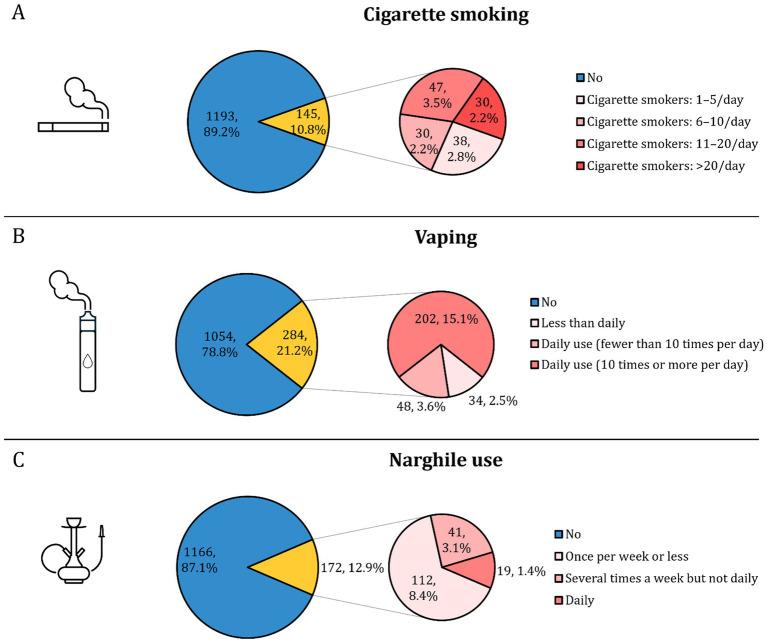
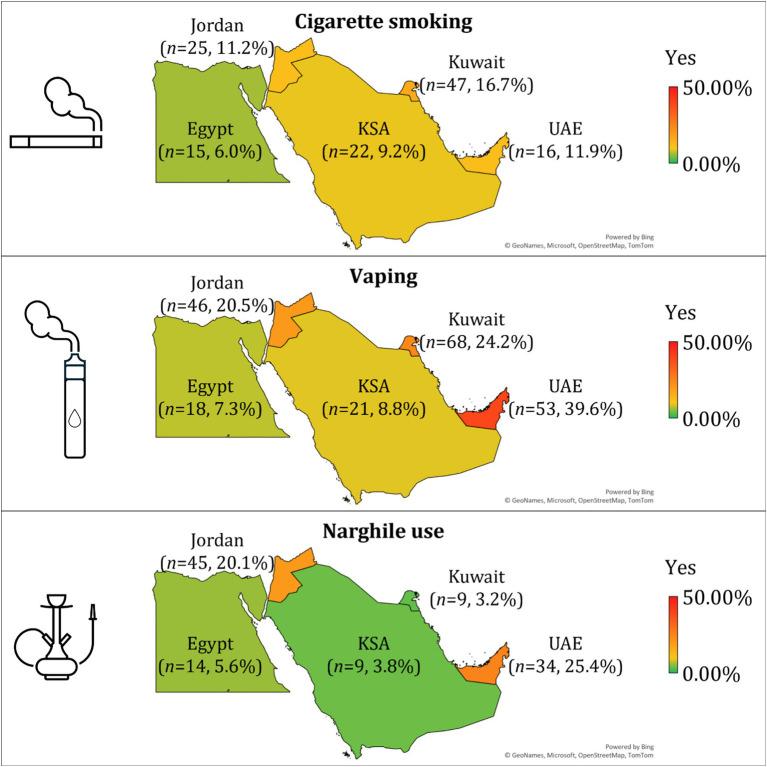
Among 1,338 university students surveyed, the majority were from Kuwait (21.0%), Egypt (18.5%), Kingdom of Saudi Arabia (KSA, 17.8%), Jordan (16.7%), and the United Arab Emirates (UAE, 10.0%). Vaping was the most prevalent form of tobacco use (21.2%), surpassing narghile (12.9%) and cigarette smoking (10.8%). Multivariate analyses revealed that male students were more likely to engage in all three tobacco use forms. Male sex was associated with higher prevalence of vaping (adjusted odds ratio (AOR) = 6.97; < 0.001), with higher odds among UAE students (AOR = 2.31; = 0.013), and lower odds among those studying in Egypt, Jordan, and KSA. Among current smokers, the mean ETUAS indicated a moderate level of agreement with attitudinal statements endorsing tobacco use (3.25 ± 0.92). In linear regression among vapers, male sex ( = -0.325; = 0.003), Social Influence ( = 0.300; < 0.001), and Behavioral Influence - Situational Trigger ( = 0.205; = 0.002) were significantly associated with favorable attitudes toward tobacco use.
CONCLUSION
This multinational study found vaping to be the leading form of tobacco use among Arab university students. Favorable attitudes toward tobacco use were associated with male sex, social influence, and the situational triggers. Interventions should target social normalization, strengthen regulations, and apply tools like VAPeS to understand youth vaping risks.
背景
电子烟的“雾化”使用日益引起公众对健康的关注。经过阿拉伯语验证的雾化态度与认知量表(VAPeS)工具从五个维度评估雾化的决定因素:社会影响、感知危害、雾化愉悦感、行为影响以及经济与自我效能。我们旨在调查阿拉伯大学生中香烟、电子烟和水烟的使用情况,并确定人口统计学/与VAPeS相关的变量与电子烟使用者吸烟态度之间的关联。
方法
2025年1月至4月期间在阿拉伯国家的大学生中进行了一项在线横断面调查。使用带有威尔逊得分置信区间的单样本比例计算患病率估计值。经过验证性因素分析后,由四个维度组成的改良VAPeS量表(社会影响、感知益处、行为影响 - 风险和行为影响 - 情境触发因素)用于评估烟草使用态度。主要结果是烟草使用态度认可得分(ETUAS)。使用多项逻辑回归和线性回归进行多变量分析,以检查与烟草使用态度相关的因素。
结果
在接受调查的1338名大学生中,大多数来自科威特(21.0%)、埃及(18.5%)、沙特阿拉伯王国(KSA,17.8%)、约旦(16.7%)和阿拉伯联合酋长国(UAE,10.0%)。雾化是最普遍的烟草使用形式(21.2%),超过了水烟(12.9%)和吸烟(10.8%)。多变量分析显示,男学生更有可能参与所有三种烟草使用形式。男性与雾化的较高患病率相关(调整后的优势比(AOR) = 6.97;<0.001),在阿联酋学生中优势更高(AOR = 2.31; = 0.013),而在埃及、约旦和沙特阿拉伯学习的学生中优势较低。在当前吸烟者中,平均ETUAS表明对支持烟草使用的态度陈述有中等程度的认同(3.25 ± 0.92)。在电子烟使用者的线性回归中,男性( = -0.325; = 0.003)、社会影响( = 0.300;<0.001)和行为影响 - 情境触发因素( = 0.205; = 0.002)与对烟草使用的积极态度显著相关。
结论
这项多国研究发现,雾化是阿拉伯大学生中最主要的烟草使用形式。对烟草使用的积极态度与男性、社会影响和情境触发因素有关。干预措施应针对社会常态化,加强监管,并应用VAPeS等工具来了解青少年雾化风险。
 Zotero 插件