
埃塞俄比亚一家三级医院收治的重症脓毒症成年患者的弥散性血管内凝血、相关因素及临床结局:一项前瞻性纵向研究
Disseminated intravascular coagulation, associated factors and clinical outcomes among critically Ill septic adults admitted to a tertiary hospital in Ethiopia: A prospective longitudinal study.
作者信息
Kiya Girum Tesfaye, Mekonnen Zeleke, Asefa Elsah Tegene, Milkias Gedion, Tadasa Edosa, Kejela Edosa, Demeke Iyasu, Fiseha Aragaw, Abebe Gemeda
机构信息
School of Medical Laboratory Sciences, Jimma University, Jimma, Ethiopia.
Department of Internal Medicine, Jimma University, Jimma, Ethiopia.
出版信息
PLoS One. 2025 Aug 22;20(8):e0330842. doi: 10.1371/journal.pone.0330842. eCollection 2025.
BACKGROUND
Despite the established link between sepsis and disseminated intravascular coagulation (DIC), data on the prevalence of DIC, associated factors and patient outcomes in sepsis patients are inadequate in resource-limited settings. Therefore, the present study aimed to determine the magnitude of DIC and associated factors and mortality and predictors in septic adults admitted to intensive care units (ICUs).
METHODS
A prospective longitudinal study involving adults admitted to intensive care units was conducted. A structured checklist and questionnaire were used to collect patient demographic and clinical data. Blood samples were collected on days 1, 3, and 5 of admission for all laboratory analyses. A DIC diagnosis was made on the basis of the Japanese Association for Acute Medicine (JAAM) score. Descriptive statistics, multivariable logistic regression analysis, receiver operating characteristic (ROC) curve analysis and Kaplan‒Meier survival analysis were employed in this study.
RESULTS
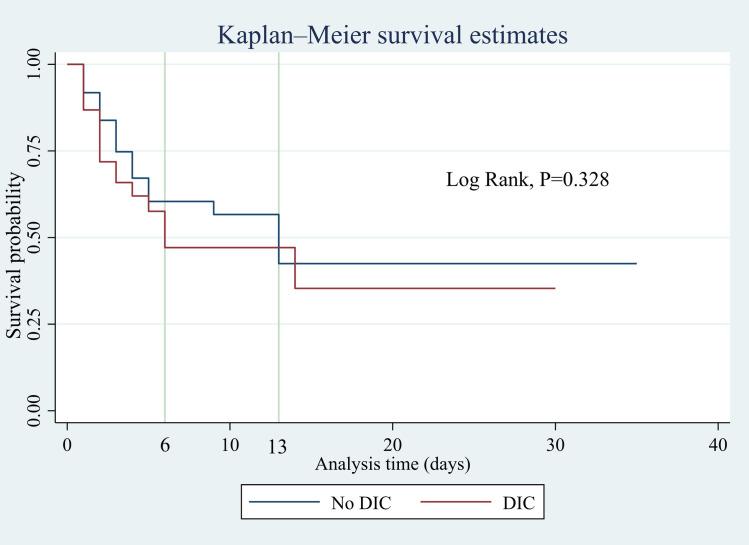
The overall prevalence of DIC in sepsis patients was 38 (25.7%). There were 24 (16.2%) patients who developed DIC on day 1 of admission, while 20 (19.4%) and 9 (12.9%) patients developed DIC on day 3 and day 5 of admission, respectively. Increased aspartate transaminase (AST) (AOR: 4.39; 95% CI: 1.75-11.01), thrombocytopenia (AOR: 6.04; 95% CI: 2.41-15.12), and prolonged prothrombin time (PT) (AOR: 3.40; 95% CI: 1.36-8.51) were independent predictors of DIC in sepsis patients. There was no statistically significant difference in survival between patients with and without DIC (p < 0.328). The JAAM score at ICU admission predicted ICU mortality (AUC: 0.787; 95% CI: 0.624-0.950).
CONCLUSION
A quarter of ICU-admitted septic adults developed DIC. The incidence was notably greater by the third day after admission, highlighting the importance of closely monitoring these patients for DIC progression. Elevated AST liver enzyme levels, thrombocytopenia, and prolonged PT are linked to the development of DIC. Changes in these variables could prompt further examination for DIC. The mortality rate did not significantly differ between septic patients with and without DIC. The JAAM score used to diagnose DIC in sepsis patients can serve as a predictor of ICU mortality in sepsis patients with DIC.
背景
尽管脓毒症与弥散性血管内凝血(DIC)之间的关联已得到证实,但在资源有限的环境中,关于脓毒症患者中DIC的患病率、相关因素及患者预后的数据并不充分。因此,本研究旨在确定入住重症监护病房(ICU)的成年脓毒症患者中DIC的严重程度、相关因素、死亡率及预测因素。
方法
开展一项涉及入住重症监护病房的成年人的前瞻性纵向研究。使用结构化清单和问卷收集患者的人口统计学和临床数据。在入院第1天、第3天和第5天采集血样进行所有实验室分析。根据日本急性医学协会(JAAM)评分进行DIC诊断。本研究采用描述性统计、多变量逻辑回归分析、受试者工作特征(ROC)曲线分析和Kaplan-Meier生存分析。
结果
脓毒症患者中DIC的总体患病率为38例(25.7%)。有24例(16.2%)患者在入院第1天发生DIC,而分别有20例(19.4%)和9例(12.9%)患者在入院第3天和第5天发生DIC。天冬氨酸转氨酶(AST)升高(调整后比值比[AOR]:4.39;95%置信区间[CI]:1.75 - 11.01)、血小板减少(AOR:6.04;95% CI:2.41 - 15.12)和凝血酶原时间(PT)延长(AOR:3.40;95% CI:1.36 - 8.51)是脓毒症患者发生DIC的独立预测因素。发生DIC和未发生DIC的患者之间的生存率无统计学显著差异(p < 0.328)。ICU入院时的JAAM评分可预测ICU死亡率(曲线下面积[AUC]:0.787;95% CI:0.624 - 0.950)。
结论
四分之一入住ICU的成年脓毒症患者发生了DIC。入院后第三天发病率显著更高,这突出了密切监测这些患者DIC进展情况的重要性。AST肝酶水平升高、血小板减少和PT延长与DIC的发生有关。这些变量的变化可能促使对DIC进行进一步检查。发生DIC和未发生DIC的脓毒症患者之间的死亡率无显著差异。用于诊断脓毒症患者DIC的JAAM评分可作为发生DIC的脓毒症患者ICU死亡率的预测指标。


 Zotero 插件