
谵妄作为右美托咪定在急性脑损伤管理中生存获益的中介因素。
Delirium as a mediating factor in the survival benefits of dexmedetomidine in acute brain injury management.
作者信息
Wang Juan, Sun Jia-Qing, Lu Yue, Yang Qi-Lin, Zhao Peng-Lai, Hang Chun-Hua, Li Wei
机构信息
Department of Neurosurgery, Nanjing Drum Tower Hospital Clinical College of Nanjing University of Chinese Medicine, Nanjing, China.
Neurosurgical Institute, Nanjing University, Nanjing, China.
出版信息
Sci Rep. 2025 Aug 22;15(1):30937. doi: 10.1038/s41598-025-14180-z.
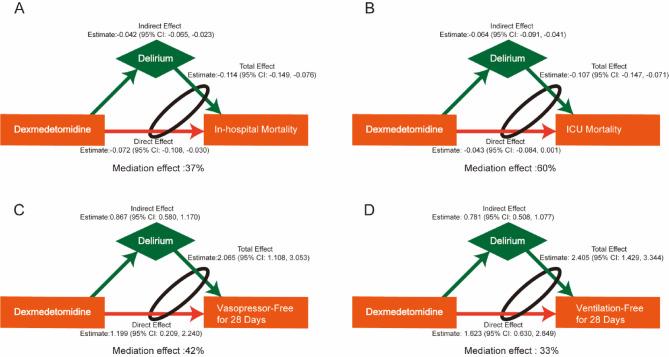
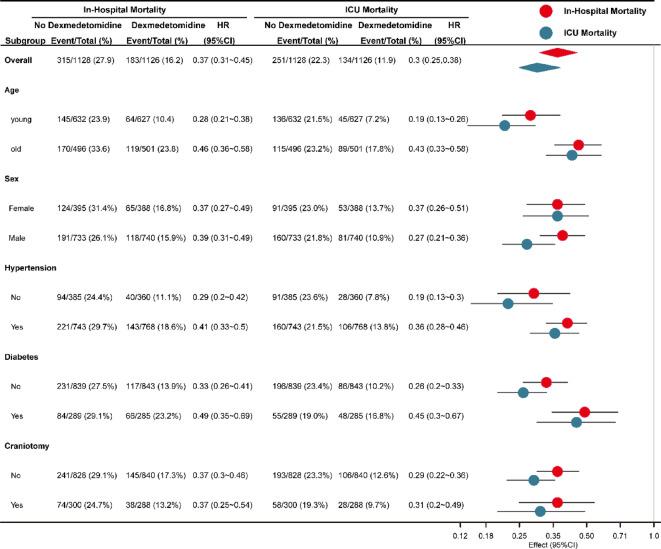
Acute brain injury (ABI) is a leading cause of ICU admission and mortality. Effective sedation is essential for preventing secondary brain injury, and dexmedetomidine has emerged as a potential neuroprotective agent. We conducted a retrospective analysis using the MIMIC-IV v3.1 database, including adult patients admitted to the ICU with ABI. Patients were divided into two groups based on whether they received dexmedetomidine. Propensity score matching (PSM), weighting methods, and doubly robust estimation were used to adjust for confounding factors. Results from the doubly robust analysis showed that dexmedetomidine use was significantly associated with reduced in-hospital mortality (HR: 0.41, 95% CI: 0.35-0.48, p < 0.001) and ICU mortality (HR: 0.34, 95% CI: 0.28-0.41, p < 0.001). Additionally, dexmedetomidine was associated with significantly increased vasopressor-free days (MD: 2.64, 95% CI: 1.98-3.30, p < 0.001) and ventilation-free days (MD: 2.23, 95% CI: 1.59-2.86, p < 0.001). Further mediation analysis indicated that delirium mediated 37% of the effect of dexmedetomidine on in-hospital mortality and 60% of its effect on ICU mortality. This suggests that delirium may be a key mediator of dexmedetomidine's beneficial effects, consistent with its potential advantages in sedation and neuroprotection observed in previous studies. In conclusion, dexmedetomidine use in ICU patients with ABI is associated with significantly lower mortality and improved clinical outcomes, with delirium acting as a critical mediator.
急性脑损伤(ABI)是重症监护病房(ICU)收治和死亡的主要原因。有效的镇静对于预防继发性脑损伤至关重要,右美托咪定已成为一种潜在的神经保护剂。我们使用MIMIC-IV v3.1数据库进行了一项回顾性分析,纳入了因ABI入住ICU的成年患者。根据患者是否接受右美托咪定将其分为两组。采用倾向评分匹配(PSM)、加权方法和双重稳健估计来调整混杂因素。双重稳健分析结果显示,使用右美托咪定与降低住院死亡率(风险比:0.41,95%置信区间:0.35-0.48,p<0.001)和ICU死亡率(风险比:0.34,95%置信区间:0.28-0.41,p<0.001)显著相关。此外,右美托咪定与无血管活性药物使用天数显著增加(平均差:2.64,95%置信区间:1.98-3.30,p<0.001)和无机械通气天数显著增加(平均差:2.23,95%置信区间:1.59-2.86,p<0.001)相关。进一步的中介分析表明,谵妄介导了右美托咪定对住院死亡率影响的37%及其对ICU死亡率影响的60%。这表明谵妄可能是右美托咪定有益作用的关键中介因素,这与先前研究中观察到的其在镇静和神经保护方面的潜在优势一致。总之,在ABI的ICU患者中使用右美托咪定与显著降低死亡率和改善临床结局相关,谵妄起关键中介作用。

 Zotero 插件