
前蛋白转化酶枯草溶菌素9(PCSK-9)抑制剂在急性冠状动脉综合征患者中的疗效与安全性:一项系统评价和网状Meta分析
Efficacy and safety of PCSK-9 inhibitors in patients with acute coronary syndrome: a systematic review and network meta-analysis.
作者信息
Kao Guoying, Chen Chuan, Zhang Ying, Xu Yi, Xu Gang
机构信息
Department of Cardiovascular Medicine, Chongqing Emergency Medical Center, Chongqing University Central Hospital, No.1 Health Road, Yuzhong District, Chongqing, 400010, China.
出版信息
BMC Cardiovasc Disord. 2025 Aug 23;25(1):629. doi: 10.1186/s12872-025-05070-3.
BACKGROUND
Acute coronary syndrome (ACS) remains a leading cause of global cardiovascular morbidity and mortality, with elevated low-density lipoprotein cholesterol (LDL-C) being a key modifiable risk factor. Despite statin therapy, many patients fail to achieve optimal LDL-C targets, highlighting the need for adjunctive treatments such as PCSK9 inhibitors (e.g., Evolocumab and Alirocumab). However, comparative evidence on their efficacy and safety in ACS patients remains limited.
OBJECTIVE
To systematically evaluate the efficacy and safety of PCSK9 inhibitors (Evolocumab and Alirocumab) in patients with ACS, focusing on LDL-C reduction and major adverse cardiovascular events (MACE).
METHODS
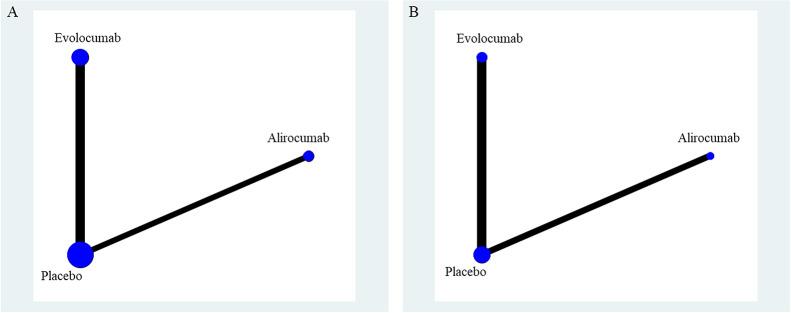
A comprehensive search was conducted in PubMed, Embase, Cochrane Library, ClinicalTrials.gov, and the WHO International Clinical Trials Registry. Eligible randomized controlled trials (RCTs) assessed PCSK9 inhibitors in ACS patients and reported outcomes on LDL-C and MACE. Both direct and network meta-analyses were performed to compare effect sizes across interventions. No direct head-to-head trials between Evolocumab and Alirocumab were identified.
RESULTS
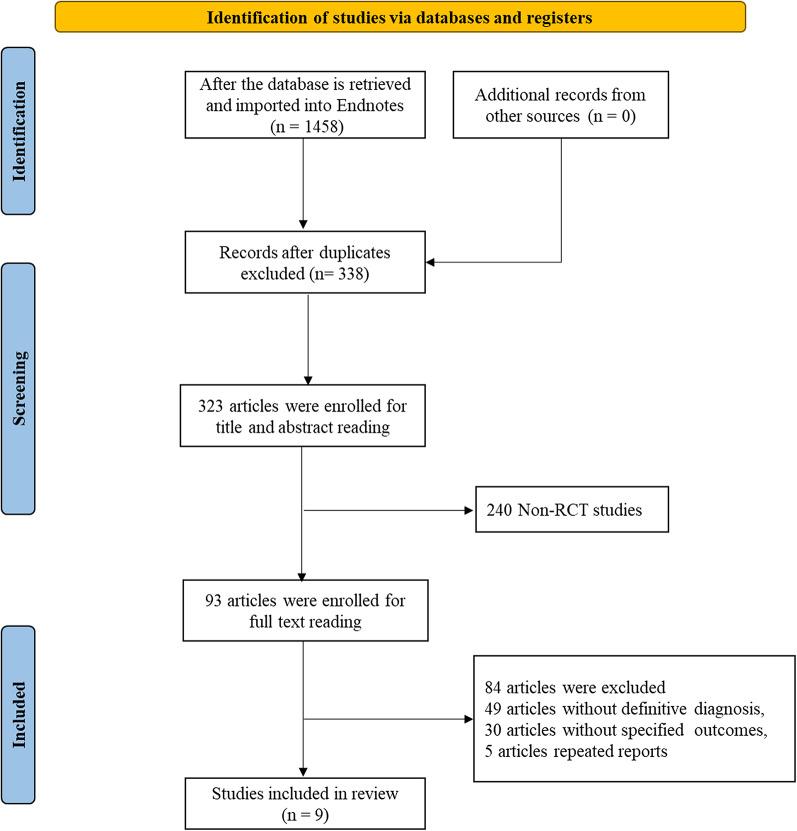
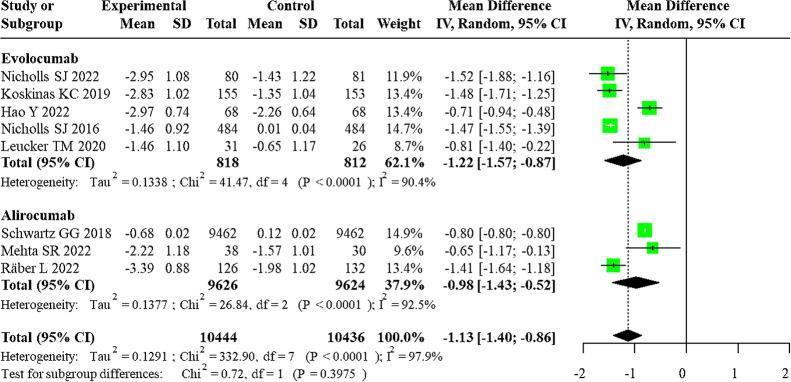
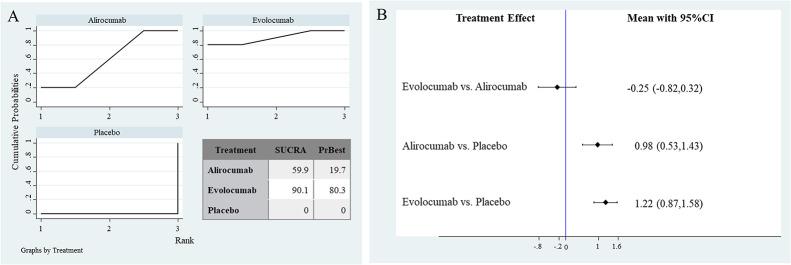
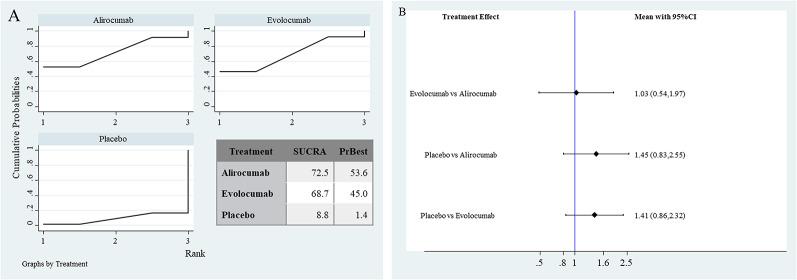
Nine RCTs involving 37,934 patients were included. Direct meta-analysis showed that PCSK9 inhibitors significantly reduced LDL-C (mean difference [MD]: - 52.7 mg/dL; 95% CI: - 61.2 to - 44.1) and lowered the risk of MACE (odds ratio [OR]: 0.79; 95% CI: 0.68-0.93). In subgroup analysis, Evolocumab produced greater LDL-C reductions, while Alirocumab showed a stronger trend toward MACE reduction, though not statistically significant (OR: 0.84; 95% CI: 0.68-1.03). Network meta-analysis confirmed these patterns but revealed no statistically significant differences between the two agents.
CONCLUSION
PCSK9 inhibitors significantly improve lipid profiles and reduce cardiovascular event risk in ACS patients. While Evolocumab and Alirocumab offer similar overall benefits, their differential effects on LDL-C and MACE warrant further investigation. These findings support the role of PCSK9 inhibitors in secondary prevention strategies for high-risk cardiovascular populations.
背景
急性冠状动脉综合征(ACS)仍然是全球心血管疾病发病和死亡的主要原因,低密度脂蛋白胆固醇(LDL-C)升高是一个关键的可改变风险因素。尽管使用了他汀类药物治疗,但许多患者未能达到最佳的LDL-C目标,这凸显了对诸如前蛋白转化酶枯草溶菌素9(PCSK9)抑制剂(如依洛尤单抗和阿利西尤单抗)等辅助治疗的需求。然而,关于它们在ACS患者中的疗效和安全性的比较证据仍然有限。
目的
系统评价PCSK9抑制剂(依洛尤单抗和阿利西尤单抗)在ACS患者中的疗效和安全性,重点关注LDL-C降低和主要不良心血管事件(MACE)。
方法
在PubMed、Embase、Cochrane图书馆、ClinicalTrials.gov和世界卫生组织国际临床试验注册库中进行了全面检索。符合条件的随机对照试验(RCT)评估了PCSK9抑制剂在ACS患者中的应用,并报告了LDL-C和MACE的结果。进行了直接和网状荟萃分析以比较各干预措施的效应大小。未发现依洛尤单抗和阿利西尤单抗之间的直接头对头试验。
结果
纳入了9项涉及37934例患者的RCT。直接荟萃分析表明,PCSK9抑制剂显著降低了LDL-C(平均差值[MD]:-52.7mg/dL;95%置信区间[CI]:-61.2至-44.1),并降低了MACE风险(比值比[OR]:0.79;95%CI:0.68-0.93)。在亚组分析中,依洛尤单抗使LDL-C降低幅度更大,而阿利西尤单抗显示出更强的降低MACE的趋势,尽管无统计学意义(OR:0.84;95%CI:0.68-1.03)。网状荟萃分析证实了这些模式,但显示两种药物之间无统计学显著差异。
结论
PCSK9抑制剂显著改善ACS患者的血脂水平并降低心血管事件风险。虽然依洛尤单抗和阿利西尤单抗总体益处相似,但它们对LDL-C和MACE的不同影响值得进一步研究。这些发现支持了PCSK9抑制剂在高危心血管人群二级预防策略中的作用。


 Zotero 插件