
脑网络微观结构变化对中风后上肢镜像运动的影响。
The impact of brain network microstructural changes on upper limb mirror movements after stroke.
作者信息
Dai Jie, Li Zhaoqing, Tao Jingyan, Sun Shuping, Li Jianhua
机构信息
Department of Rehabilitation Medicine, Sir Run Run Shaw Hospital, Zhejiang University School of Medicine, Hangzhou, China.
出版信息
Front Neurol. 2025 Aug 6;16:1643870. doi: 10.3389/fneur.2025.1643870. eCollection 2025.
OBJECTIVE
This study aimed to investigate the relationship between brain network microstructural changes and surface electromyographic (sEMG) signs of upper limb mirror movements (MMs) in stroke patients, focusing on the corpus callosum and bilateral corticospinal tracts (CSTs).
METHOD
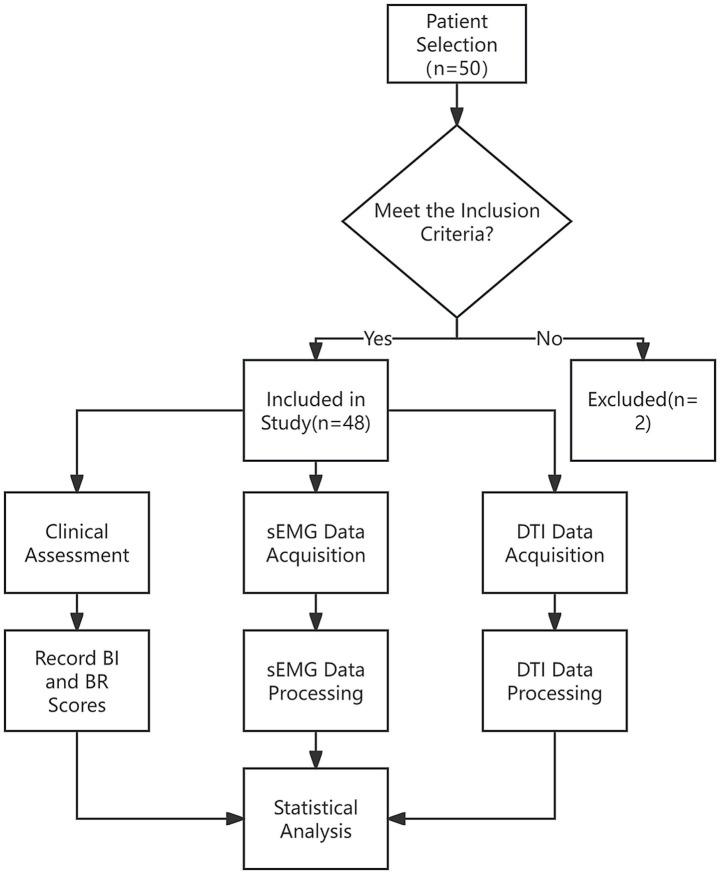
A retrospective analysis was conducted on 48 stroke patients (mean age 60.63y, range 15-83y) who underwent sEMG and diffusion tensor imaging (DTI). All the stroke patients were in the subacute to chronic phase. sEMG parameters, including overflow percentage (OF) and standardized net excitation (SNE), were measured during unilateral maximum contraction tasks. DTI metrics, such as fractional anisotropy (FA), mean diffusivity (MD), axial diffusivity (AD), and radial diffusivity (RD), were analyzed in the corpus callosum and bilateral CSTs. All DTI metrics were processed and computed using FSL (FSL, version 5.0.5). Correlation analyses were performed between sEMG parameters, DTI metrics, and clinical data.
RESULTS
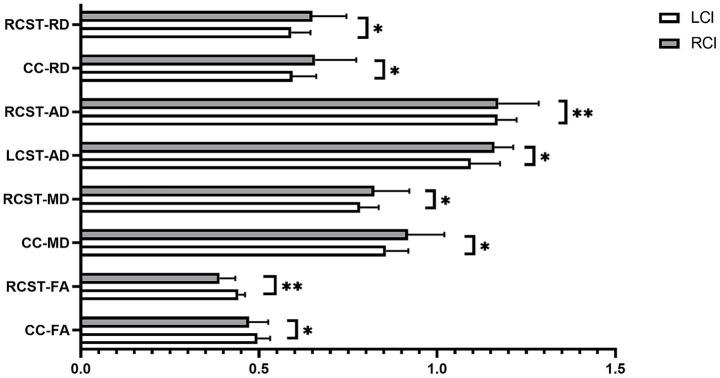
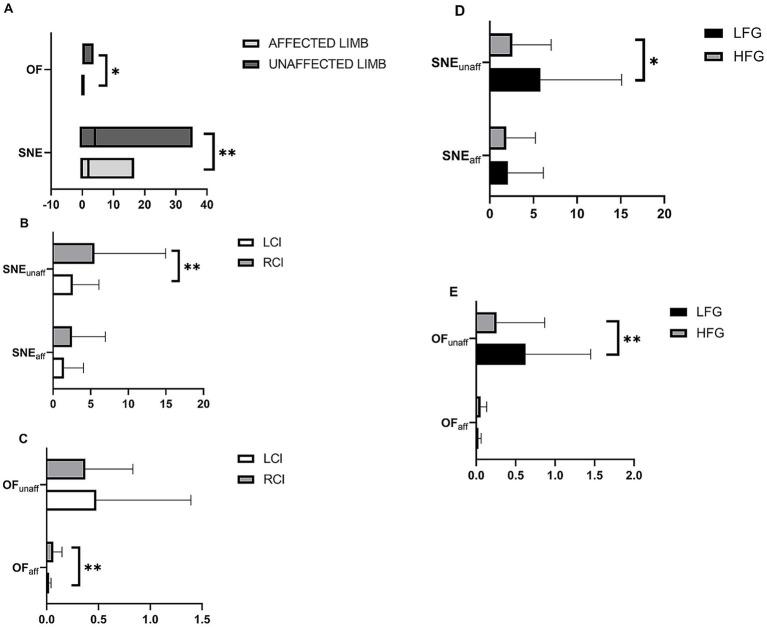
There was a significant asymmetry in motor overflow between affected and unaffected limbs, with higher OF and SNE in the unaffected limb during affected limb movement. The RCI (right-sided cerebral infarction) group showed more pronounced MMs compared to the LCI (left-sided cerebral infarction) group. The DTI metrics were closely related to age and disease duration. In the LCI group, a negative correlation was found between FA values of the corpus callosum and MMs, and between FA of the CST and MMs in the affected limb.
CONCLUSION
The study demonstrated that sEMG manifestations of MMs could reflect the motor function of the affected upper limb in stroke patients. Microstructural changes to the corpus callosum and CSTs might be one of the causes of the post-stroke MMs.
目的
本研究旨在探讨中风患者脑网络微观结构变化与上肢镜像运动(MMs)的表面肌电图(sEMG)征象之间的关系,重点关注胼胝体和双侧皮质脊髓束(CSTs)。
方法
对48例接受sEMG和扩散张量成像(DTI)的中风患者(平均年龄60.63岁,范围15 - 83岁)进行回顾性分析。所有中风患者均处于亚急性期至慢性期。在单侧最大收缩任务期间测量sEMG参数,包括溢出百分比(OF)和标准化净兴奋(SNE)。在胼胝体和双侧CSTs中分析DTI指标,如分数各向异性(FA)、平均扩散率(MD)、轴向扩散率(AD)和径向扩散率(RD)。所有DTI指标均使用FSL(FSL,版本5.0.5)进行处理和计算。对sEMG参数、DTI指标和临床数据进行相关性分析。
结果
患侧和健侧肢体的运动溢出存在显著不对称,患侧肢体运动时健侧肢体的OF和SNE更高。右侧脑梗死(RCI)组的MMs比左侧脑梗死(LCI)组更明显。DTI指标与年龄和病程密切相关。在LCI组中,胼胝体的FA值与MMs之间以及患侧肢体CST的FA与MMs之间存在负相关。
结论
该研究表明,MMs的sEMG表现可反映中风患者患侧上肢的运动功能。胼胝体和CSTs的微观结构变化可能是中风后MMs的原因之一。
 Zotero 插件