
重新审视信任与信息参与,并剖析情感在中国公共卫生危机早期公众反应中的作用:基于网络的调查研究
Reconsidering Trust and Information Engagement and Unpacking the Role of Emotion in Public Responses During the Early Stage of a Public Health Crisis in China: Web-Based Survey Study.
作者信息
Liu Zhiming, Tu Jiawei, Lee Tien-Tsung, Wei Lu
机构信息
Department of Communication, Faculty of Social Sciences, University of Macau, Taipa, Macau, China.
Communication University of Zhejiang, Hangzhou, China.
出版信息
Online J Public Health Inform. 2025 Aug 25;17:e77790. doi: 10.2196/77790.
BACKGROUND
The COVID-19 pandemic continues to offer valuable insights into crisis management and risk communication, particularly through retrospective analyses that allow a more comprehensive understanding. Emotional responses played a crucial role in shaping how individuals processed information and built trust in different objects in the early stages of the COVID-19 pandemic.
OBJECTIVE
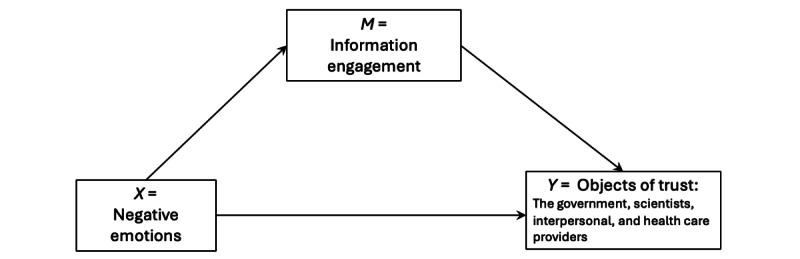
This study aimed to investigate how negative emotions influence online information engagement and trust in 4 distinct entities: government, scientists, health care providers, and other people (relatives, friends, family, and strangers).
METHODS
A nationwide survey was conducted in China from January 31 to February 9, 2020, involving 1568 adult participants. The data collection was particularly valuable due to the limited access to national samples in China during the early stages of the public health crisis. Participants were asked questions related to negative emotions, engagement with online information, and their trust in 4 different entities (government, scientists, other people, and health care providers) during the pandemic. Mediation analyses were performed to test the associations between the examined variables. A 95% bootstrap CI approach was used to estimate the mediation effects.
RESULTS
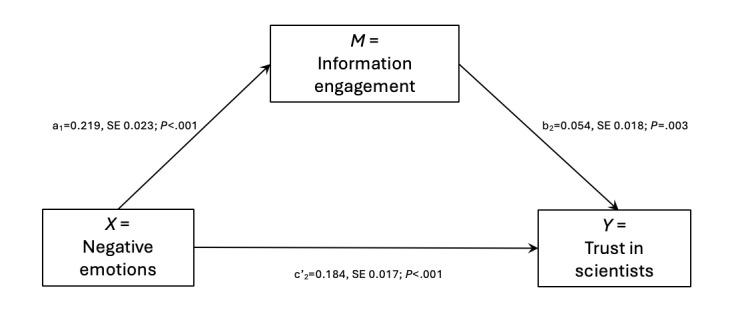
This study reveals that negative emotions not only had a direct effect on trust but also indirectly fostered trust in the government and scientists through increased information engagement. There was a positive association (B=0.219, SE 0.023; P<.001) between negative emotions and information engagement. In addition, individuals experiencing more negative emotions tended to trust more in the government (B=0.191, SE 0.022; P<.001) and scientists (B=0.184, SE 0.017; P<.001). However, this effect did not extend to trust in health care providers or interpersonal trust.
CONCLUSIONS
The research findings reveal that while negative emotions directly and indirectly enhanced trust in the government and scientists through increased information engagement, they did not significantly impact trust in health care providers or interpersonal relationships in the Chinese context. These findings highlight the different pathways through which emotions and information behaviors affect trust during public health crises, offering critical lessons for future public health emergencies and risk communication.
背景
新冠疫情持续为危机管理和风险沟通提供宝贵见解,特别是通过回顾性分析能实现更全面的理解。在新冠疫情早期,情绪反应在塑造个体如何处理信息以及对不同对象建立信任方面发挥了关键作用。
目的
本研究旨在调查负面情绪如何影响对4个不同实体的在线信息参与度和信任,这4个实体分别是政府、科学家、医疗保健提供者以及其他人(亲属、朋友、家人和陌生人)。
方法
2020年1月31日至2月9日在中国进行了一项全国性调查,涉及1568名成年参与者。在公共卫生危机早期,中国获取全国性样本的机会有限,因此此次数据收集尤为珍贵。参与者被问及与负面情绪、在线信息参与度以及在疫情期间对4个不同实体(政府、科学家、其他人以及医疗保健提供者)的信任相关的问题。进行中介分析以检验所研究变量之间的关联。采用95%自抽样置信区间方法估计中介效应。
结果
本研究表明,负面情绪不仅对信任有直接影响,还通过增加信息参与度间接促进了对政府和科学家的信任。负面情绪与信息参与度之间存在正相关(B = 0.219,标准误0.023;P <.001)。此外,经历更多负面情绪的个体往往对政府(B = 0.191,标准误0.022;P <.001)和科学家(B = 0.184,标准误0.017;P <.001)的信任度更高。然而,这种影响并未扩展到对医疗保健提供者的信任或人际信任。
结论
研究结果表明,虽然负面情绪通过增加信息参与度直接和间接地增强了对政府和科学家的信任,但在中国背景下,它们对医疗保健提供者的信任或人际关系没有显著影响。这些发现凸显了在公共卫生危机期间情绪和信息行为影响信任的不同途径,为未来的公共卫生突发事件和风险沟通提供了重要经验教训。

 Zotero 插件