
利用智能手机移动数据了解南非农村青年成人中的艾滋病毒风险:可行性研究
Leveraging Smartphone Mobility Data to Understand HIV Risk Among Rural South African Young Adults: Feasibility Study.
作者信息
Mathenjwa Thulile, Okango Elphas Luchemo, Tram Khai Hoan, Inghels Maxime, Cuadros Diego, Kim Hae-Young, Walsh Fiona, Barnighausen Till, Dobra Adrian, Tanser Frank
机构信息
Africa Health Research Institute, Krith Building, Third Floor, 719 Umbilo Rd, Durban, 4001, South Africa, 27 315210455.
Faculty of Health Sciences, School of Public Health, Division of Epidemiology & Biostatistics, University of Cape Town, Cape Town, South Africa.
出版信息
JMIR Mhealth Uhealth. 2025 Aug 25;13:e67519. doi: 10.2196/67519.
BACKGROUND
Smartphones provide a precise method to study human mobility at an unprecedented scale, allowing researchers to explore the links between mobility, HIV risk, and treatment outcomes. However, leveraging smartphone technology to study HIV risk in rural settings presents unique challenges and opportunities.
OBJECTIVE
This study assessed the feasibility of using smartphone GPS technology to collect mobility data from young adults in rural KwaZulu Natal, South Africa. We also present key lessons learned during the study.
METHODS
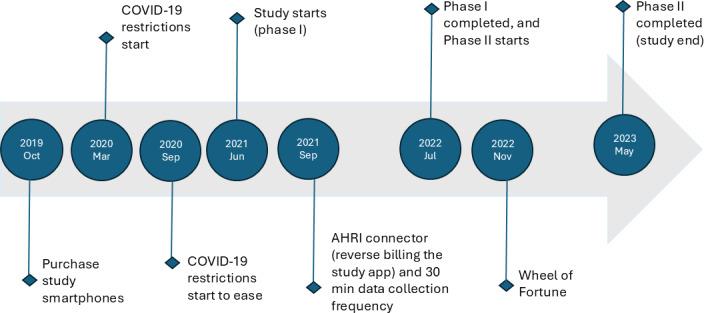
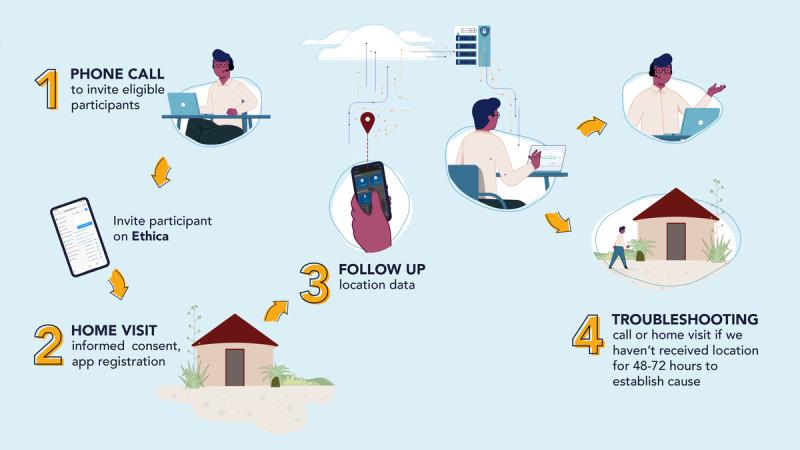
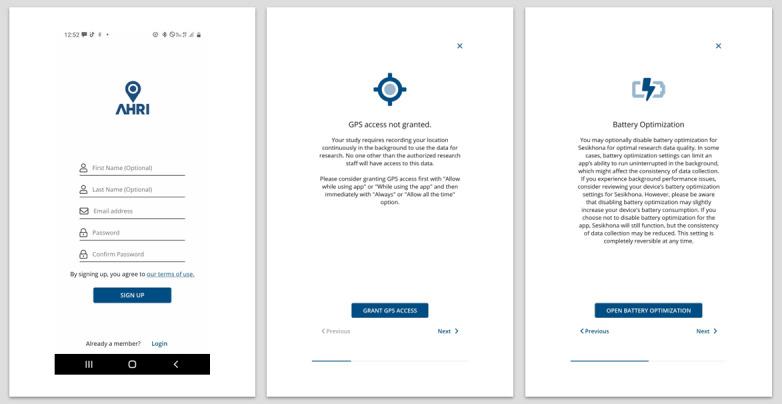
The study was conducted in 2 phases (June 2021-May 2023) with males and females aged 20-30 years old. In phase I, participants received smartphones with a customized study app (Avicenna research software). In phase II, they used their personal smartphones and installed the study app. The app used Android location services to record the smartphone location every 30 minutes and send it to a secure study server hourly. Participants were followed up for 6 months (26 wk). If location data were missing for 48-72 hours, participants were contacted for troubleshooting. Engagement strategies, including reverse billing and gamification (Wheel of Fortune), were implemented to address internet connection barriers and aid data collection.
RESULTS
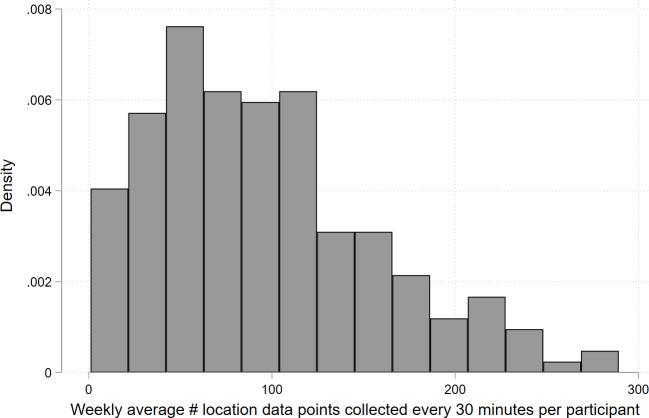
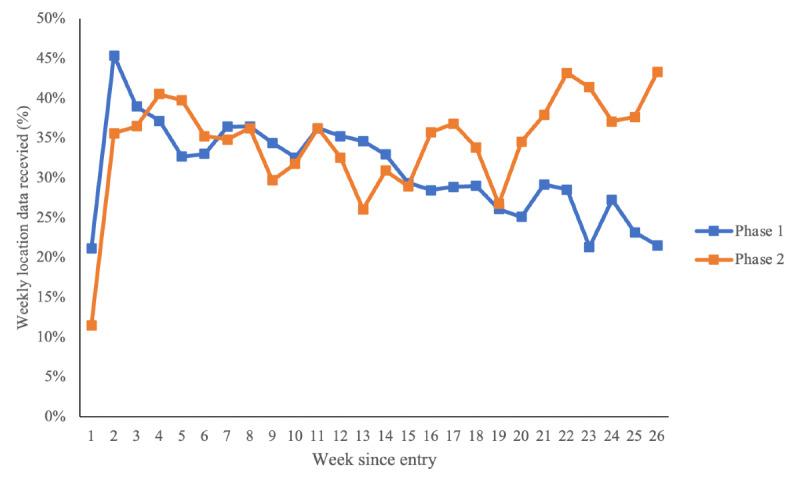
A total of 207 participants were enrolled (phase I: 163; phase II: 44) with 204 providing mobility data. Participants recorded 27.6 million location points with a median number of 74,865 (IQR 28,471-186,578) per participant. The mean weekly location points recorded was 95.3 out of 336 possible half-hour intervals (28.4%). Phase II saw more stable data collection in the latter half of the study, due to increased user engagement with the app. Challenges included phone-related issues (screen malfunctions, lost and broken phone), app terminations, and limited internet connectivity. Reverse billing and gamification strategies improved location data collection through increased user engagement.
CONCLUSIONS
This study demonstrates that the use of smartphone-based GPS technology is feasible among young adults in a rural South African setting. Although only 28.4% (95.3/336) of expected weekly location data were collected, the study offers insights into engagement strategies that can be used to enhance location data collection in similar contexts. Continuous troubleshooting identified challenges and informed solutions to data collection gaps. Reverse billing system and gamification resulted in significant increases in location data received. These findings underscore the potential of integrating mobile health tools into health systems to better support high-risk mobile populations.
背景
智能手机提供了一种前所未有的精确方法来研究人类移动性,使研究人员能够探索移动性、艾滋病毒风险和治疗结果之间的联系。然而,利用智能手机技术在农村地区研究艾滋病毒风险既带来了独特的挑战,也带来了机遇。
目的
本研究评估了使用智能手机全球定位系统(GPS)技术从南非夸祖鲁-纳塔尔省农村地区的年轻人中收集移动性数据的可行性。我们还介绍了研究过程中吸取的关键经验教训。
方法
该研究分两个阶段进行(2021年6月至2023年5月),研究对象为年龄在20至30岁之间的男性和女性。在第一阶段,参与者收到配备定制研究应用程序(阿维森纳研究软件)的智能手机。在第二阶段,他们使用自己的个人智能手机并安装研究应用程序。该应用程序利用安卓定位服务每30分钟记录一次智能手机位置,并每小时将其发送到一个安全的研究服务器。对参与者进行了6个月(26周)的随访。如果位置数据缺失48至72小时,就会联系参与者进行故障排除。实施了包括反向计费和游戏化(幸运大转盘)在内的参与策略,以解决互联网连接障碍并协助数据收集。
结果
总共招募了207名参与者(第一阶段:163名;第二阶段:44名),其中204名提供了移动性数据。参与者记录了2760万个位置点,每位参与者的中位数为7,4865个(四分位间距28,471 - 186,578个)。记录的平均每周位置点在336个可能的半小时间隔中为95.3个(28.4%)。由于用户对应用程序的参与度提高,第二阶段在研究的后半段数据收集更为稳定。挑战包括与手机相关的问题(屏幕故障、手机丢失和损坏)、应用程序终止以及互联网连接有限。反向计费和游戏化策略通过提高用户参与度改善了位置数据收集。
结论
本研究表明,在南非农村地区的年轻人中使用基于智能手机的GPS技术是可行的。尽管仅收集了预期每周位置数据的28.4%(95.3/336),但该研究为可用于在类似环境中加强位置数据收集的参与策略提供了见解。持续的故障排除发现了挑战并为数据收集差距提供了解决方案。反向计费系统和游戏化导致收到的位置数据显著增加。这些发现强调了将移动健康工具整合到卫生系统中以更好地支持高风险流动人群的潜力。

 Zotero 插件