
探究幽门螺杆菌与肠道艰难梭菌感染之间的关系:一项横断面研究的证据
Investigating the relationship between Helicobacter pylori and intestinal Clostridioides difficile infection: evidence from a cross-sectional study.
作者信息
Yin Linlin, Tu Hongfei, Zhu Yue, Qian Jingjing, Yang Yang, Wei Chen, Ding Chengliang, Zhang Bin
机构信息
Department of Digestive Diseases, The Second Hospital of Nanjing, Affiliated to Nanjing University of Chinese Medicine, Nanjing, Jiangsu, 210000, China.
出版信息
BMC Gastroenterol. 2025 Aug 25;25(1):616. doi: 10.1186/s12876-025-04227-w.
BACKGROUND
Helicobacter pylori (H. pylori) infection in the stomach can lead to alterations in the gut microbiota. However, the association between H. pylori infection and Clostridioides difficile infection (CDI) remains unclear.
METHODS
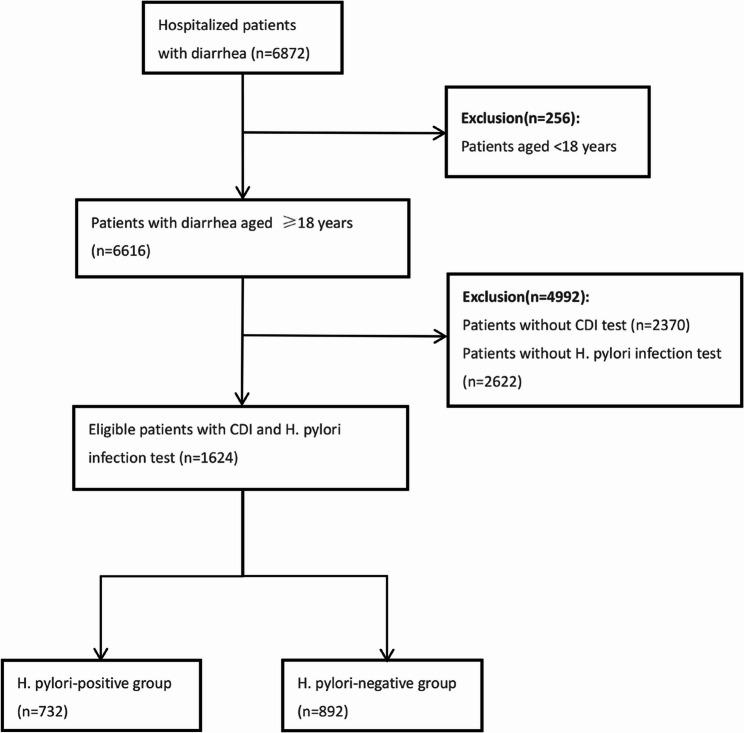
We conducted a retrospective cross-sectional study to evaluate the association between H. pylori infection and CDI. We included patients hospitalized for diarrhea at our center between 2019 and 2024 who underwent both H. pylori and CDI testing during their hospital stay. H. pylori infection was diagnosed using either the carbon-13 urea breath test or the rapid urease test. CDI was diagnosed using a two-step testing algorithm. Patients were categorized into H. pylori-positive and -negative groups. We compared the prevalence of CDI between groups and assessed the association using logistic regression. To adjust for potential confounders, propensity score matching (PSM) was performed, followed by further analysis.
RESULTS
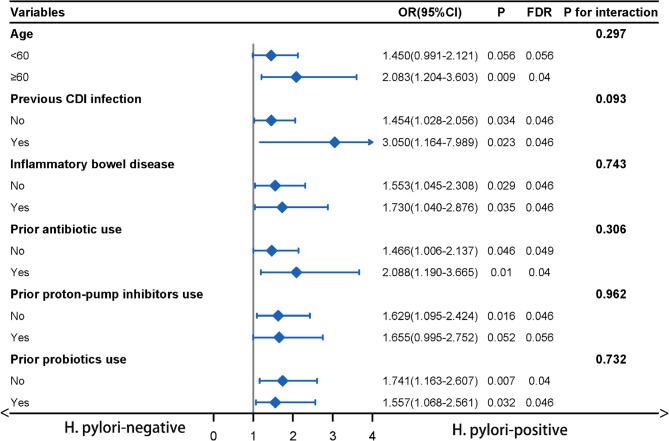
We included 1,624 patients: 732 H. pylori-positive and 892 H. pylori-negative. The prevalence of CDI was significantly higher in the H. pylori-positive group (13.7%, 95% CI: 11.2%-16.2%) compared to the H. pylori-negative group (9.0%, 95% CI: 7.1%-10.8%) ( = 0.003). Univariate logistic regression showed that H. pylori infection was associated with CDI (OR: 1.606, 95% CI: 1.176–2.194; = 0.003). Multivariate analysis also suggested that H. pylori infection was independently associated with CDI (OR: 1.817, 95% CI: 1.320–2.501; < 0.001). This association remained significant after PSM.
CONCLUSIONS
Our findings suggest that current H. pylori infection may be associated with Clostridioides difficile infection.
SUPPLEMENTARY INFORMATION
The online version contains supplementary material available at 10.1186/s12876-025-04227-w.
背景
胃内幽门螺杆菌(H. pylori)感染可导致肠道微生物群改变。然而,幽门螺杆菌感染与艰难梭菌感染(CDI)之间的关联仍不清楚。
方法
我们进行了一项回顾性横断面研究,以评估幽门螺杆菌感染与CDI之间的关联。纳入了2019年至2024年期间在我们中心因腹泻住院且住院期间同时接受幽门螺杆菌和CDI检测的患者。幽门螺杆菌感染采用碳-13尿素呼气试验或快速尿素酶试验进行诊断。CDI采用两步检测算法进行诊断。患者被分为幽门螺杆菌阳性组和阴性组。我们比较了两组之间CDI的患病率,并使用逻辑回归评估关联。为了调整潜在的混杂因素,进行了倾向评分匹配(PSM),然后进行进一步分析。
结果
我们纳入了1624例患者:732例幽门螺杆菌阳性,892例幽门螺杆菌阴性。幽门螺杆菌阳性组的CDI患病率(分别为13.7%,95% CI:11.2%-16.2%)显著高于幽门螺杆菌阴性组(9.0%,95% CI:7.1%-10.8%)(P = 0.003)。单因素逻辑回归显示,幽门螺杆菌感染与CDI相关(OR:1.

 Zotero 插件