
他拉唑帕尼和放疗可增强维奈克拉对治疗诱导的衰老三阴性乳腺癌细胞的促衰老清除功效。
Talazoparib and radiation enhance the senolytic efficacy of venetoclax in therapy-induced senescent triple-negative breast cancer cells.
作者信息
Almudimeegh Sultan, Almutairi Mashal M, Softah Abrar, Alhazzani Khalid, Binobaid Lama, Alshammari Musaad, Sobeai Homood M As, Saleh Tareq, Alotaibi Moureq R, Alhoshani Ali
机构信息
Department of Pharmacology and Toxicology, College of Pharmacy, King Saud University, Riyadh, 11451, Kingdom of Saudi Arabia.
Department of Pharmacology, College of Pharmacy, Umm Alqura University, Makkah, Saudi Arabia.
出版信息
Saudi Pharm J. 2025 Aug 26;33(5):31. doi: 10.1007/s44446-025-00034-2.
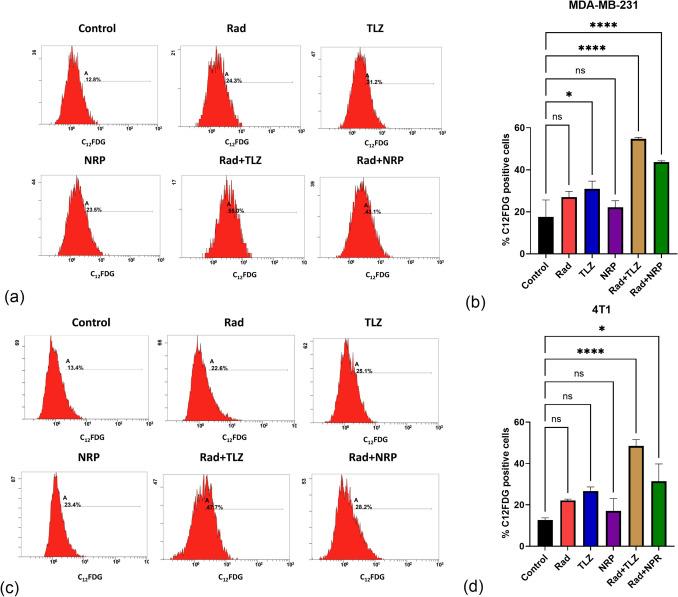
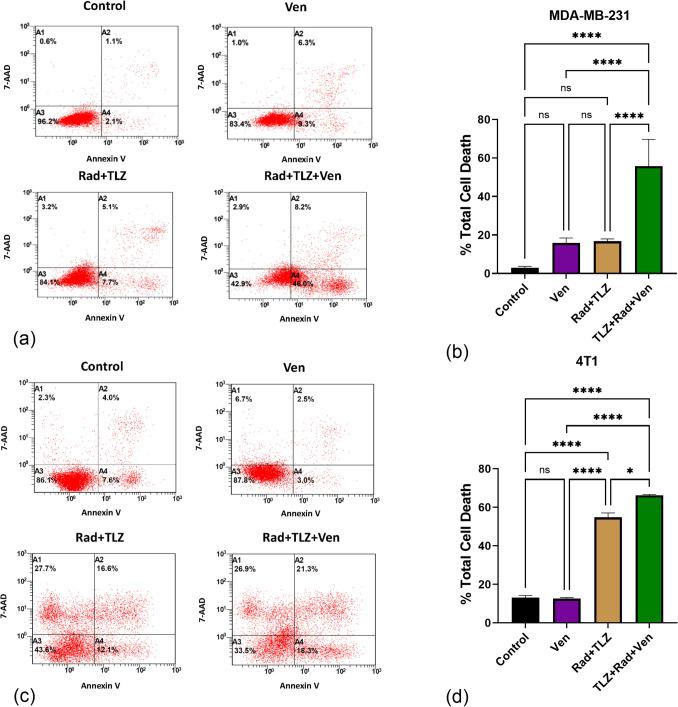
Triple-negative breast cancer (TNBC) presents ongoing clinical challenges, often leading to relapse in many patients. The relapse is partly explained by tumor cells transitioning into a senescent state following chemotherapy or radiation, resulting in a more aggressive phenotype, contributing to disease recurrence. Consequently, combining senolytics with traditional treatments could be a viable and promising strategy in treating TNBC. To address this, we induced therapy-induced senescence (TIS) both in vitro and in vivo by combining the poly ADP-ribose polymerase (PARP) inhibitor talazoparib with radiation. We tested whether exposure to the senolytic agent, venetoclax, would result in the eradication of senescent cells and augmentation of apoptosis. TIS Markers, like senescence-associated beta-galactosidase (SA-β-gal), CDKN1A, and senescence-associated secretory phenotype (SASP) marker IL-6, were altered following talazoparib and radiation in both 4T1 and MDA-MB-231 TNBC cell lines. Interestingly, venetoclax treatment following TIS induction led to pronounced apoptotic cell death and significant changes in SA-β-gal and IL-6, implying enhanced sensitivity post-senescence induction. Furthermore, these data were validated in vivo in an immunocompetent TNBC-bearing mouse model, in which venetoclax alone had a modest effect on growth inhibition. However, when combined with radiotherapy/talazoparib, venetoclax dramatically interfered with tumor recovery post-senescence induction, indicating a potential strategy to mitigate disease recurrence. These results suggest that combining radiotherapy with PARP inhibitors with senolytic agents such as venetoclax could potentially overcome disease relapse associated with TNBC.
三阴性乳腺癌(TNBC)带来了持续的临床挑战,常常导致许多患者复发。复发的部分原因是肿瘤细胞在化疗或放疗后转变为衰老状态,从而产生更具侵袭性的表型,促使疾病复发。因此,将衰老细胞溶解剂与传统治疗方法相结合可能是治疗TNBC的一种可行且有前景的策略。为了解决这个问题,我们通过将聚ADP核糖聚合酶(PARP)抑制剂他拉唑帕尼与放疗相结合,在体外和体内诱导治疗诱导的衰老(TIS)。我们测试了暴露于衰老细胞溶解剂维奈克拉是否会导致衰老细胞的清除和凋亡的增加。在4T1和MDA-MB-231 TNBC细胞系中,他拉唑帕尼和放疗后,TIS标志物,如衰老相关β-半乳糖苷酶(SA-β-gal)、细胞周期蛋白依赖性激酶抑制剂1A(CDKN1A)和衰老相关分泌表型(SASP)标志物白细胞介素-6(IL-6)都发生了改变。有趣的是,TIS诱导后进行维奈克拉治疗导致明显的凋亡性细胞死亡以及SA-β-gal和IL-6的显著变化,这意味着衰老诱导后敏感性增强。此外,这些数据在具有免疫活性的荷TNBC小鼠模型中得到了体内验证,在该模型中,单独使用维奈克拉对生长抑制有适度的作用。然而,当与放疗/他拉唑帕尼联合使用时,维奈克拉显著干扰了衰老诱导后的肿瘤恢复,表明这是一种减轻疾病复发的潜在策略。这些结果表明,将放疗与PARP抑制剂与维奈克拉等衰老细胞溶解剂相结合可能潜在地克服与TNBC相关的疾病复发。


 Zotero 插件