
抑郁症的新型及新兴药物治疗方法。
New and emerging pharmacologic treatments for MDD.
作者信息
Uyar Aslihan, Gonul Ali Saffet
机构信息
Standardization of Computational Anatomy Techniques for Cognitive and Behavioral Sciences (SoCAT) Lab, Department of Psychiatry, Faculty of the Medicine, Ege University, Izmir, Türkiye.
Department of Psychiatry, Mugla Sıtkı Kocman University Training and Research Hospital, Mugla, Türkiye.
出版信息
Front Psychiatry. 2025 Aug 8;16:1621887. doi: 10.3389/fpsyt.2025.1621887. eCollection 2025.
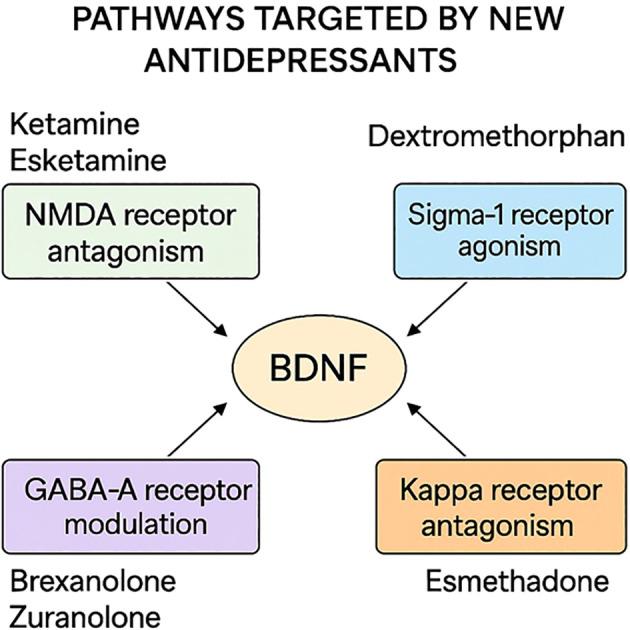
Major depressive disorder (MDD) presents a significant global health challenge, characterized by a high prevalence and significant impact on quality of life. Traditional antidepressants fall short in terms of efficacy and onset speed, up to 60% of patients. This review delves into the new and emerging pharmacologic treatments for MDD, focusing on their mechanisms of action, clinical effectiveness, and potential to fill the gaps left by conventional therapies. New and emerging treatments in MDD have centered on different neurobiological pathways than the traditional monoaminergic systems. Ketamine and its enantiomer, S-ketamine, have been highlighted for their rapid antidepressant effects, which act through non-competitive -methyl-d-aspartate (NMDA) receptor antagonism and other pathways involving synaptic plasticity. Clinical trials have demonstrated the ability of ketamine to quickly reduce symptoms, particularly in treatment-resistant cases, with effects noticeable within hours and lasting several days post-administration. Furthermore, the combination of dextromethorphan and bupropion has shown promise. This formulation leverages the NMDA receptor antagonism and sigma-1 receptor agonism of dextromethorphan, complemented by the inhibition of monoamine uptake and metabolism by bupropion, resulting in quicker and more durable antidepressant effects compared with monotherapy. Neurosteroids such as brexanolone and zuranolone, which target γ-aminobutyric acid (GABA)-A receptors, have emerged as effective treatments for postpartum depression. Brexanolone, administered via infusion, and zuranolone, available as an oral formulation, both have demonstrated efficacy in clinical settings. Novel treatments targeting opioid pathways, such as esmethadone, and selective kappa receptor antagonists offer new hope for addressing the symptoms of MDD through mechanisms not traditionally associated with antidepressant action.
重度抑郁症(MDD)是一项重大的全球健康挑战,其特点是患病率高且对生活质量有重大影响。传统抗抑郁药在疗效和起效速度方面存在不足,高达60%的患者受此影响。本综述深入探讨了用于治疗MDD的新型和新兴药物疗法,重点关注其作用机制、临床疗效以及填补传统疗法遗留空白的潜力。MDD的新型和新兴疗法聚焦于与传统单胺能系统不同的神经生物学途径。氯胺酮及其对映体S-氯胺酮因其快速抗抑郁作用而受到关注,其作用机制是通过非竞争性N-甲基-D-天冬氨酸(NMDA)受体拮抗作用以及其他涉及突触可塑性的途径。临床试验已证明氯胺酮能够快速减轻症状,尤其是在难治性病例中,给药后数小时内即可见效,且效果可持续数天。此外,右美沙芬和安非他酮的组合也显示出前景。该制剂利用了右美沙芬的NMDA受体拮抗作用和σ-1受体激动作用,并辅以安非他酮对单胺摄取和代谢的抑制作用,与单一疗法相比,可产生更快、更持久的抗抑郁效果。诸如布雷沙诺龙和祖拉诺龙等神经甾体靶向γ-氨基丁酸(GABA)-A受体,已成为产后抑郁症的有效治疗方法。通过静脉输注给药的布雷沙诺龙和口服制剂祖拉诺龙在临床环境中均已证明有效。针对阿片类途径的新型疗法,如依斯美沙酮,以及选择性κ受体拮抗剂,为通过非传统抗抑郁作用机制解决MDD症状带来了新希望。
 Zotero 插件