
静脉注射利多卡因(1.0毫克/千克)对宫腔镜检查患者成功置入双腔喉罩气道时丙泊酚ED50和ED95的影响:一项随机对照试验
Effect of Intravenous Lidocaine (1.0 mg/Kg) on Propofol ED50 and ED95 for Successful Double-Lumen Laryngeal Mask Airway Placement in Hysteroscopy Patients: A Randomized Controlled Trial.
作者信息
Zhang Jingwen, Li Jiaxing, Ni Juan
机构信息
Department of Anesthesiology, West China Second University Hospital, Sichuan University, Chengdu, People's Republic of China.
Key Laboratory of Birth Defects and Related Diseases of Women and Children (Sichuan University), Ministry of Education, Chengdu, People's Republic of China.
出版信息
Drug Des Devel Ther. 2025 Aug 20;19:7259-7268. doi: 10.2147/DDDT.S538816. eCollection 2025.
PURPOSE
It has been demonstrated that administration of intravenous lidocaine promotes laryngeal mask airway (LMA) placement. This research aimed to evaluate the effect of intravenous lidocaine at a dosage of 1.0 mg/kg on the 50% and 95% effective doses (ED50 and ED95) of propofol required for the successful placement of a double-lumen LMA during propofol-fentanyl-based anesthesia in patients undergoing hysteroscopy.
PATIENTS AND METHODS
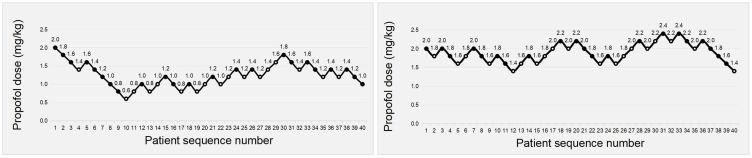
Eighty patients who underwent hysteroscopy were screened and randomly enrolled in either lidocaine group (group L, n=40) or the saline group (group S, n=40). The propofol induction dose per patient was established via an up-and-down sequential method. Under the guidance of bispectral index (BIS) value monitoring, the propofol doses required for the successful placement of a double-lumen LMA in 50% and 95% of the patients in the two groups (ED50 and ED95) were compared. The total propofol induction dose, awakening duration, and adverse outcomes were documented and analyzed.
RESULTS
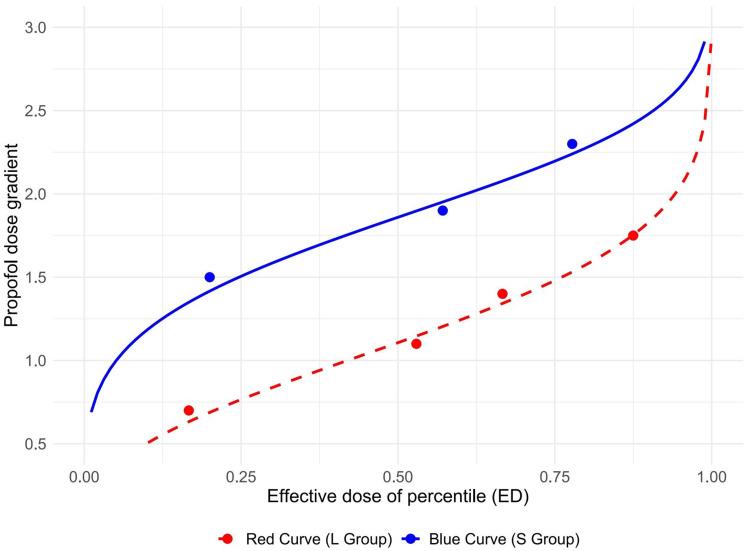
The propofol's ED50 was notably lower in the L group than in the S group (1.15±0.27 mg/kg versus 1.83±0.26 mg/kg; p<0.05, Cohen's d=2.56). The ED95 (95% confidence interval) of propofol was 2.04 (1.23-2.85) mg/kg in the L group and 2.64 (1.95-3.33) mg/kg in the S group, with a small effect size for the difference (Cohen's d=0.25). The total propofol induction dose in the L group was lower than that in the S group (p<0.05). There existed no variations in terms of awakening duration or incidence of adverse events.
CONCLUSION
In patients who underwent hysteroscopy, post-propofol intravenous lidocaine at 1.0 mg/kg markedly reduced the propofol's ED50 in propofol-fentanyl-based anesthesia for successful placement of a double-lumen LMA without significant adverse reactions.
目的
已证实静脉注射利多卡因可促进喉罩置入。本研究旨在评估在宫腔镜检查患者基于丙泊酚 - 芬太尼的麻醉过程中,静脉注射1.0mg/kg剂量的利多卡因对成功置入双腔喉罩所需丙泊酚的50%和95%有效剂量(ED50和ED95)的影响。
患者与方法
筛选80例行宫腔镜检查的患者,并随机分为利多卡因组(L组,n = 40)或生理盐水组(S组,n = 40)。通过序贯法确定每位患者的丙泊酚诱导剂量。在脑电双频指数(BIS)值监测的指导下,比较两组中50%和95%患者成功置入双腔喉罩所需的丙泊酚剂量(ED50和ED95)。记录并分析丙泊酚总诱导剂量、苏醒时间及不良事件。
结果
L组丙泊酚的ED50显著低于S组(1.15±0.27mg/kg对1.83±0.26mg/kg;p<0.05,Cohen's d = 2.56)。L组丙泊酚的ED95(95%置信区间)为2.04(1.23 - 2.85)mg/kg,S组为2.64(1.95 - 3.33)mg/kg,差异的效应量较小(Cohen's d = 0.25)。L组丙泊酚总诱导剂量低于S组(p<0.05)。苏醒时间或不良事件发生率无差异。
结论
在接受宫腔镜检查的患者中,基于丙泊酚 - 芬太尼的麻醉下,静脉注射1.0mg/kg利多卡因后显著降低了成功置入双腔喉罩所需丙泊酚的ED50,且无明显不良反应。

 Zotero 插件