
体弱老年人的吞咽困难:自我报告的用餐时症状及风险。
Dysphagia in frail elderly: self-reported mealtime symptoms and risk.
作者信息
Valente Junior Cirley Novais, Sassi Fernanda Chiarion, Ritto Ana Paula, Pecenin Isadora Cardoso Salles Fila, Andrade Claudia Regina Furquim de
机构信息
Universidade de São Paulo. Faculdade de Medicina. Departamento de Fisioterapia, Fonoaudiologia e Terapia Ocupacional. São Paulo, SP, Brasil.
Universidade de São Paulo. Escola de Enfermagem. São Paulo, SP, Brasil.
出版信息
Rev Saude Publica. 2025 Aug 25;59:e23. doi: 10.11606/s1518-8787.2025059006440. eCollection 2025.
OBJECTIVE
This study aimed to characterize swallowing and investigate the association between self-reported coughing and/or choking during meals and the risk of dysphagia in frail elderly individuals receiving healthcare at a specialized center in São Paulo, Brazil.
METHODS
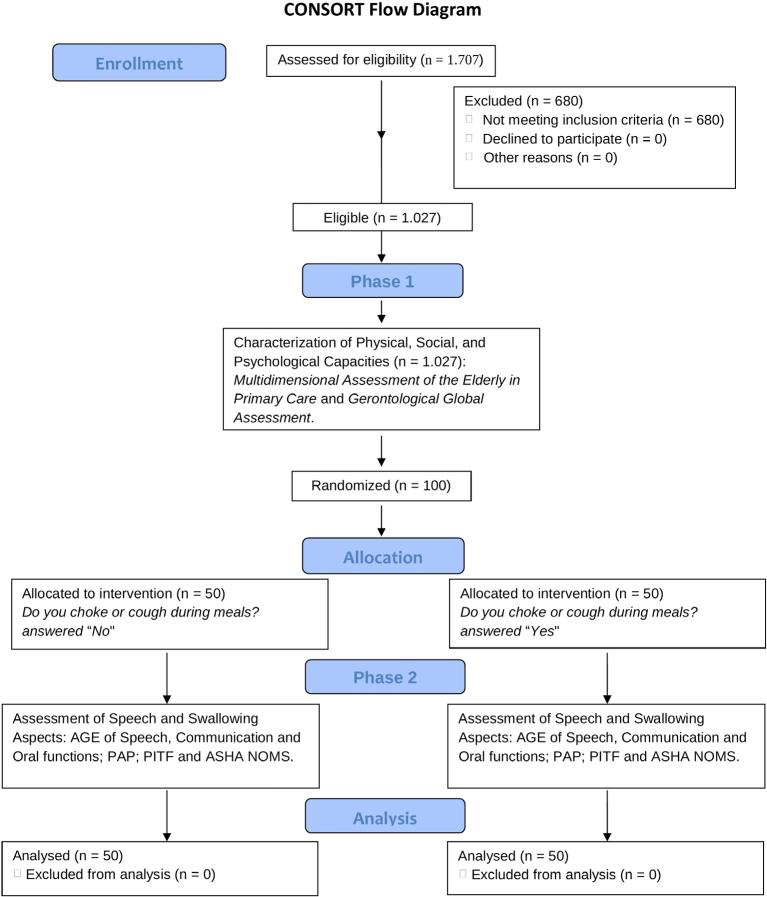
This cross-sectional observational study included elderly individuals attending an Elderly Health Reference Unit (URSI) from July 2017 to December 2023. Data from all patients referred to the URSI were collected, excluding only those with incomplete medical records. The study proceeded in two phases: the first phase involved physical, functional, and social assessments, while the second phase included speech and swallowing evaluations. Participants were categorized into groups based on self-reported mealtime symptoms. Descriptive and inferential analyses compared these groups using the Mann-Whitney U test for quantitative data and Pearson's χ2 test for qualitative data. Risk analysis employed multiple logistic regression with forward stepwise selection.
RESULTS
The study comprised 1,027 elderly individuals (mean age 78 years; 68.2% women; 64.2% self-identified as white). Approximately half reported frequent choking during meals. Sex, Multidimensional Assessment of the Elderly in Primary Care classification and score, polypharmacy, chronic diseases, falls, urinary incontinence, osteoporosis, cardiac disease, last dental visit, speech difficulty, change in food consistency, hearing loss, and hearing aid use were associated with mealtime symptoms. Speech alterations increased bronchoaspiration risk by 16%, memory complaints by 11%, and xerostomia and food consistency changes by 8%.
CONCLUSION
Speech alterations, changes in food consistency, memory complaints, and xerostomia were identified as factors increasing the risk of bronchoaspiration. Early identification and a multidisciplinary approach to swallowing disorders in frail elderly individuals are crucial for preventing aspiration pneumonia and maintaining quality of life. These findings underscore the significance of proactive management strategies in clinical practice.
目的
本研究旨在描述吞咽情况,并调查在巴西圣保罗一家专科中心接受医疗保健的体弱老年人用餐期间自我报告的咳嗽和/或呛噎与吞咽困难风险之间的关联。
方法
这项横断面观察性研究纳入了2017年7月至2023年12月期间在老年健康参考单位(URSI)就诊的老年人。收集了所有转诊至URSI的患者的数据,仅排除病历不完整的患者。研究分两个阶段进行:第一阶段包括身体、功能和社会评估,而第二阶段包括言语和吞咽评估。参与者根据自我报告的用餐时症状进行分组。描述性和推断性分析使用曼-惠特尼U检验对定量数据进行比较,使用皮尔逊χ²检验对定性数据进行比较。风险分析采用向前逐步选择的多元逻辑回归。
结果
该研究包括1027名老年人(平均年龄78岁;68.2%为女性;64.2%自我认定为白人)。约一半的人报告在用餐期间经常呛噎。性别、初级保健中老年人多维评估分类和评分、多种药物治疗、慢性病、跌倒、尿失禁、骨质疏松症、心脏病、上次牙科就诊、言语困难、食物稠度变化、听力损失和助听器使用与用餐时症状有关。言语改变使支气管误吸风险增加16%,记忆问题增加11%,口干和食物稠度变化增加8%。
结论
言语改变、食物稠度变化、记忆问题和口干被确定为增加支气管误吸风险的因素。对体弱老年人吞咽障碍进行早期识别和多学科方法对于预防吸入性肺炎和维持生活质量至关重要。这些发现强调了临床实践中积极管理策略的重要性。
 Zotero 插件