
用于生物医学应用的人工智能驱动的电化学传感器:技术进展与未来挑战
AI-Empowered Electrochemical Sensors for Biomedical Applications: Technological Advances and Future Challenges.
作者信息
Liu Yafeng, Liu Xiaohui, Wang Xuemei, Jiang Hui
机构信息
State Key Laboratory of Digital Medical Engineering, School of Biological Science and Medical Engineering, Southeast University, Nanjing 210096, China.
出版信息
Biosensors (Basel). 2025 Jul 28;15(8):487. doi: 10.3390/bios15080487.
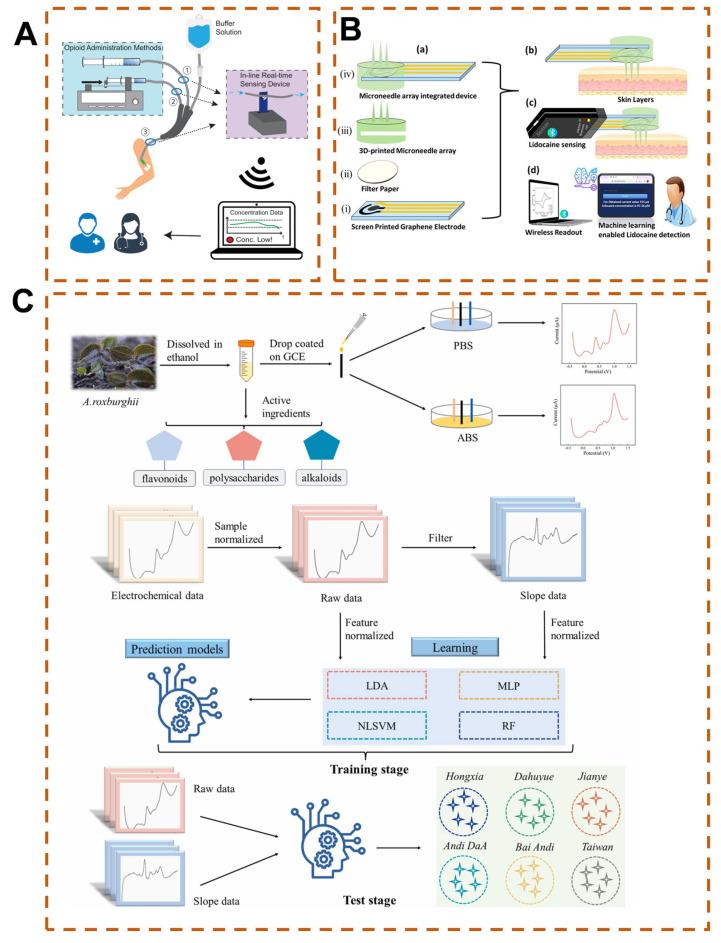
Biomarkers play a pivotal role in disease diagnosis, therapeutic efficacy evaluation, prognostic assessment, and drug screening. However, the trace concentrations of these markers in complex physiological environments pose significant challenges to efficient detection. It is necessary to avoid interference from non-specific signals, which may lead to misjudgment of other substances as biomarkers and affect the accuracy of detection results. With the rapid advancements in electrochemical technologies and artificial intelligence (AI) algorithms, intelligent electrochemical biosensors have emerged as a promising approach for biomedical detection, offering speed, specificity, high sensitivity, and accuracy. This review focuses on elaborating the latest applications of AI-empowered electrochemical biosensors in the biomedical field, including disease diagnosis, treatment monitoring, drug development, and wearable devices. AI algorithms can further improve the accuracy, sensitivity, and repeatability of electrochemical sensors through the screening and performance prediction of sensor materials, as well as the feature extraction and noise reduction suppression of sensing signals. Even in complex physiological microenvironments, they can effectively address common issues such as electrode fouling, poor signal-to-noise ratio, chemical interference, and matrix effects. This work may provide novel insights for the development of next-generation intelligent biosensors for precision medicine.
生物标志物在疾病诊断、治疗效果评估、预后评估和药物筛选中发挥着关键作用。然而,这些标志物在复杂生理环境中的痕量浓度给高效检测带来了重大挑战。有必要避免非特异性信号的干扰,因为这可能导致将其他物质误判为生物标志物,并影响检测结果的准确性。随着电化学技术和人工智能(AI)算法的快速发展,智能电化学生物传感器已成为生物医学检测的一种有前景的方法,具有速度快、特异性强、灵敏度高和准确性好等优点。本文综述重点阐述了人工智能赋能的电化学生物传感器在生物医学领域的最新应用,包括疾病诊断、治疗监测、药物研发和可穿戴设备。人工智能算法可以通过传感器材料的筛选和性能预测,以及传感信号的特征提取和降噪抑制,进一步提高电化学传感器的准确性、灵敏度和可重复性。即使在复杂的生理微环境中,它们也能有效解决诸如电极污染、信噪比差、化学干扰和基质效应等常见问题。这项工作可能为开发用于精准医学的下一代智能生物传感器提供新的见解。
 Zotero 插件