
ODDM:在不平衡的彩色眼底图像上集成SMOTE Tomek与深度学习以对多种眼部疾病进行分类
ODDM: Integration of SMOTE Tomek with Deep Learning on Imbalanced Color Fundus Images for Classification of Several Ocular Diseases.
作者信息
Qureshi Afraz Danish Ali, Malik Hassaan, Naeem Ahmad, Hassan Syeda Nida, Jeong Daesik, Naqvi Rizwan Ali
机构信息
Department of Computer Science, National College of Business Administration & Economics Lahore, Multan Sub Campus, Multan 60000, Pakistan.
Department of Computer Science, NFC Institute of Engineering and Technology, Multan 60000, Pakistan.
出版信息
J Imaging. 2025 Aug 18;11(8):278. doi: 10.3390/jimaging11080278.
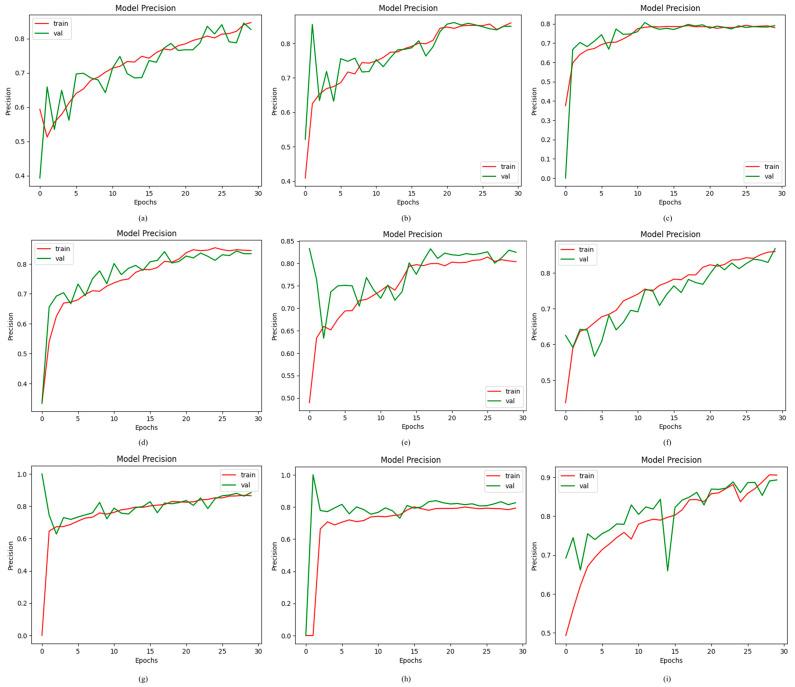
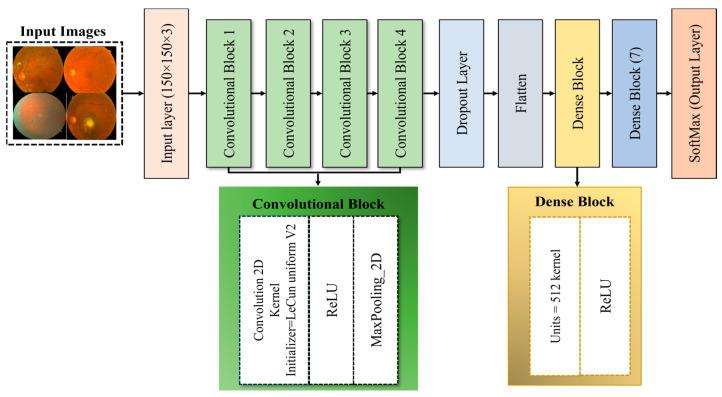
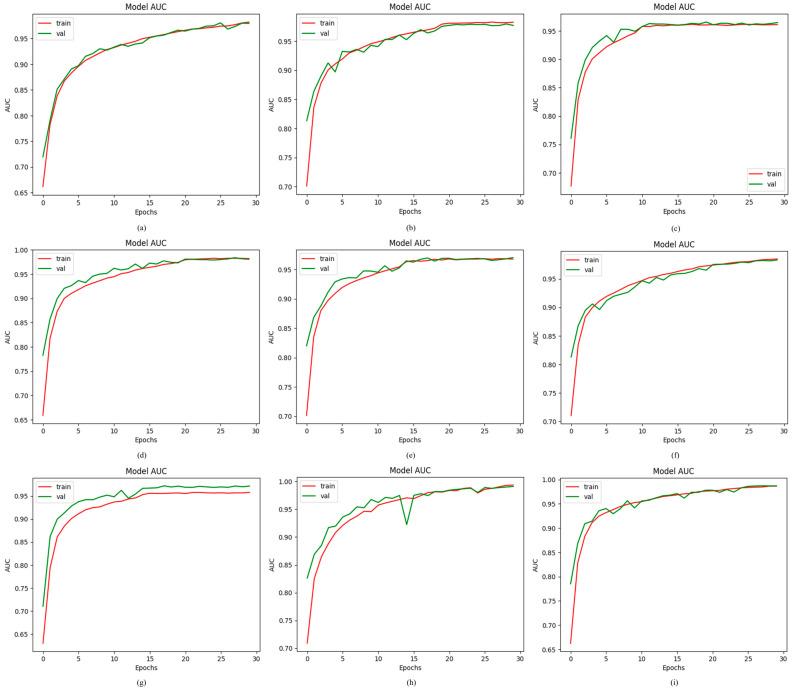
Ocular disease (OD) represents a complex medical condition affecting humans. OD diagnosis is a challenging process in the current medical system, and blindness may occur if the disease is not detected at its initial phase. Recent studies showed significant outcomes in the identification of OD using deep learning (DL) models. Thus, this work aims to develop a multi-classification DL-based model for the classification of seven ODs, including normal (NOR), age-related macular degeneration (AMD), diabetic retinopathy (DR), glaucoma (GLU), maculopathy (MAC), non-proliferative diabetic retinopathy (NPDR), and proliferative diabetic retinopathy (PDR), using color fundus images (CFIs). This work proposes a custom model named the ocular disease detection model (ODDM) based on a CNN. The proposed ODDM is trained and tested on a publicly available ocular disease dataset (ODD). Additionally, the SMOTE Tomek (SM-TOM) approach is also used to handle the imbalanced distribution of the OD images in the ODD. The performance of the ODDM is compared with seven baseline models, including DenseNet-201 (R), EfficientNet-B0 (R), Inception-V3 (R), MobileNet (R), Vgg-16 (R), Vgg-19 (R), and ResNet-50 (R). The proposed ODDM obtained a 98.94% AUC, along with 97.19% accuracy, a recall of 88.74%, a precision of 95.23%, and an F1-score of 88.31% in classifying the seven different types of OD. Furthermore, ANOVA and Tukey HSD (Honestly Significant Difference) post hoc tests are also applied to represent the statistical significance of the proposed ODDM. Thus, this study concludes that the results of the proposed ODDM are superior to those of baseline models and state-of-the-art models.
眼部疾病(OD)是一种影响人类的复杂病症。在当前医疗体系中,OD诊断是一个具有挑战性的过程,如果疾病在初始阶段未被检测到,可能会导致失明。最近的研究表明,使用深度学习(DL)模型在OD识别方面取得了显著成果。因此,这项工作旨在开发一种基于多分类DL的模型,用于使用彩色眼底图像(CFI)对七种OD进行分类,包括正常(NOR)、年龄相关性黄斑变性(AMD)、糖尿病视网膜病变(DR)、青光眼(GLU)、黄斑病变(MAC)、非增殖性糖尿病视网膜病变(NPDR)和增殖性糖尿病视网膜病变(PDR)。这项工作提出了一种基于卷积神经网络(CNN)的自定义模型,称为眼部疾病检测模型(ODDM)。所提出的ODDM在一个公开可用的眼部疾病数据集(ODD)上进行训练和测试。此外,还使用SMOTE Tomek(SM-TOM)方法来处理ODD中OD图像的不平衡分布。将ODDM的性能与七种基线模型进行比较,包括DenseNet-201(R)、EfficientNet-B0(R)、Inception-V3(R)、MobileNet(R)、Vgg-16(R)、Vgg-19(R)和ResNet-50(R)。所提出的ODDM在对七种不同类型的OD进行分类时,获得了98.94%的曲线下面积(AUC),以及97.19%的准确率、88.74%的召回率、95.23%的精确率和88.31%的F1分数。此外,还应用方差分析(ANOVA)和Tukey HSD(真实显著差异)事后检验来表示所提出的ODDM的统计显著性。因此,本研究得出结论,所提出的ODDM的结果优于基线模型和现有模型。

 Zotero 插件