
耦合的计算机模拟毒理学模型揭示了双酚A及其替代品在中国地表水中的等效生态风险。
Coupled In Silico Toxicology Models Reveal Equivalent Ecological Risks from BPA and Its Alternatives in Chinese Surface Waters.
作者信息
Zhang Jiawei, Xiao Jingzi, Tao Huanyu, Zhang Mengtao, Lu Lu, Qin Changbo
机构信息
Institute of Strategic Planning, Chinese Academy of Environmental Planning, Ministry of Ecology and Environment, Beijing 100041, China.
School of Environment, Tsinghua University, Beijing 100084, China.
出版信息
Toxics. 2025 Aug 9;13(8):671. doi: 10.3390/toxics13080671.
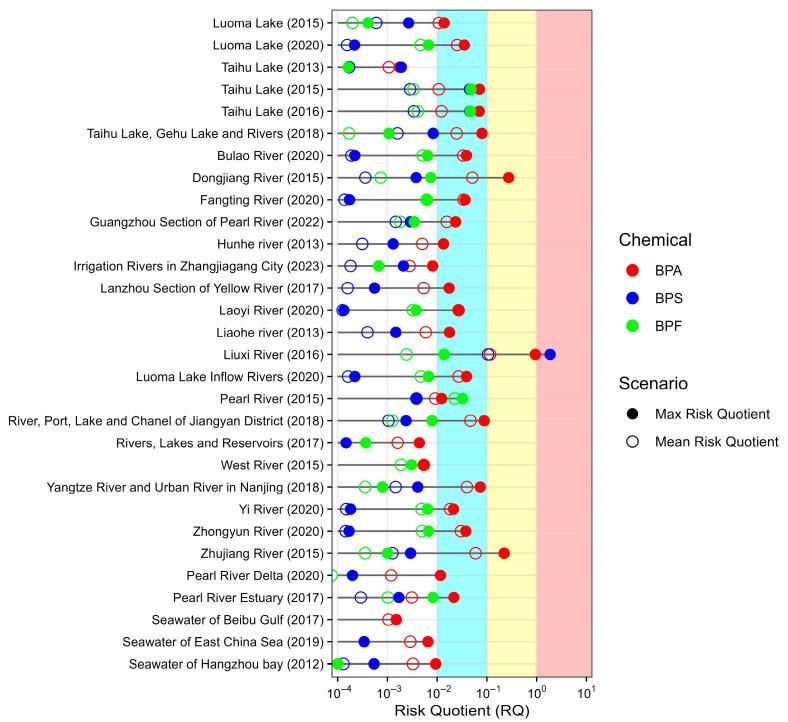
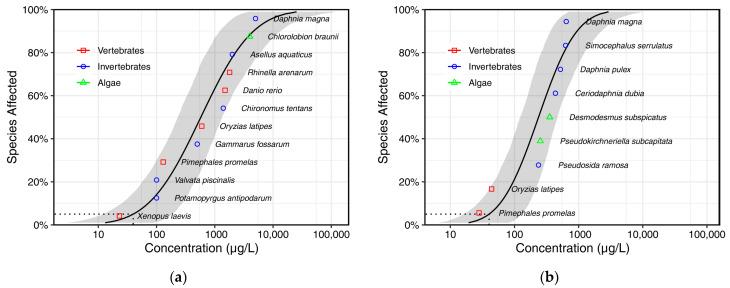
As bisphenol A (BPA) has gradually become restricted in production scenarios, the ecological risk level of its main replacement chemicals, i.e., bisphenol S (BPS) and bisphenol F (BPF), should be noted. To overcome the limitations of toxicity data, two kinds of in silico toxicology models (quantitative structure-activity relationship (QSAR) and interspecies correlation estimation (ICE) models) were used to predict enough toxicity data for multiple species. The accuracy of the coupled in silico toxicology models was verified by comparing experimental and predicted data results. Reliable predicted no-effect concentrations (PNECs) of 8.04, 35.2, and 34.2 μg/L were derived for BPA, BPS, and BPF, respectively, using species sensitivity distribution (SSD). Accordingly, the ecological risk quotient (RQ) values of BPA, BPS, and BPF for aquatic organisms were assessed in 32 major Chinese surface waters; they ranged from nearly 0 to 1.86, but were <0.1 in most cases, which indicated that the overall ecological risk level of BPA and its alternatives was low. However, in some cases, the ecological risks posed by BPA alternatives have reached equivalent levels to those posed by BPA (e.g., Liuxi River, Taihu Lake, and Pearl River), which requires further attention. This study provides evidence that the application of coupled in silico toxicology models can effectively predict toxicity data for new chemicals, avoiding time-consuming and laborious animal experiments. The main findings of this study can support environmental risk assessment and management for new chemicals that lack toxicity data.
由于双酚A(BPA)在生产场景中逐渐受到限制,应关注其主要替代化学品双酚S(BPS)和双酚F(BPF)的生态风险水平。为克服毒性数据的局限性,使用了两种计算机毒理学模型(定量构效关系(QSAR)模型和种间相关性估计(ICE)模型)来预测多种物种的足够毒性数据。通过比较实验数据和预测数据结果验证了耦合计算机毒理学模型的准确性。利用物种敏感性分布(SSD)分别得出BPA、BPS和BPF的可靠预测无效应浓度(PNEC)为8.04、35.2和34.2μg/L。据此,评估了中国32条主要地表水水体中BPA、BPS和BPF对水生生物的生态风险商(RQ)值;其范围从近0到1.86,但在大多数情况下<0.1,这表明BPA及其替代品的总体生态风险水平较低。然而,在某些情况下,BPA替代品带来的生态风险已达到与BPA相当的水平(如流溪河、太湖和珠江),这需要进一步关注。本研究证明,耦合计算机毒理学模型的应用可以有效预测新化学品的毒性数据,避免耗时费力的动物实验。本研究的主要发现可为缺乏毒性数据的新化学品的环境风险评估和管理提供支持。

 Zotero 插件