
热浪和寒潮与细颗粒物对肺炎死亡率的相反交互作用。
Opposite Interactive Effects of Heat Wave and Cold Spell with Fine Particulate Matter on Pneumonia Mortality.
作者信息
Zheng Yi, Xu Ruijun, Chen Yuling, Li Yingxin, Bi Yuxin, Jia Xiaohong, Wang Sirong, Luo Lu, Wei Jing, Wang Rui, Shi Chunxiang, Lv Ziquan, Huang Suli, Chen Gongbo, Sun Hong, Sun Bochao, Feng Nongping, Liu Yuewei
机构信息
Department of Epidemiology, School of Public Health, Sun Yat-sen University, Guangzhou 510080, China.
Department of Evironmental Health, Guangzhou Center for Disease Control and Prevention, Guangzhou 510440, China.
出版信息
Toxics. 2025 Aug 21;13(8):702. doi: 10.3390/toxics13080702.
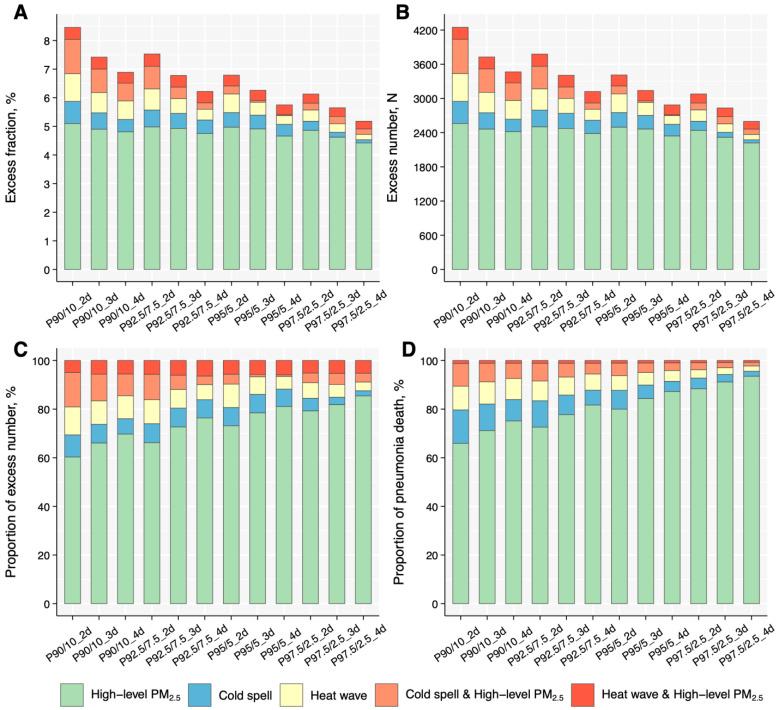
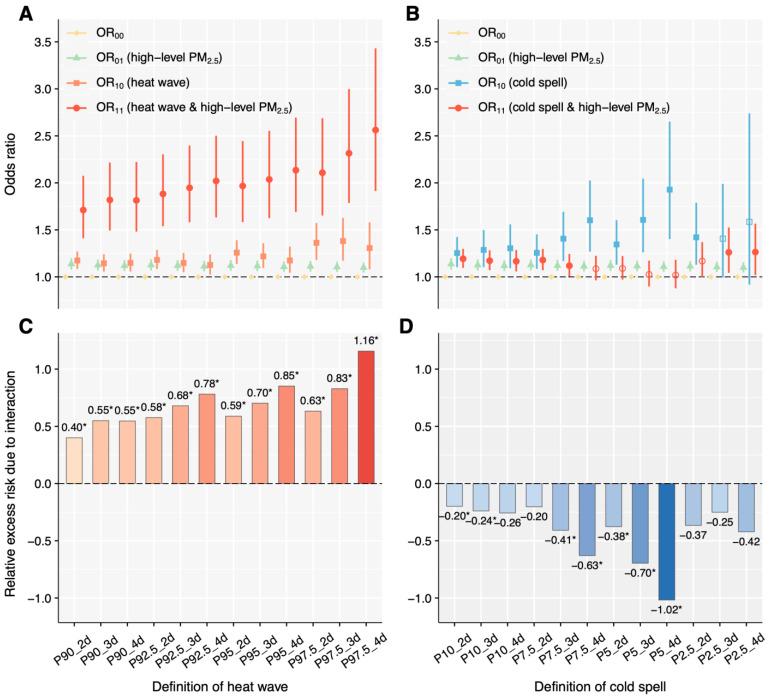
Exposure to extreme temperature events (ETEs) and ambient fine particulate matter (PM) has been linked to an increased risk of pneumonia mortality, but their interactive effects remain largely unknown. We investigated 50,196 pneumonia deaths from 2015 to 2022 in Jiangsu province, China, with a time-stratified case-crossover design. An individual-level exposure to heat wave, cold spell, and PM was assessed at each subject's residential address using validated grid datasets. Conditional logistic regression models integrated with a distributed lag nonlinear model were used to quantitatively estimate both independent and interactive effects. With different ETE definitions, the cumulative odds ratio (OR) of pneumonia mortality associated with heat wave and cold spell ranged from 1.22 (95% confidence interval [CI]: 1.14, 1.31) to 1.60 (1.40, 1.81), and from 1.08 (1.002, 1.17) to 1.18 (1.01, 1.38), respectively, while the OR for PM ranged from 1.013 (1.006, 1.021) to 1.016 (1.009, 1.024). We observed a synergistic effect (relative excess risk due to interaction [RERI] ranging from 0.40 [0.06, 0.76] to 1.16 [0.41, 2.09]) of co-exposure to heat wave and PM, as well as an antagonistic effect (RERI ranging from -0.20 [-0.40, -0.03] to -1.02 [-1.78, -0.38]) of co-exposure to cold spell and PM on pneumonia mortality. It was estimated that up to 6.49% of pneumonia deaths were attributable to heat wave and PM exposures. We found that heat wave and cold spell interacted oppositely with PM to increase the odds of pneumonia mortality, highlighting the needs to reduce co-exposures to heat wave and PM.
暴露于极端温度事件(ETEs)和环境细颗粒物(PM)与肺炎死亡率增加有关,但其交互作用在很大程度上仍不清楚。我们采用时间分层病例交叉设计,对2015年至2022年中国江苏省50196例肺炎死亡病例进行了调查。利用经过验证的网格数据集,在每个受试者的居住地址评估个体层面的热浪、寒潮和PM暴露情况。使用与分布滞后非线性模型相结合的条件逻辑回归模型来定量估计独立效应和交互效应。采用不同的ETE定义,与热浪和寒潮相关的肺炎死亡率累积比值比(OR)分别为1.22(95%置信区间[CI]:1.14,1.31)至1.60(1.40,1.81),以及1.08(1.002,1.17)至1.18(1.01,1.38),而PM的OR为1.013(1.006,1.021)至1.016(1.009,1.024)。我们观察到热浪和PM共同暴露具有协同效应(交互作用引起的相对超额风险[RERI]范围为0.40[0.06,0.76]至1.16[0.41,2.09]),以及寒潮和PM共同暴露对肺炎死亡率具有拮抗效应(RERI范围为-0.20[-0.40,-0.03]至-1.02[-1.78,-0.38])。据估计,高达6.49%的肺炎死亡可归因于热浪和PM暴露。我们发现热浪和寒潮与PM的相互作用相反,会增加肺炎死亡的几率,突出了减少热浪和PM共同暴露的必要性。


 Zotero 插件