
高三尖杉酯碱减轻体外皮肤衰老模型中的细胞外基质降解、皮肤屏障功能障碍和炎症。
Harringtonine Attenuates Extracellular Matrix Degradation, Skin Barrier Dysfunction, and Inflammation in an In Vitro Skin Aging Model.
作者信息
Lee Sullim, Lee Sanghyun
机构信息
Department of Life Science, College of Bio-Nano Technology, Gachon University, Seongnam 13120, Republic of Korea.
Department of Plant Science and Technology, Chung-Ang University, Anseong 17546, Republic of Korea.
出版信息
Curr Issues Mol Biol. 2025 Aug 10;47(8):642. doi: 10.3390/cimb47080642.
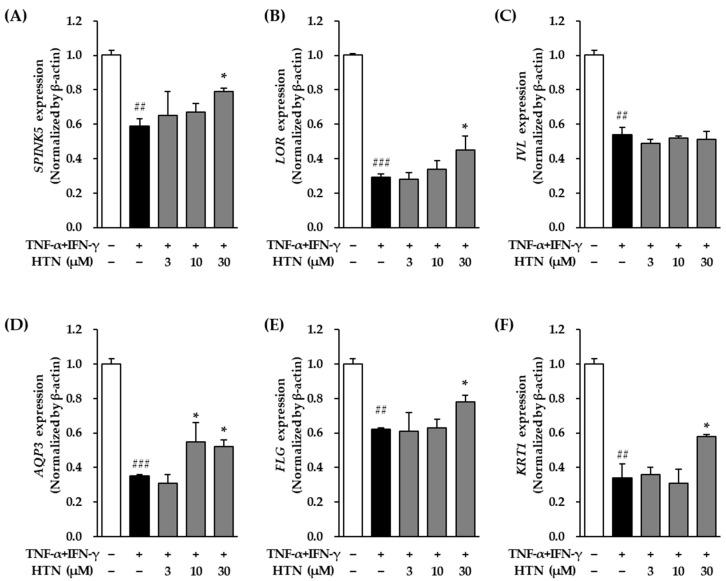
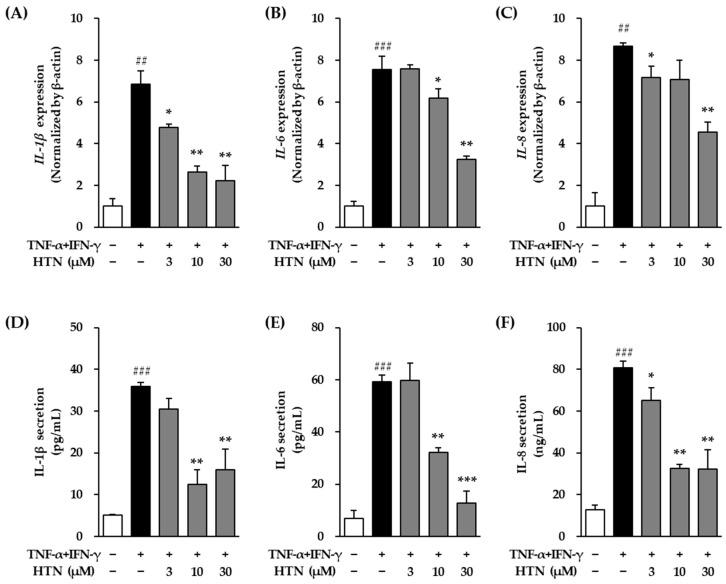
With the growing interest in natural strategies for preventing skin aging, plant-derived compounds are being actively investigated for their potential protective effects against skin inflammation and extracellular matrix (ECM) degradation. In this study, we explored the anti-aging and anti-inflammatory effects of harringtonine, an alkaloid isolated from , in normal human epidermal keratinocytes (NHEKs) under inflammatory stress induced by tumor necrosis factor-alpha (TNF-α) and interferon-gamma (IFN-γ). Harringtonine significantly suppressed the expression of matrix metalloproteinases (, , and and restored the expression of collagen synthesis-related genes [collagen type I alpha 1 chain (), collagen type I alpha 2 chain (), and collagen type IV alpha 1 chain )], indicating its protective role in ECM degradation. Additionally, harringtonine improved the expression of skin barrier-related genes, such as serine peptidase inhibitor kazal type 5 (), loricrin (), quaporin-3 (), filaggrin (), and keratin 1 () although it had no significant effect on involucrin (). Harringtonine also markedly reduced the production of pro-inflammatory cytokines [interleukin (IL)-1β, IL-6, and IL-8] and inflammatory mediators, including prostaglandin E (PGE), cyclooxygenase-2 (COX-2), and nitric oxide (NO). Our findings suggest that harringtonine may serve as a promising natural compound for mitigating skin aging and inflammation through multi-targeted modulation of ECM remodeling, skin barrier function, and inflammatory response.
随着人们对预防皮肤衰老的天然策略的兴趣日益浓厚,植物来源的化合物因其对皮肤炎症和细胞外基质(ECM)降解的潜在保护作用而受到积极研究。在本研究中,我们探讨了从[植物名称未给出]中分离出的生物碱三尖杉酯碱在肿瘤坏死因子-α(TNF-α)和干扰素-γ(IFN-γ)诱导的炎症应激下对正常人表皮角质形成细胞(NHEKs)的抗衰老和抗炎作用。三尖杉酯碱显著抑制基质金属蛋白酶(MMP-1、MMP-3和MMP-9)的表达,并恢复了胶原蛋白合成相关基因[Ⅰ型胶原蛋白α1链(COL1A1)、Ⅰ型胶原蛋白α2链(COL1A2)和Ⅳ型胶原蛋白α1链(COL4A1)]的表达,表明其在ECM降解中的保护作用。此外,三尖杉酯碱改善了皮肤屏障相关基因的表达,如丝氨酸蛋白酶抑制剂Kazal型5(SPINK5)、兜甲蛋白(LOR)、水通道蛋白-3(AQP3)、丝聚蛋白(FLG)和角蛋白1(KRT1),尽管它对内披蛋白(IVL)没有显著影响。三尖杉酯碱还显著降低了促炎细胞因子[白细胞介素(IL)-1β、IL-6和IL-8]以及包括前列腺素E(PGE)、环氧合酶-2(COX-2)和一氧化氮(NO)在内的炎症介质的产生。我们的研究结果表明,三尖杉酯碱可能是一种有前途的天然化合物,可通过多靶点调节ECM重塑、皮肤屏障功能和炎症反应来减轻皮肤衰老和炎症。


 Zotero 插件