
母体炎症状态对出生时胎儿端粒长度的影响。
The Influence of Maternal Inflammatory Status on Fetal Telomere Length at Birth.
作者信息
Diaconu Mircea, Olaru Flavius, Abu-Awwad Ahmed, Abu-Awwad Simona-Alina, Dragomir Tiberiu, Sacarin Geanina, Pilut Nicolae Ciprian, Sorop Bogdan, Bicu Melisa, Nitu Razvan
机构信息
Department of Obstetrics and Gynecology, "Victor Babes" University of Medicine and Pharmacy, 300041 Timisoara, Romania.
Clinic of Obstetrics and Gynecology, "Pius Brinzeu" County Clinical Emergency Hospital, 300723 Timisoara, Romania.
出版信息
Biomedicines. 2025 Aug 14;13(8):1974. doi: 10.3390/biomedicines13081974.
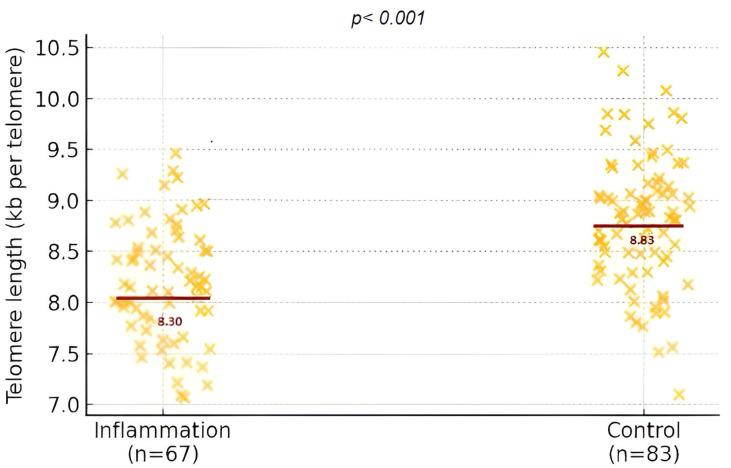
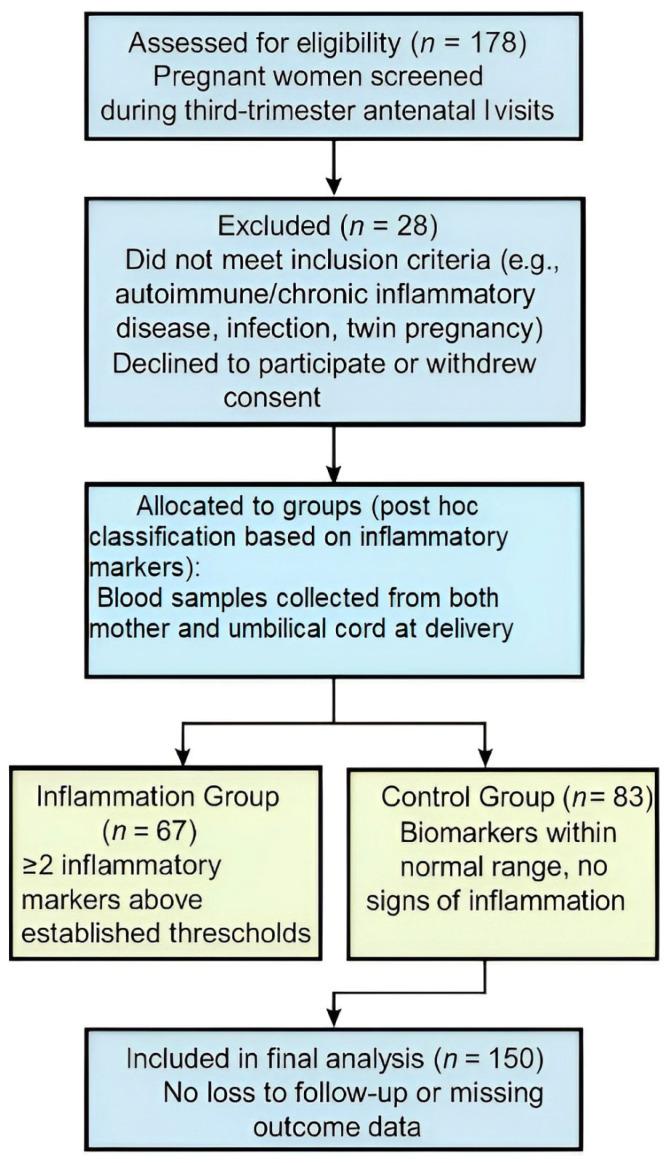
: Fetal telomere length (FTL) at birth is considered a key marker of early biological aging and future disease risk. While chronic inflammation is known to accelerate telomere attrition in adults, limited evidence exists on how maternal inflammation during pregnancy impacts FTL. This study aimed to investigate the association between maternal systemic inflammatory status in late pregnancy and FTL at birth. : We conducted a prospective cohort study including 150 clinically healthy pregnant women recruited in the third trimester. Participants were stratified post hoc into an inflammation group (n = 67) and a control group (n = 83) based on circulating inflammatory markers: high-sensitivity C-reactive protein (hsCRP), interleukin-6 (IL-6), TNF-α, and IL-10. Umbilical cord blood was collected at birth, and telomere length was quantified using real-time PCR. Correlation and multivariable linear regression analyses were performed to evaluate associations between maternal inflammation and FTL. : Mothers in the inflammation group had significantly elevated hsCRP, IL-6, and TNF-α levels, and lower IL-10 concentrations. FTL was significantly shorter in this group compared to the controls. Unlike previous investigations that relied on single pro-inflammatory markers, our study tests a composite immune-balance index (IL-6/IL-10 ratio) together with hsCRP in a prospectively followed cohort of clinically healthy pregnancies. Using its correlation coefficient, the IL-6/IL-10 ratio alone explained approximately 28% of the total variance in fetal telomere length-almost double the variance captured by IL-6 assessed in isolation. IL-6 and hsCRP emerged as independent negative predictors of FTL in multivariable models (β = -0.37 and -0.29, respectively). The IL-6/IL-10 ratio showed the strongest inverse correlation with FTL (r = -0.53, < 0.001). : Subclinical systemic inflammation in late pregnancy is independently associated with shorter fetal telomere length at birth, highlighting maternal immune imbalance (especially IL-6/IL-10 ratio) as a modifiable determinant of early biological aging. These findings underscore the need to consider maternal inflammatory profiling in pregnancy as a potential target for early-life preventive strategies.
出生时的胎儿端粒长度(FTL)被认为是早期生物衰老和未来疾病风险的关键标志物。虽然已知慢性炎症会加速成年人的端粒磨损,但关于孕期母亲炎症如何影响FTL的证据有限。本研究旨在调查孕晚期母亲全身炎症状态与出生时FTL之间的关联。
我们进行了一项前瞻性队列研究,纳入了150名在孕晚期招募的临床健康孕妇。根据循环炎症标志物:高敏C反应蛋白(hsCRP)、白细胞介素-6(IL-6)、肿瘤坏死因子-α(TNF-α)和白细胞介素-10,事后将参与者分为炎症组(n = 67)和对照组(n = 83)。出生时采集脐带血,使用实时PCR定量端粒长度。进行相关性和多变量线性回归分析以评估母亲炎症与FTL之间的关联。
炎症组母亲的hsCRP、IL-6和TNF-α水平显著升高,IL-10浓度较低。与对照组相比,该组的FTL明显更短。与以往依赖单一促炎标志物的研究不同,我们的研究在一个前瞻性随访的临床健康妊娠队列中,同时检测了复合免疫平衡指数(IL-6/IL-10比值)和hsCRP。仅使用其相关系数,IL-6/IL-10比值就解释了胎儿端粒长度总变异的约28%——几乎是单独评估的IL-6所捕获变异的两倍。在多变量模型中,IL-6和hsCRP成为FTL的独立负向预测因子(β分别为-0.37和-0.29)。IL-6/IL-10比值与FTL的负相关性最强(r = -0.53,P < 0.001)。
孕晚期的亚临床全身炎症与出生时较短的胎儿端粒长度独立相关,突出了母亲免疫失衡(尤其是IL-6/IL-10比值)作为早期生物衰老的一个可改变决定因素。这些发现强调了将孕期母亲炎症谱分析作为早期预防策略潜在靶点的必要性。
 Zotero 插件