
孕期羊水中细胞外超氧化物歧化酶(SOD3)、谷胱甘肽及氧化还原动力学的证据
Evidence for Extracellular Superoxide Dismutase (SOD3), Glutathione and Redox Dynamics in Amniotic Fluid Throughout Gestation.
作者信息
Knieps Leah, Alsat Ebru Aileen, Melaku Tamene, Mueller Andreas, Bagci Soyhan
机构信息
Neonatology and Pediatric Intensive Care, Children's Hospital, University of Bonn, 53127 Bonn, Germany.
出版信息
Children (Basel). 2025 Aug 19;12(8):1086. doi: 10.3390/children12081086.
INTRODUCTION
Amniotic fluid (AF) plays a pivotal role in foetal gastrointestinal development by delivering bioactive factors that support intestinal maturation. However, the redox environment of AF and its potential contribution to foetal intestinal homeostasis remain insufficiently characterised. This study aimed to quantify key antioxidant markers-superoxide dismutase isoforms (SOD1, SOD3), glutathione (GSH), and the oxidative DNA damage marker 8-hydroxy-2-deoxyguanosine (8-OHdG)-in AF across gestational ages and compare them with those in human milk (HM).
METHODS
AF samples ( = 60) were collected from pregnancies between 15 and 40 weeks of gestation, grouped into preterm (<37 weeks) and term (≥37 weeks). SOD1, SOD3, GSH, and 8-OHdG concentrations were quantified using ELISA. HM samples ( = 45) were similarly analysed.
RESULTS
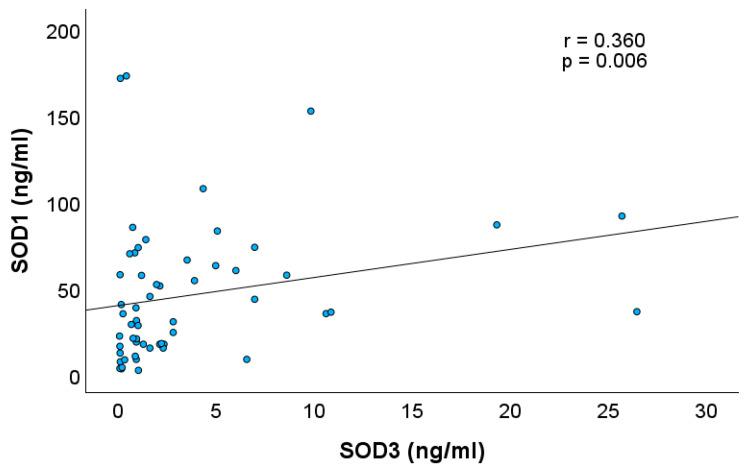
SOD1 and SOD3 in AF concentrations decreased significantly with gestational age (GA) ( < 0.001), while 8-OHdG levels increased ( < 0.001). SOD3 showed a negative correlation with 8-OHdG ( = 0.004). HM contained significantly higher levels of both SOD isoforms compared to AF (AF vs. HM: 35.6 (1.9-172.3) vs. 267.9 (54.6-843.8), < 0.001 for SOD1 and 1.2 ng/mL (0.1-26.5) vs. 5.5 ng/mL (0.1-300.0), < 0.001 for SOD3), regardless of GA.
CONCLUSIONS
Our findings highlight the dynamic nature of the redox environment in AF and its potential importance for foetal GIT development. The disruption of redox balance by preterm birth or inadequate AF intake during foetal life may have long-term consequences for intestinal development and function. These insights provide a foundation for future clinical studies aimed at enhancing neonatal feeding regimens, particularly for preterm infants and those with congenital gastrointestinal disorders.
引言
羊水(AF)通过传递支持肠道成熟的生物活性因子,在胎儿胃肠道发育中发挥关键作用。然而,羊水的氧化还原环境及其对胎儿肠道内环境稳定的潜在贡献仍未得到充分表征。本研究旨在量化不同孕周羊水中的关键抗氧化标志物——超氧化物歧化酶同工酶(SOD1、SOD3)、谷胱甘肽(GSH)以及氧化DNA损伤标志物8-羟基-2'-脱氧鸟苷(8-OHdG),并将其与母乳(HM)中的这些标志物进行比较。
方法
收集妊娠15至40周孕妇的羊水样本(n = 60),分为早产组(<37周)和足月组(≥37周)。采用酶联免疫吸附测定法(ELISA)定量测定SOD1、SOD3、GSH和8-OHdG的浓度。对母乳样本(n = 45)进行类似分析。
结果
羊水中SOD1和SOD3的浓度随孕周(GA)显著降低(P < 0.001),而8-OHdG水平升高(P < 0.001)。SOD3与8-OHdG呈负相关(r = 0.004)。与羊水相比,母乳中两种SOD同工酶的含量均显著更高(羊水与母乳:SOD1为35.6(1.9 - 172.3)与267.9(54.6 - 843.8),P < 0.001;SOD3为1.2 ng/mL(0.1 - 26.5)与5.5 ng/mL(0.1 - 300.0),P < 0.001),与孕周无关。
结论
我们的研究结果突出了羊水中氧化还原环境的动态性质及其对胎儿胃肠道发育的潜在重要性。早产或胎儿期羊水摄入不足导致的氧化还原平衡破坏可能对肠道发育和功能产生长期影响。这些见解为未来旨在优化新生儿喂养方案的临床研究奠定了基础,特别是针对早产儿和患有先天性胃肠道疾病的婴儿。

 Zotero 插件