
前列腺素通过调节膀胱腔内可溶性核苷酸酶的释放来调节尿嘌呤。
Prostaglandins Regulate Urinary Purines by Modulating Soluble Nucleotidase Release in the Bladder Lumen.
作者信息
Borhani Peikani Mahsa, Gutierrez Cruz Alejandro, Buckley Zoe S, Mutafova-Yambolieva Violeta N
机构信息
Department of Physiology and Cell Biology, School of Medicine, University of Nevada Reno, Reno, NV 89557, USA.
出版信息
Int J Mol Sci. 2025 Aug 19;26(16):8023. doi: 10.3390/ijms26168023.
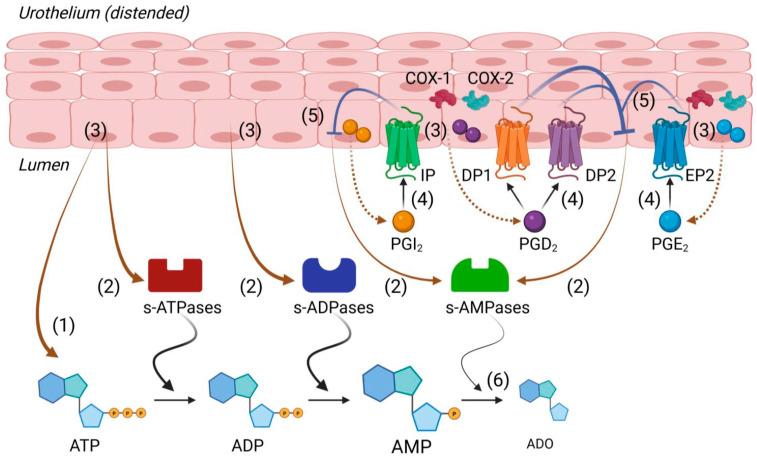
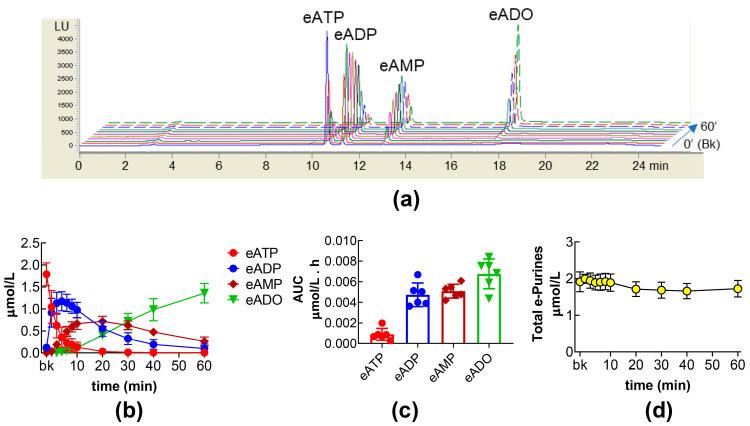
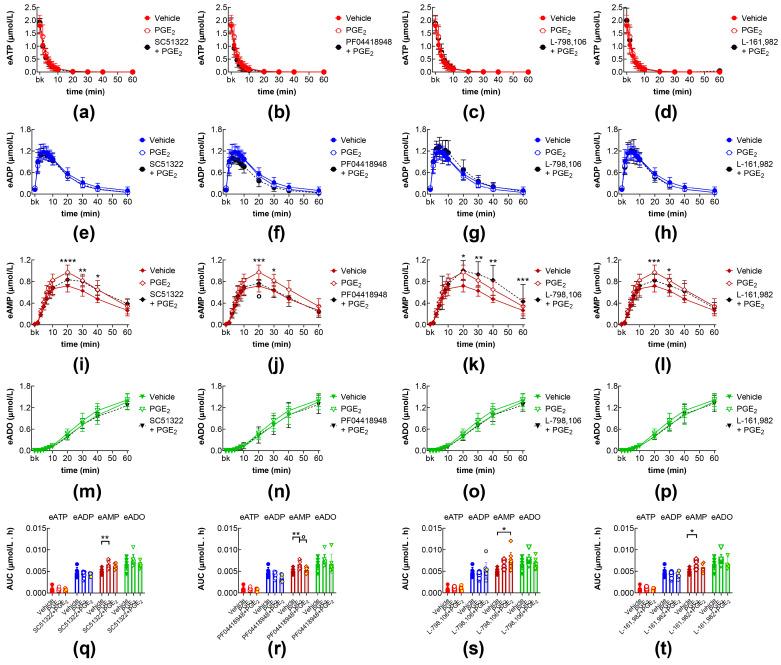
Distention of the urinary bladder wall during filling stretches the urothelium and induces the release of chemical mediators, including adenosine 5'-triphosphate (ATP) and prostaglandins (PGs), that transmit signals between cells within the bladder wall. The urothelium also releases soluble nucleotidases (s-NTDs) that control the availability of ATP and its metabolites at receptor sites in umbrella cells and cells deeper in the bladder wall, as well as in the urine. This study investigated whether PGs regulate the intravesical breakdown of ATP by s-NTDs. Using a murine decentralized mucosa-only bladder model and an HPLC technology with fluorescence detection, we evaluated the decrease in ATP and increase in ADP, AMP, and adenosine (ADO) in intraluminal solutions (ILS) collected at the end of physiological bladder filling. PGD, PGE, and PGI, but not PGF, inhibited the conversion of AMP (produced from ATP) to ADO, likely due to a suppressed intravesical release of s-AMPases. The effects of exogenous PGD, PGE, and PGI were mediated by DP1/DP2, EP2, and IP prostanoid receptors, respectively. Activation of either DP1 or DP2 receptors by endogenous PGD also led to AMP increase and ADO decrease in ILS-containing ATP substrate. Finally, PGs produced by either COX-1 or COX-2 inhibited the hydrolysis of AMP to ADO. Together, these observations suggest that (1) endogenous PGs (chiefly PGD, and to lesser degree PGE and PGI) allow release of s-NTDs like s-ATPases and s-ADPases but impede the formation of ADO from intravesical ATP by inhibiting the release of s-NTDs/s-AMPases; (2) it is possible that high concentrations of PGD, PGE and PGI, as anticipated in inflammation or bladder pain syndrome, delay the ADO production and prolong the action of excitatory purine mediators; and (3) either COX-1 and COX-2 are constitutively expressed in the mouse bladder mucosa or COX-2 is induced by distention of the urothelium during bladder filling.
膀胱充盈时膀胱壁的扩张会拉伸尿路上皮,并诱导化学介质的释放,包括5'-三磷酸腺苷(ATP)和前列腺素(PGs),这些介质在膀胱壁内的细胞之间传递信号。尿路上皮还会释放可溶性核苷酸酶(s-NTDs),其可控制伞状细胞、膀胱壁深层细胞以及尿液中受体部位的ATP及其代谢产物的可用性。本研究调查了PGs是否通过s-NTDs调节膀胱内ATP的分解。使用小鼠去神经支配的仅含黏膜的膀胱模型和具有荧光检测功能的高效液相色谱技术,我们评估了在生理性膀胱充盈结束时收集的腔内溶液(ILS)中ATP的减少以及ADP、AMP和腺苷(ADO)的增加。PGD、PGE和PGI,但不包括PGF,抑制了由ATP产生的AMP向ADO的转化,这可能是由于膀胱内s-AMPases的释放受到抑制。外源性PGD、PGE和PGI的作用分别由DP1/DP2、EP2和IP前列腺素受体介导。内源性PGD对DP1或DP2受体的激活也导致含ATP底物的ILS中AMP增加和ADO减少。最后,由COX-1或COX-2产生的PGs抑制了AMP向ADO的水解。总之,这些观察结果表明:(1)内源性PGs(主要是PGD,其次是PGE和PGI)允许s-ATPases和s-ADPases等s-NTDs的释放,但通过抑制s-NTDs/s-AMPases的释放来阻碍膀胱内ATP形成ADO;(2)如在炎症或膀胱疼痛综合征中预期的那样,高浓度的PGD、PGE和PGI可能会延迟ADO的产生并延长兴奋性嘌呤介质的作用;(3)COX-1和COX-2要么在小鼠膀胱黏膜中组成性表达,要么COX-2在膀胱充盈期间由尿路上皮的扩张诱导表达。



 Zotero 插件