
“如果你没睡好(……)你就不想出去跑步,不想骑自行车,你就只想坐着,什么都不做”——1型糖尿病青少年对24小时运动行为的认知。
"If You Haven't Slept a Lot (…) You Don't Want to Go Out for a Run, You Don't Want to Ride a Bike, You Just Kind of Sit and You Just (…) Do Nothing"-Perceptions of 24-Hour Movement Behaviours Among Adolescents Living with Type 1 Diabetes.
作者信息
Patience Mhairi, Kirk Alison, Janssen Xanne, Sanders James, Crawford Megan
机构信息
Psychology Group, Department of Psychological Sciences & Health, Faculty of Humanities & Social Sciences, University of Strathclyde, Glasgow G1 1XP, UK.
Physical Activity for Health Group, Department of Psychological Sciences & Health, Faculty of Humanities & Social Sciences, University of Strathclyde, Glasgow G1 1XP, UK.
出版信息
Int J Environ Res Public Health. 2025 Aug 19;22(8):1295. doi: 10.3390/ijerph22081295.
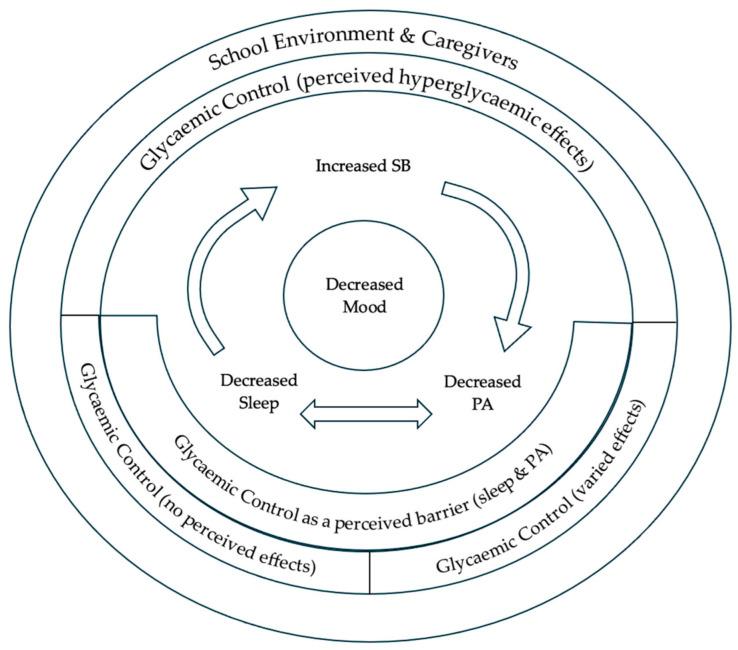
The importance of physical activity, sedentary behaviour, and sleep behaviour in adolescents with type 1 diabetes (T1D) has been explored in isolation. However, adolescents experience health benefits when these behaviours are balanced appropriately throughout the day, and are considered to be interconnected rather than isolated. The aim of this study was to investigate the perspectives of adolescents living with T1D towards these behaviours collectively. The participants were 15 adolescents (aged 11-18 years) with T1D, recruited using online methods and word of mouth. Online semi-structured interviews were transcribed using intelligent verbatim and analysed using thematic analysis. We identified the following four central themes and five subthemes: (1) sleep and physical activity are understood and valued above sedentary behaviour; (2) recognition of movement behaviours' interconnection; (3) movement behaviours' interaction with health outcomes (mood, glycaemic control, and glycaemic control as a barrier to movement behaviours); and (4) movement behaviours within the environmental context of the adolescent (school and caregivers). Adolescents with T1D are aware of the interconnectedness of each movement behaviour and the positive influence a balanced approach can have on mood and T1D management. The findings provide important information for future holistic interventions promoting healthy behaviours that target the adolescent, their school environment, and their caregivers.
1型糖尿病(T1D)青少年的身体活动、久坐行为和睡眠行为的重要性已被单独探讨。然而,当这些行为在一天中得到适当平衡时,青少年会从中受益,并且这些行为被认为是相互关联的,而非孤立的。本研究的目的是调查患有T1D的青少年对这些行为的总体看法。参与者为15名患有T1D的青少年(年龄在11 - 18岁之间),通过网络方法和口碑招募而来。在线半结构化访谈采用智能逐字记录并进行主题分析。我们确定了以下四个核心主题和五个子主题:(1)睡眠和身体活动比久坐行为更被理解和重视;(2)认识到运动行为的相互联系;(3)运动行为与健康结果的相互作用(情绪、血糖控制,以及血糖控制对运动行为的阻碍);(4)青少年环境背景(学校和照顾者)中的运动行为。患有T1D的青少年意识到每种运动行为的相互联系,以及平衡的方法对情绪和T1D管理的积极影响。这些发现为未来针对青少年、其学校环境和照顾者的促进健康行为的整体干预提供了重要信息。
 Zotero 插件