
体育锻炼对中国老年人抑郁和跌倒风险的双重影响——来自2020年中国健康与养老追踪调查(CHARLS)的证据
The dual impact of physical exercise on depression and fall risk in older Chinese adults - evidence from CHARLS 2020.
作者信息
Yuan Wenhui, Cui Jinghang
机构信息
College of Physical Education, Xi'an Shiyou University, Xi'an, China.
Center for Applied Science in Health and Aging, Western Kentucky University, Bowling Green, KY, United States.
出版信息
Front Public Health. 2025 Aug 11;13:1615326. doi: 10.3389/fpubh.2025.1615326. eCollection 2025.
INTRODUCTION
Rapid population aging in China has elevated concerns regarding the mental and physical well-being of older adults. This study investigates the interrelationships among physical exercise, depression, and fall risk using data from the 2020 wave of the China Health and Retirement Longitudinal Study (CHARLS).
METHODS
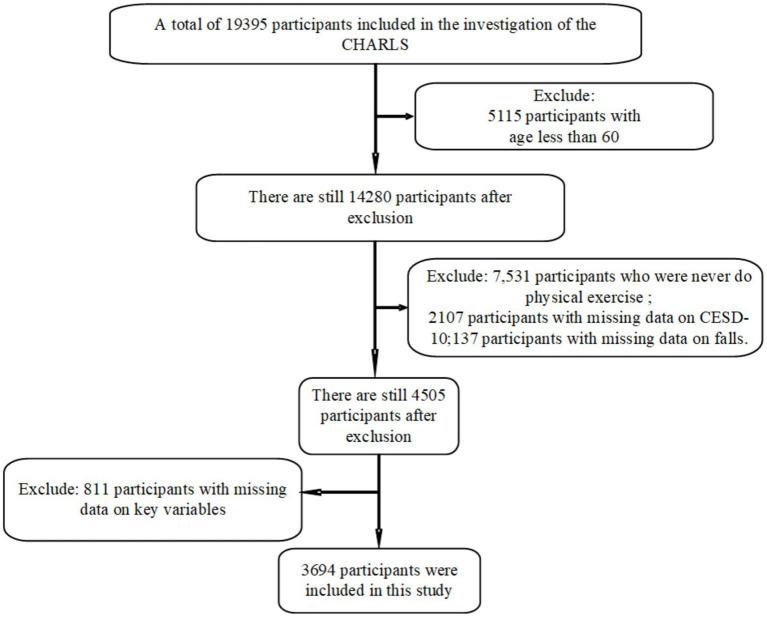
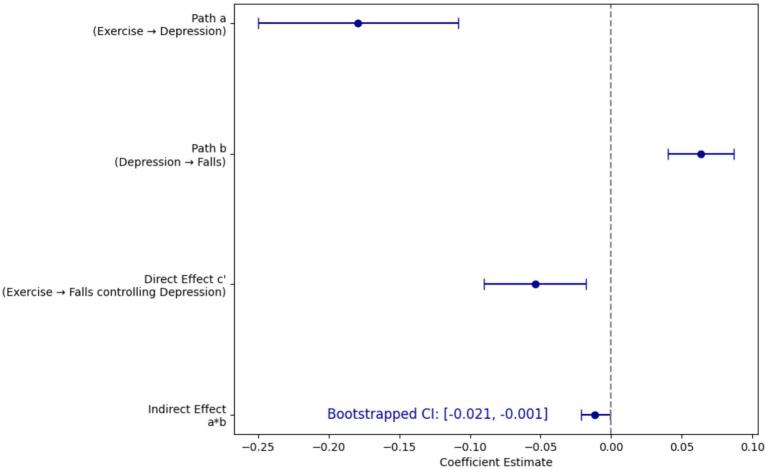
We analyzed a sample of 3,694 older adults. An ordinary least squares regression model was employed to assess the impact of physical exercise on depression, while a logistic regression model was used to examine the effect on fall risk. Key control variables included age, biological sex, income, marital status, and major accident history. Mediation analyses were then conducted to test the indirect effect of exercise on fall risk through depression, with subgroup analyses comparing urban and rural respondents.
RESULTS
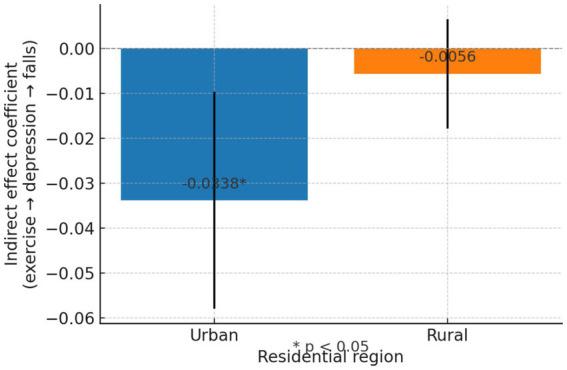
Results from the depression model revealed that physical exercise significantly reduced depression scores ( ), and males exhibited lower scores relative to females. The falls model indicated a trend toward reduced fall risk with increased exercise ( ), while older age and female gender are associated with elevated risk. Mediation analysis demonstrated a significant indirect effect in the urban group (mean indirect effect = -0.0338), but not in the rural group (mean indirect effect = -0.0056).
DISCUSSION
These findings suggest that physical exercise not only directly improves mental health but also indirectly reduces fall risk through alleviating depressive symptoms in urban older adults. The lack of a significant mediating effect in rural areas suggests that local contextual factors may alter the exercise-depression-fall pathway. The results support integrated public health interventions tailored to local settings to enhance both mental and physical outcomes among China's aging population.
引言
中国人口的快速老龄化引发了人们对老年人身心健康的担忧。本研究利用中国健康与养老追踪调查(CHARLS)2020年的数据,调查体育锻炼、抑郁和跌倒风险之间的相互关系。
方法
我们分析了3694名老年人的样本。采用普通最小二乘法回归模型评估体育锻炼对抑郁的影响,同时使用逻辑回归模型检验对跌倒风险的影响。关键控制变量包括年龄、生物性别、收入、婚姻状况和重大事故史。然后进行中介分析,以检验运动通过抑郁对跌倒风险的间接影响,并进行亚组分析比较城乡受访者。
结果
抑郁模型的结果显示,体育锻炼显著降低了抑郁得分( ),男性得分相对于女性较低。跌倒模型表明,随着运动量增加,跌倒风险有降低的趋势( ),而年龄较大和女性与较高的风险相关。中介分析表明,城市组存在显著的间接效应(平均间接效应=-0.0338),而农村组则没有(平均间接效应=-0.0056)。
讨论
这些发现表明,体育锻炼不仅能直接改善心理健康,还能通过减轻城市老年人的抑郁症状间接降低跌倒风险。农村地区缺乏显著的中介效应表明,当地环境因素可能会改变运动-抑郁-跌倒的路径。研究结果支持根据当地情况量身定制综合公共卫生干预措施,以改善中国老年人口的身心健康状况。

 Zotero 插件