
感染与支气管扩张症急性加重后心血管事件的增加有关。
infection is linked to increases in cardiovascular events post exacerbation in bronchiectasis.
作者信息
L Engin, Owen Caroline A, Reid Fred, Cabrera Claudia, Haworth Charles S, Hughes Rod
机构信息
Clinical Development, Early R&I, BioPharmaceuticals R&D, AstraZeneca, Gothenburg, Sweden.
Clinical Development, Early R&I, BioPharmaceuticals R&D, AstraZeneca, Gaithersburg, MD, USA.
出版信息
ERJ Open Res. 2025 Aug 26;11(4). doi: 10.1183/23120541.01126-2024. eCollection 2025 Jul.
INTRODUCTION
(PsA) infection contributes to disease progression in bronchiectasis (BE), particularly exacerbations which are known to increase the risk of cardiovascular (CV) events. However, the link between PsA infection and CV events in BE is unknown. Thus, we investigated whether there is an association between PsA airway infection and the risk of CV events post-exacerbation.
METHODS
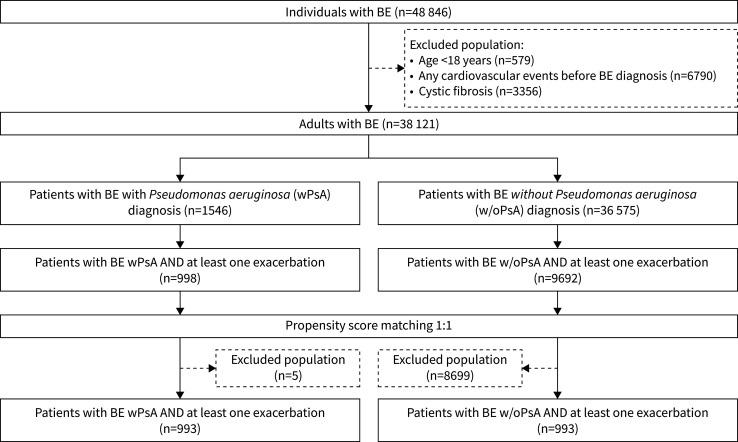
This was a US retrospective cohort study using the TriNetX platform between 2008 and 2019. Adult patients with (wPsA) or without (w/oPsA) PsA airway infection were included. Date of first exacerbation corresponded to the index date, and patients were followed for up to 5 years post index. Risk ratios (RR) for hospitalisation, subsequent exacerbation, mortality and incidence of pre-specified CV events were estimated. Propensity score matching (PSM) was used to balance baseline characteristics.
RESULTS
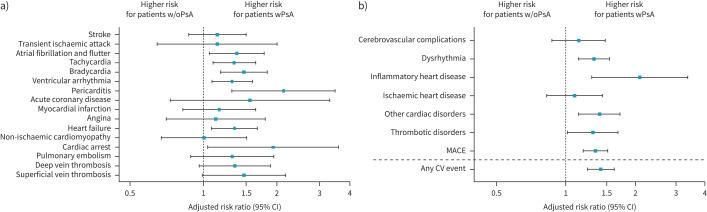
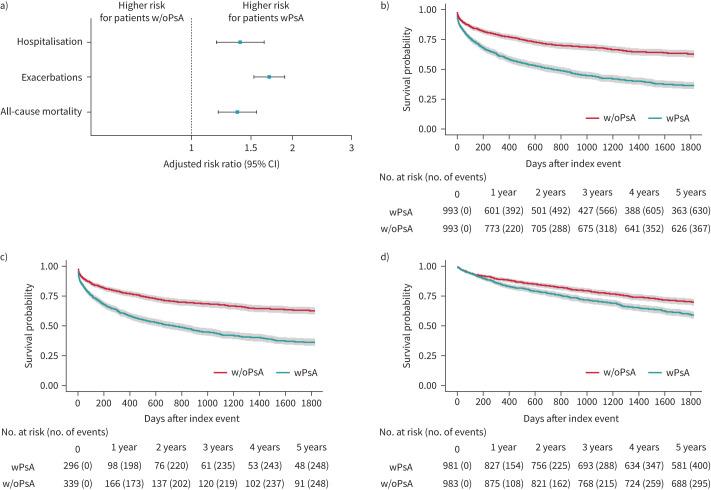
After PSM, patients wPsA infection were at a greater risk of hospitalisation (RR: 1.40; 95% CI: 1.19-1.64), subsequent exacerbation (RR: 1.70; 95% CI: 1.53-1.90) and mortality (RR: 1.37; 95% CI: 1.20-1.56) than patients w/oPsA. PsA infection was associated with a higher risk of dysrhythmias (RR: 1.32; 95% CI: 1.13-1.54), inflammatory heart disease (RR: 2.09; 95% CI: 1.29-3.37), other cardiac disorders (RR: 1.40; 95% CI: 1.14-1.72), thrombotic disorders (RR: 1.31; 95% CI: 1.01-1.68), major adverse cardiovascular events (RR: 1.35; 95% CI: 1.19-1.52) and any CV outcome (RR: 1.42; 95% CI: 1.24-1.62).
CONCLUSION
PsA infection in patients with BE is associated with an increased risk of CV events following a baseline exacerbation. These data highlight the multisystemic nature of BE and the need to raise awareness of the potential increased risk of CV events in patients with BE experiencing exacerbations.
引言
支气管扩张症(BE)中的肺炎链球菌(PsA)感染会促使疾病进展,尤其是会增加心血管(CV)事件风险的病情加重情况。然而,BE中PsA感染与CV事件之间的联系尚不清楚。因此,我们调查了PsA气道感染与病情加重后CV事件风险之间是否存在关联。
方法
这是一项在美国进行的回顾性队列研究,使用TriNetX平台,时间跨度为2008年至2019年。纳入了患有(wPsA)或未患有(w/oPsA)PsA气道感染的成年患者。首次病情加重日期对应于索引日期,患者在索引日期后随访长达5年。估计了住院、后续病情加重、死亡率以及预先指定的CV事件发生率的风险比(RR)。使用倾向评分匹配(PSM)来平衡基线特征。
结果
经过PSM后,与未感染PsA的患者相比,感染PsA的患者住院风险更高(RR:1.40;95%置信区间:1.19 - 1.64)、后续病情加重风险更高(RR:1.70;95%置信区间:1.53 - 1.90)以及死亡风险更高(RR:1.37;95%置信区间:1.20 - 1.56)。PsA感染与心律失常风险更高(RR:1.32;95%置信区间:1.13 - 1.54)、炎症性心脏病风险更高(RR:2.09;95%置信区间:1.29 - 3.37)、其他心脏疾病风险更高(RR:1.40;95%置信区间:1.14 - 1.72)、血栓形成性疾病风险更高(RR:1.31;95%置信区间:1.01 -
 Zotero 插件