
II型时间-强度曲线(TIC)乳腺病变的动态对比增强T1加权成像参数分析
Analysis of dynamic contrast-enhanced T1-weighted imaging parameters in type II TIC breast lesions.
作者信息
Jiang Jimei, Ma Weibin, Li Ming, Han Shanhua, Luo Yu
机构信息
Department of Radiology, Shanghai Fourth People's Hospital, School of Medicine, Tongji University, Shanghai, China.
出版信息
Front Oncol. 2025 Aug 12;15:1403262. doi: 10.3389/fonc.2025.1403262. eCollection 2025.
BACKGROUND
In dynamic contrast-enhanced T1-weighted imaging (DCE-T1WI) of breast lesions, type III time-intensity curves (TICs) are associated with malignant lesions, and type I TICs are associated with benign lesions, but the association of type II curves with the status of breast lesions remains controversial. This study aimed to analyze the semi-quantitative parameters derived from DCE-T1WI in patients with type II TIC breast lesions and to develop a nomogram for the benign/malignant classification of lesions with type II TICs.
METHODS
Data of patients with type II TIC breast lesions were retrospectively collected. The following semi-quantitative parameters were collected: signal intensity of pre-contrast (SIpre), peak signal intensity (SIp), signal intensity of wash-in (SIwi), slope of peak (Sp), slope of wash-in (Swi), time to peak (Tp), time of wash-in (Twi), enhancement rate of peak (ERp), and enhancement rate of wash-in (ERwi). Univariable and multivariable analyses were performed to select useful clinical and DCE-T1WI features. Selected features were used for nomogram model development. The sensitivity, specificity, positive predictive value (PPV), negative predictive value (NPV), accuracy, and area under the curve (AUC) were used for model performance evaluation.
RESULTS
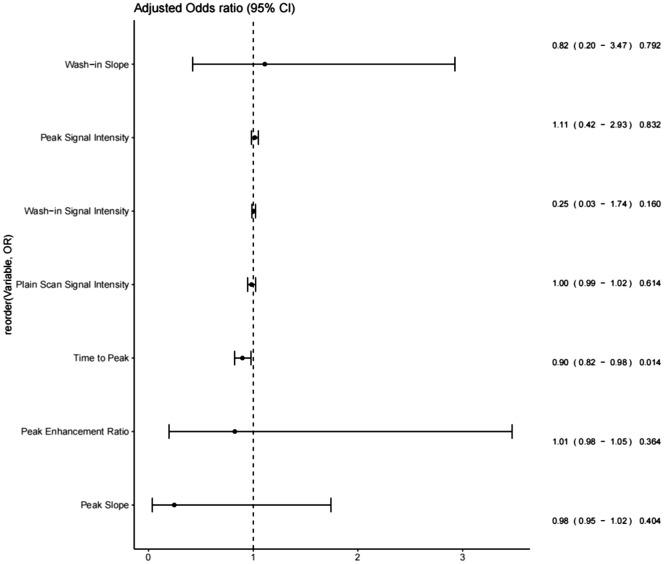
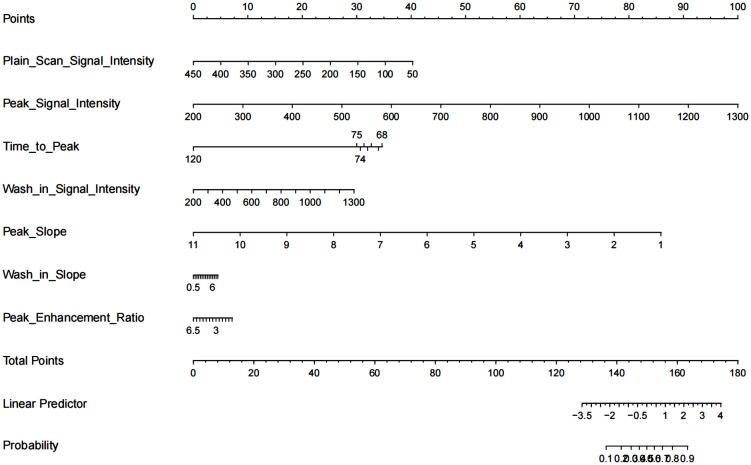
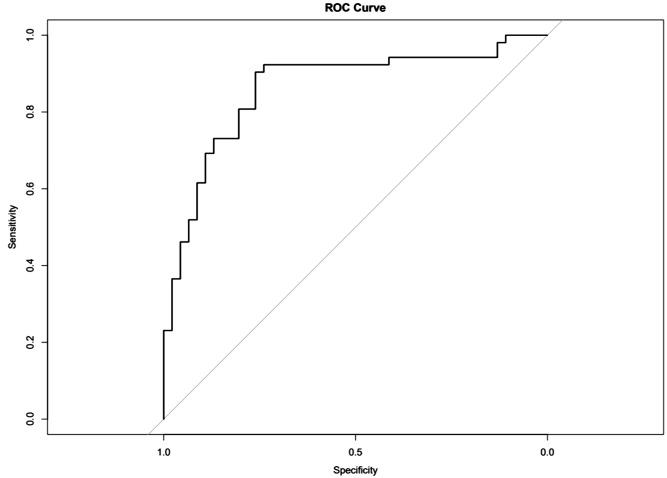
Ninety-eight female patients with type II TIC breast lesions were included (53 with malignant lesions). After univariable and multivariable logistic regression analyses, only Tp showed an odds ratio of 0.95 (p = 0.014, 95% confidence interval: 0.93-0.97). A nomogram was constructed and included Swi, SIp, SIwi, SIpre, Tp, ERp, and Sp. The sensitivity, specificity, PPV, NPV, and accuracy of the nomogram were 0.827, 0.761, 0.795, 0.796, and 0.796, respectively. The AUC was 0.862.
CONCLUSION
DCE-T1WI semi-quantitative parameters were different among benign and malignant lesions in patients with type II TIC lesions. Tp showed the most significant difference after a multivariable logistic regression analysis. The results suggest that DCE-T1WI semi-quantitative parameters can be used to predict malignant lesions in patients with type II TIC.
背景
在乳腺病变的动态对比增强T1加权成像(DCE-T1WI)中,III型时间-强度曲线(TIC)与恶性病变相关,I型TIC与良性病变相关,但II型曲线与乳腺病变状态的关系仍存在争议。本研究旨在分析II型TIC乳腺病变患者DCE-T1WI的半定量参数,并建立II型TIC病变良恶性分类的列线图。
方法
回顾性收集II型TIC乳腺病变患者的数据。收集以下半定量参数:对比前信号强度(SIpre)、峰值信号强度(SIp)、流入期信号强度(SIwi)、峰值斜率(Sp)、流入期斜率(Swi)、达峰时间(Tp)、流入时间(Twi)、峰值增强率(ERp)和流入期增强率(ERwi)。进行单变量和多变量分析以选择有用的临床和DCE-T1WI特征。选定的特征用于列线图模型的开发。敏感性、特异性、阳性预测值(PPV)、阴性预测值(NPV)、准确性和曲线下面积(AUC)用于模型性能评估。
结果
纳入98例II型TIC乳腺病变女性患者(53例为恶性病变)。经过单变量和多变量逻辑回归分析,只有Tp显示比值比为0.95(p = 0.014,95%置信区间:0.93-0.97)。构建了一个列线图,包括Swi、SIp、SIwi、SIpre、Tp、ERp和Sp。列线图的敏感性、特异性、PPV、NPV和准确性分别为0.827、0.761、0.795、0.796和0.796。AUC为0.862。
结论
II型TIC病变患者的良性和恶性病变之间DCE-T1WI半定量参数不同。多变量逻辑回归分析后Tp显示出最显著差异。结果表明,DCE-T1WI半定量参数可用于预测II型TIC患者的恶性病变。


 Zotero 插件