
两项随机对照试验中肺癌筛查有效性异质性的比较分析
A comparative analysis of heterogeneity in lung cancer screening effectiveness in two randomised controlled trials.
作者信息
Welz Max, van der Aalst Carlijn M, Alfons Andreas, Naghi Andrea A, Heuvelmans Marjolein A, Groen Harry J M, de Jong Pim A, Aerts Joachim, Oudkerk Matthijs, de Koning Harry J, Ten Haaf Kevin
机构信息
Department of Public Health, Erasmus MC-University Medical Center Rotterdam, Rotterdam, the Netherlands.
Econometric Institute, Erasmus University Rotterdam, Rotterdam, the Netherlands.
出版信息
Nat Commun. 2025 Aug 28;16(1):8060. doi: 10.1038/s41467-025-63471-6.
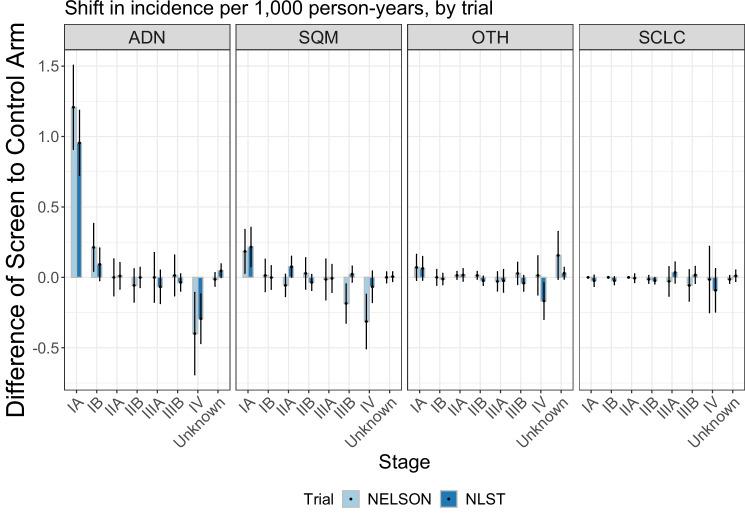
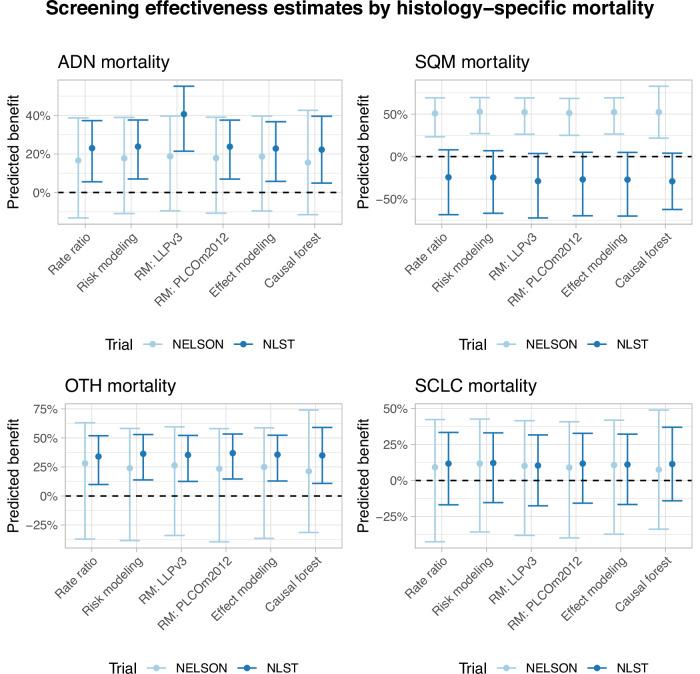
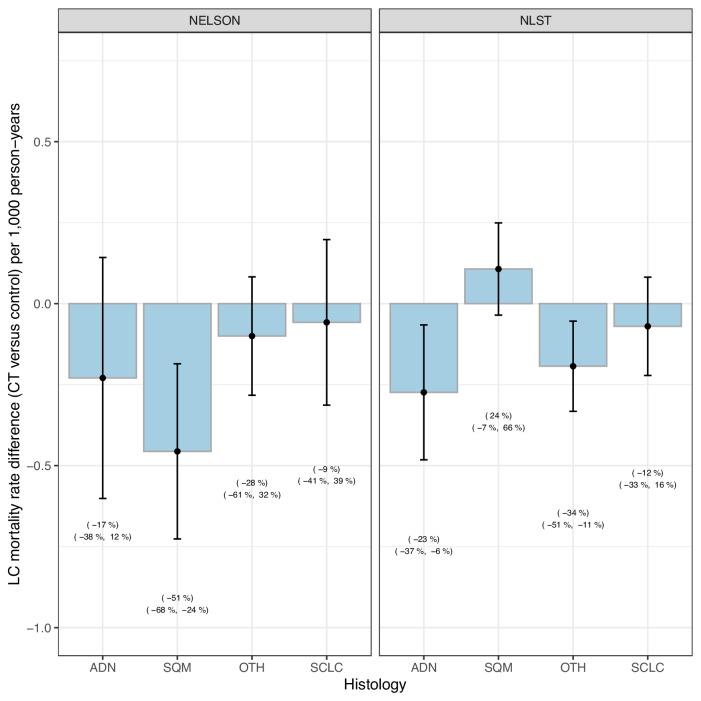
Clinical trials demonstrate that screening can reduce lung cancer mortality by over 20%. However, lung cancer screening effectiveness (reduction in lung cancer specific mortality) may vary by personal risk-factors. Here we evaluate heterogeneity in lung cancer screening effectiveness through traditional sub-group analyses, predictive modelling approaches and machine-learning in individual-level data from the Dutch-Belgian lung cancer screening trial (NELSON; 14,808 participants, 12,429 men, 2377 women, 2 persons with an unknown sex) and the National Lung Screening Trial (NLST; 53,405 participants, 31,501 men, 21,904 women). We find that screening effectiveness varies by pack-years (screening effectiveness ranges across trials: lowest groups = 26.8-50.9%, highest groups = 5.5-9.5%), smoking status (screening effectiveness ranges across trials: former smokers = 37.8-39.1%, current smokers = 16.1-22.7%) and sex (screening effectiveness ranges across trials: women = 24.6-25.3%; men = 8.3-24.9%). Furthermore, screening effectiveness varies by histology (screening effectiveness ranges across trials: adenocarcinoma = 17.8-23.0%, other lung cancers = 24.5-35.5%, small-cell carcinoma = 9.7%-11.3%). Screening is ineffective for squamous-cell carcinoma in NLST (screening effectiveness = 27.9% (95% confidence interval: 69.8% increase to 4.5% decrease) mortality increase) but effective in NELSON (screening effectiveness = 52.2% (95% confidence interval: 25.7-69.1% decrease) mortality reduction). We find that variations in screening effectiveness across pack-years, smoking status, and sex are primarily explained by a greater prevalence of histologies with favourable screening effectiveness in these groups. Our study shows that heterogeneity in lung screening effectiveness is primarily driven by histology and that relaxing smoking-related screening eligibility criteria may enhance screening effectiveness.
临床试验表明,筛查可将肺癌死亡率降低20%以上。然而,肺癌筛查的有效性(降低肺癌特异性死亡率)可能因个人风险因素而异。在此,我们通过传统亚组分析、预测建模方法和机器学习,对来自荷兰-比利时肺癌筛查试验(NELSON;14808名参与者,12429名男性,2377名女性,2名性别未知者)和国家肺癌筛查试验(NLST;53405名参与者,31501名男性,21904名女性)的个体层面数据中的肺癌筛查有效性异质性进行评估。我们发现,筛查有效性因吸烟包年数(各试验中筛查有效性范围:最低组=26.8 - 50.9%,最高组=5.5 - 9.5%)、吸烟状况(各试验中筛查有效性范围:既往吸烟者=37.8 - 39.1%,当前吸烟者=16.1 - 22.7%)和性别(各试验中筛查有效性范围:女性=24.6 - 25.3%;男性=8.3 - 24.9%)而有所不同。此外,筛查有效性因组织学类型而异(各试验中筛查有效性范围:腺癌=17.8 - 23.0%,其他肺癌=24.5 - 35.5%,小细胞癌=9.7% - 11.3%)。在NLST中,筛查对鳞状细胞癌无效(筛查有效性=27.9%(95%置信区间:死亡率增加69.8%至降低4.5%)),但在NELSON中有效(筛查有效性=52.2%(95%置信区间:死亡率降低25.7 - 69.1%))。我们发现,吸烟包年数、吸烟状况和性别之间筛查有效性的差异主要是由于这些组中筛查有效性良好的组织学类型患病率较高。我们的研究表明,肺癌筛查有效性的异质性主要由组织学类型驱动,放宽与吸烟相关的筛查资格标准可能会提高筛查有效性。


 Zotero 插件