
长新冠患者体位性直立性心动过速综合征的特征:来自LISTEN研究的自我报告数据。
Characterization of Postural Orthostatic Tachycardia Syndrome in Long COVID: Self-reported Data From the LISTEN Study.
作者信息
Al Mouslmani Mohammad, Sawano Mitsuaki, Arun Adith S, Wu Yilun, Shah Rishi M, Kaleem Shayaan, Zhou Tianna, Murugiah Karthik, Lu Yuan, Herrin Jeph, Bishop Pamela, Taub Pam, Peixoto Aldo J, Bhattacharjee Bornali, Iwasaki Akiko, Krumholz Harlan M
机构信息
Department of Hospital Medicine, Yale New Haven Hospital, New Haven, Connecticut, USA; Center for Outcomes Research and Evaluation, Yale New Haven Hospital, New Haven, Connecticut, USA.
Center for Outcomes Research and Evaluation, Yale New Haven Hospital, New Haven, Connecticut, USA; Section of Cardiovascular Medicine, Department of Internal Medicine, Yale School of Medicine, New Haven, Connecticut, USA.
出版信息
JACC Adv. 2025 Aug;4(8):101873. doi: 10.1016/j.jacadv.2025.101873.
BACKGROUND
Postural orthostatic tachycardia syndrome (POTS) has emerged as a significant cardiovascular phenotype among individuals experiencing postacute COVID-19 syndrome, commonly referred to as long COVID.
OBJECTIVES
The purpose of this study was to describe the experience of people reporting long COVID-associated POTS.
METHODS
We collected data from individuals aged ≥18 years with self-reported long COVID who participated in the Yale Listen to Immune, Symptom and Treatment Experiences Now (LISTEN) cohort, an online observational study. The study included participants surveyed from May 2022 to July 2023. POTS status was determined by self-reported diagnosis of POTS. We compared the demographics, symptoms, associated conditions, and health status of people with and without self-reported POTS.
RESULTS
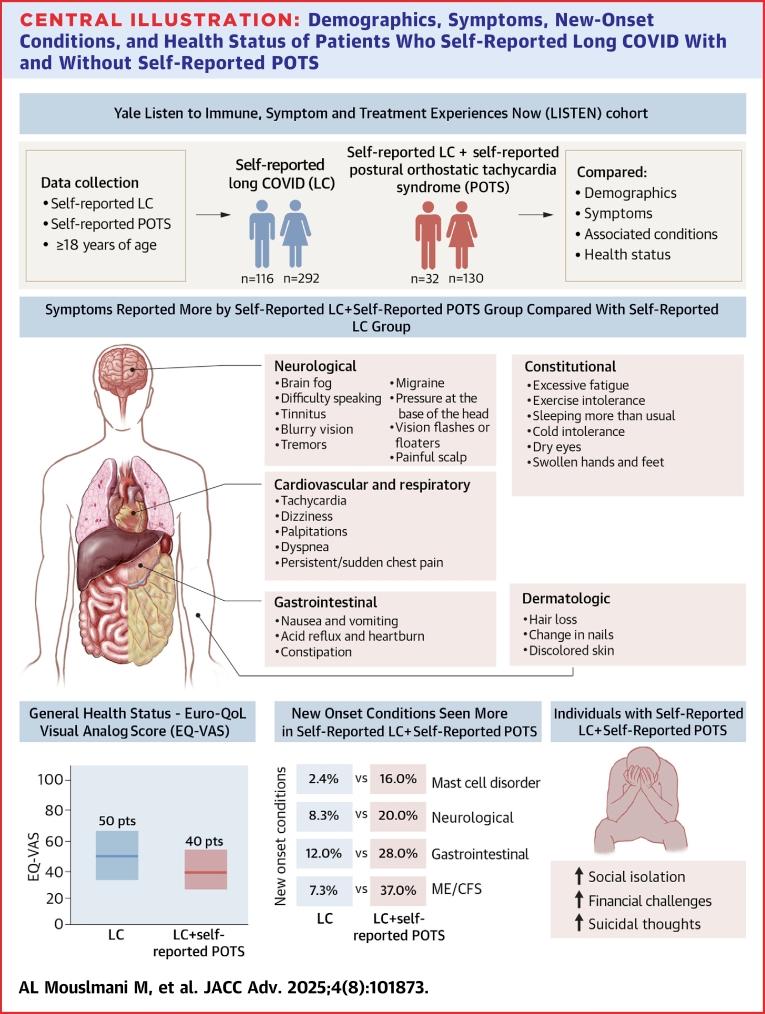
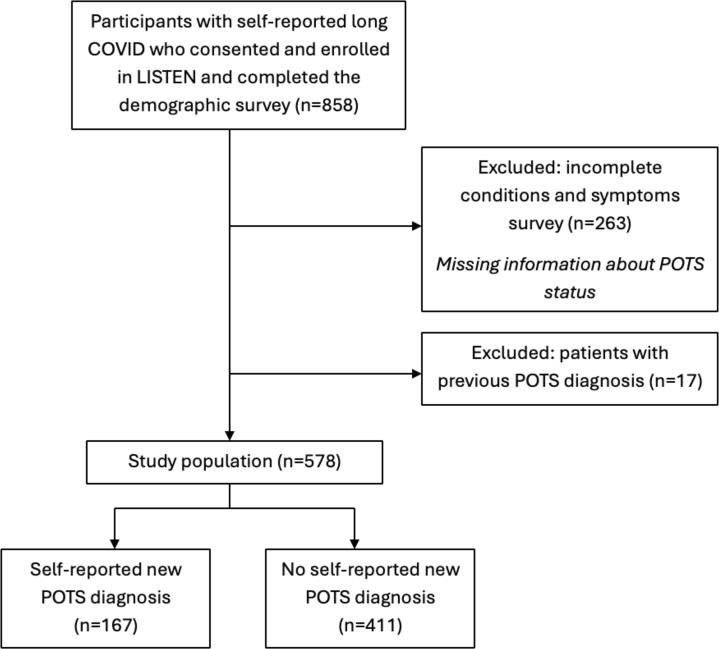
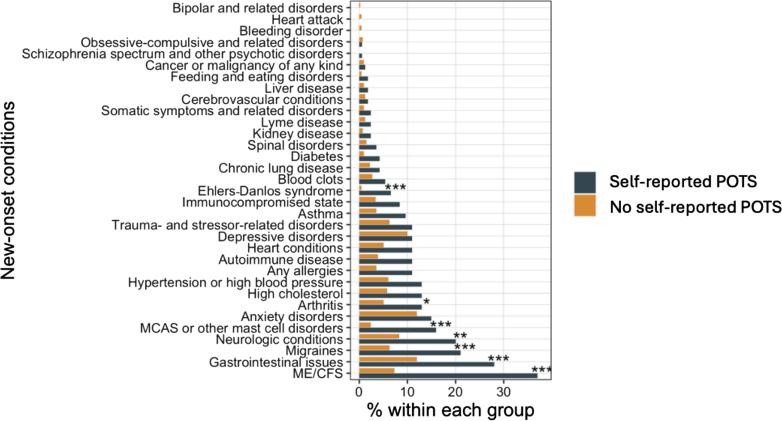
Of the 578 individuals included, 167 (28.9%) reported new-onset POTS and 411 (71.1%) did not report POTS as one of their long COVID-associated conditions. Seventy-eight percent of participants with self-reported POTS were women (range, 18-74 years). Participants with self-reported POTS were younger, had more financial difficulties, more social isolation, more suicidal thoughts, worse health status measured by the EuroQoL visual analog scale, and reported higher rates of rapid heart rate after standing up, dizziness, palpitations, persistent chest pain, sudden chest pain, excessive fatigue, exercise intolerance, heat intolerance, brain fog, tinnitus, migraine, internal tremors, skin discoloration, and dry eyes, as well as new-onset myalgic encephalomyelitis/chronic fatigue syndrome and mast cell disorders.
CONCLUSIONS
Individuals with self-reported long COVID-associated POTS experienced substantial health burdens in various domains compared with those without self-reported POTS, highlighting the urgency for further research to understand the mechanism, characterize the physiological derangements, and target treatments so we can help these individuals.
背景
体位性直立性心动过速综合征(POTS)已成为急性新冠后综合征(通常称为长期新冠)患者中一种重要的心血管表型。
目的
本研究的目的是描述报告患有长期新冠相关POTS的人群的经历。
方法
我们从年龄≥18岁、自我报告患有长期新冠的个体中收集数据,这些个体参与了耶鲁大学“现在倾听免疫、症状和治疗经历”(LISTEN)队列研究,这是一项在线观察性研究。该研究纳入了2022年5月至2023年7月接受调查的参与者。POTS状态通过自我报告的POTS诊断来确定。我们比较了自我报告有POTS和没有POTS的人群的人口统计学特征、症状、相关疾病和健康状况。
结果
在纳入的578名个体中,167名(28.9%)报告新发POTS,411名(71.1%)未将POTS报告为其长期新冠相关疾病之一。自我报告有POTS的参与者中78%为女性(年龄范围18 - 74岁)。自我报告有POTS的参与者更年轻,有更多经济困难、更多社交隔离、更多自杀念头,根据欧洲五维度健康量表视觉模拟量表测量的健康状况更差,并且报告站立后心率加快、头晕、心悸、持续性胸痛、突发性胸痛、过度疲劳、运动不耐受、不耐热、脑雾、耳鸣、偏头痛、体内震颤、皮肤变色和干眼的发生率更高,以及新发肌痛性脑脊髓炎/慢性疲劳综合征和肥大细胞疾病。
结论
与未自我报告有POTS的个体相比,自我报告患有长期新冠相关POTS的个体在各个方面都承受着巨大的健康负担,凸显了进一步开展研究以了解其机制、描述生理紊乱特征并确定治疗靶点的紧迫性,以便我们能够帮助这些个体。
 Zotero 插件